
Capricorn
PDFGeneral information

Description
Capricorn is the tenth sign of the zodiac, the sign of people born between 22 December and 20 January. It belongs to the element of Earth, its ruling planet in astrological tradition is Saturn, and the qualities usually attached to it are discipline, patience, solidity and loyalty to one's word. The image itself is very old. Babylonian astronomers already described the constellation in the cuneiform compendium MUL.APIN as a “goat-fish”, a creature with the head of a goat and the tail of a fish. The Greeks tied it to several stories at once: to the goat Amalthea who nursed the infant Zeus, and to the goat-legged god Pan, who, in one version of the myth, dived into the Nile to flee the monster Typhon so that the lower half of his body turned into a fish. Among the forty-eight constellations listed by Claudius Ptolemy in the Almagest, Capricorn has always been faint to the eye and ancient in origin.
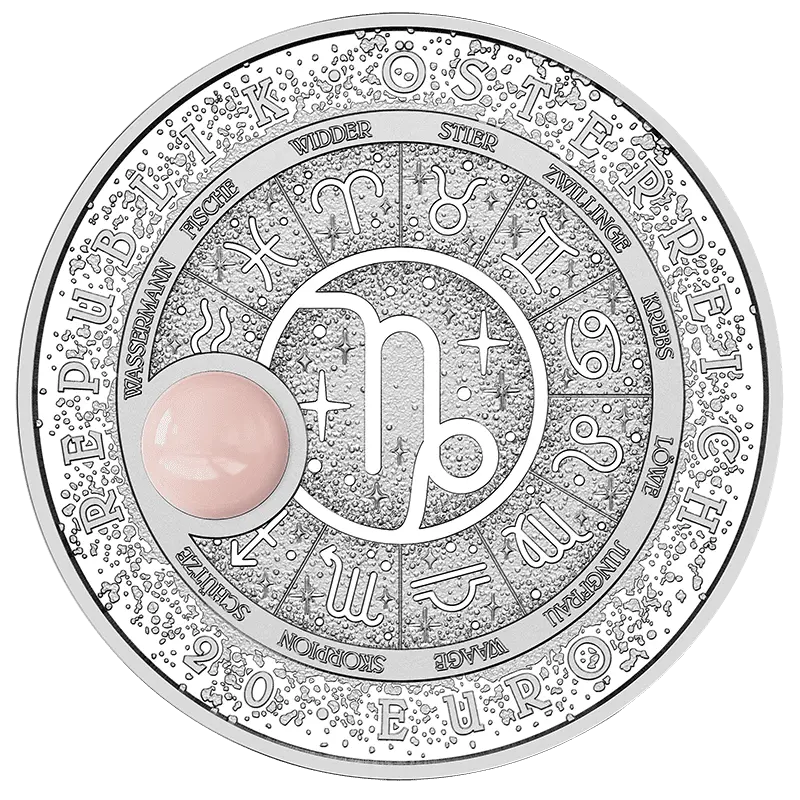
The coin was issued by the Austrian Mint and the design works like a personal calendar. A ring carrying all twelve zodiac signs runs around the centre, and the place of the relevant sign is marked by a coloured gemstone set flush with the field. For Capricorn the companion stone is rose quartz, a pale pink variety of quartz coloured by microscopic impurities. In ancient Egypt it was associated with beauty and love, and today it is known as the “stone of love”. The stone is more than decoration: it turns a flat relief into a small star chart in which the sign can be found not only by eye but by touch.
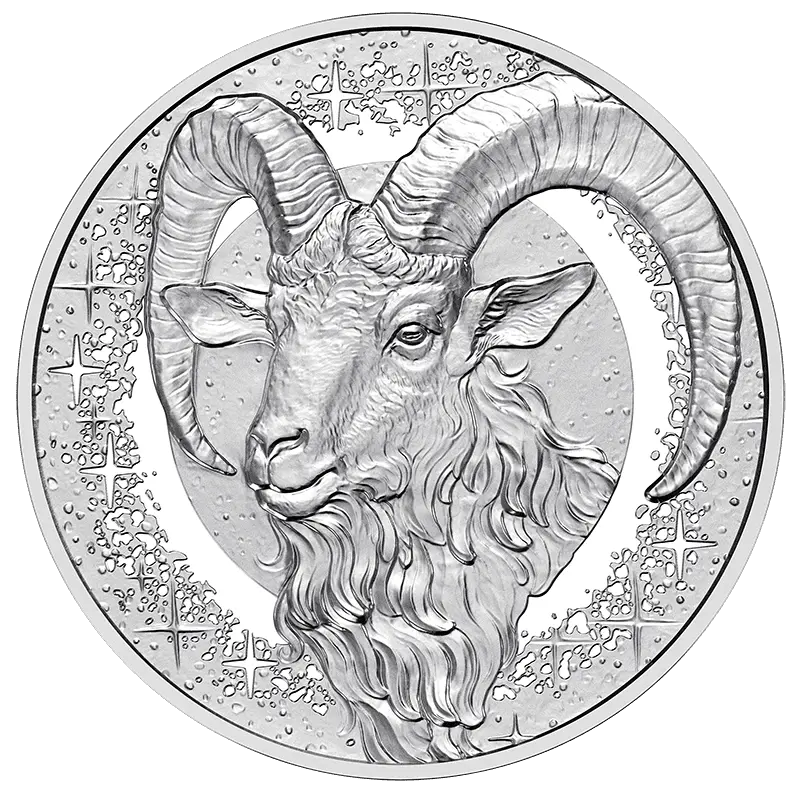
The reverse features not the mythical goat-fish but a real animal, the Alpine ibex. It is a symbol of the high mountains: it lives on sheer rock faces where almost nobody climbs, and in Austria it stands for stubbornness and the ability to hold on at the very edge. The history of the species is dramatic. In the nineteenth century Alpine ibex were hunted almost to extinction, and only one herd in Italy survived; later, thanks to a protected reserve and reintroductions, the population was restored, including in the Austrian Alps. Choosing this animal for a winter sign links an ancient myth to the living nature of the country that strikes the coin.
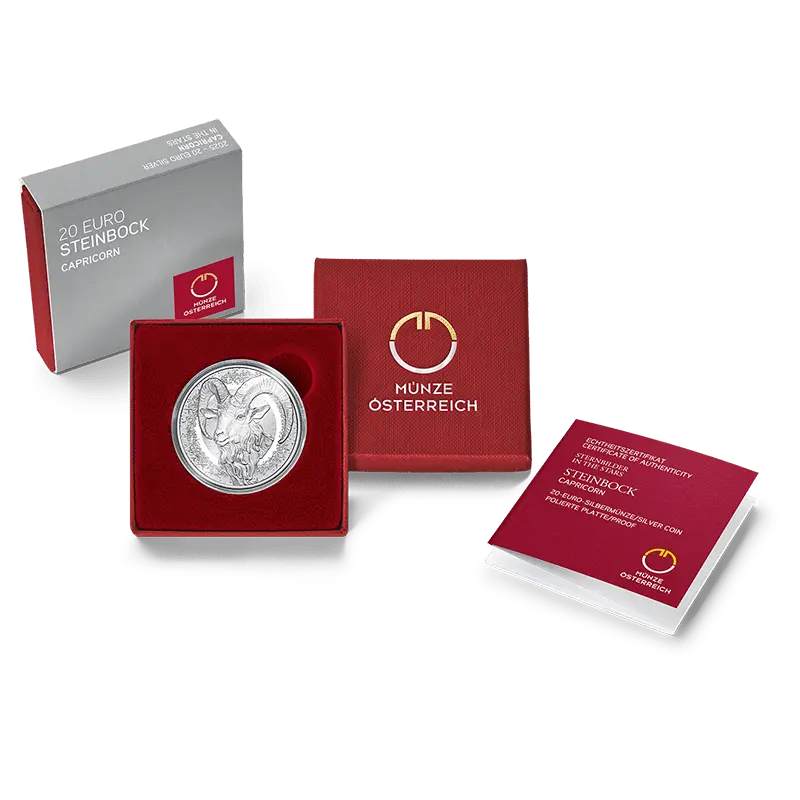
The coin was released on 5 November 2025 and is the work of Austrian Mint artist Kathrin Kuntner. For a collector it is interesting because it combines three layers of meaning: ancient astronomy, alpine wildlife and the modern technique of setting a stone into a struck relief. It opens the “In the Stars” cycle, in which every zodiac sign has its own coin and its own mineral.
Obverse
The obverse belongs to the calendar ring. Along the circumference run the names and symbols of all twelve signs, with “REPUBLIK ÖSTERREICH” at the top edge and “20 EURO” at the bottom. In the centre the Capricorn symbol is struck large, and at its position on the ring a small round piece of rose quartz is set and polished level with the surface. The background is a starry sky with raised stars of varied size, so that the geometry of the ring does not fight the overall picture of the night.
Reverse
At the centre of the reverse stands an Alpine ibex with heavy swept-back horns, modelled in expressive relief so that the folds of the coat and the strength of the neck are clearly visible. The figure is placed in a circle that breaks into a multitude of stars toward the rim, and behind the animal lies the starry sky. Both sides share one graphic manner.