
Horn
PDFGeneral information

Description
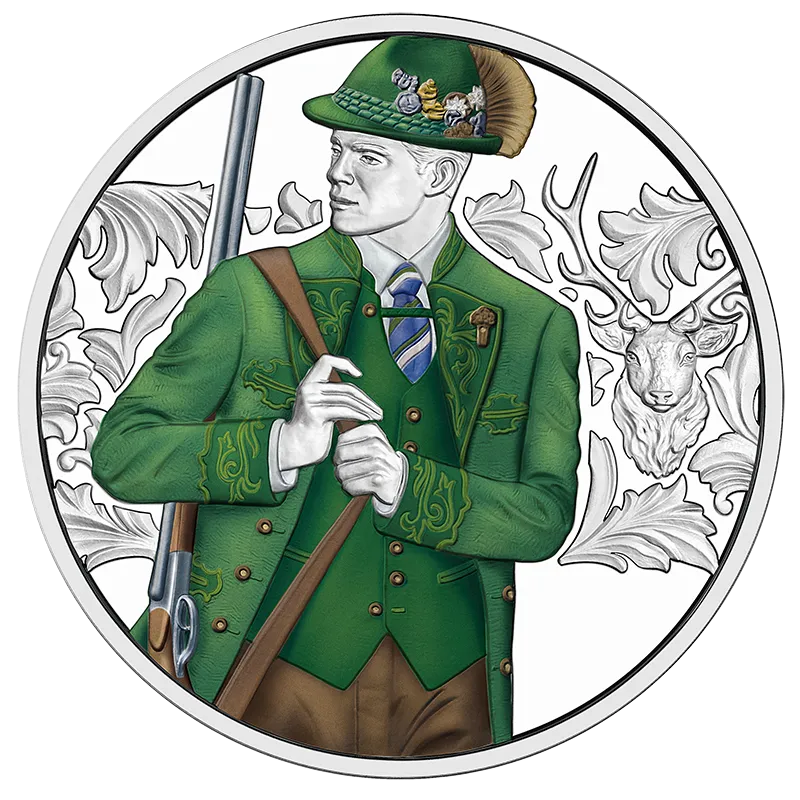
The last coin of the series shows a man in traditional costume whose waistcoat buttons and jacket decorations are made of horn. Around him is an ornament in the spirit of horn carving, and in the centre rises the head of a proud stag. It is the most "forest" subject of the series: horn links the costume with the hunter's craft and the image of Alpine nature. The craftsmen who carve horn show how fine and durable things come from a simple material. The coin was issued on 9 September 2026.
Horn in the folk costume is also a mark of belonging to the world of hunters and foresters. Buttons of antler on green or grey cloth are recognised at once, and carved appliqués with the head of a stag give the clothing nobility. The coin unites in one image the man, the material and the animal with which he is bound: in this way the idea of harmony between the hunter and nature is conveyed, to which he owes both food and material for his craft.
The Austrian Tracht is a language spoken by cloth, thread and buttons. Festive and everyday dress differ by occasion and region but keep the same materials: linen cloth, dressed leather, dense loden, details of horn and bone. These materials passed from generation to generation together with the skills of craftsmen, and it is to them that the Austrian Mint's "gschneizt & kampelt" coin series is devoted.
Interest in traditional dress in Austria has grown noticeably in recent years. Young people increasingly choose the costume not only for festivals but for everyday life, and workshops that have kept the old techniques are gaining new customers. For such people it matters what a garment is made of, who made it and how many generations of craftsmen stand behind each stitch. The coin takes up this thought and makes it accessible to those who gather the memory of a culture in metal.
Horn is one of the oldest materials of the folk costume. Hunting trophies, the antlers of stag and roe deer, were put to use: buttons, buckles, clasps and appliqués were turned from them and ornamental decorations carved. Horn buttons on a waistcoat or jacket are the mark of a true hunting costume, and each such detail is made by hand. The material is tied to the forest and the mountains, to hunting and a careful attitude to nature, for nothing that was taken was wasted.
The "gschneizt & kampelt" series is arranged like a gallery: each coin tells of one material of the folk costume and of the craftsmen who work with it. The name comes from popular speech and is something like "in full dress". The four coins appeared in two pairs, in 2025 and 2026; they were created by the engraver Anna Schlindner with the participation of Elena Dolgova.
Obverse
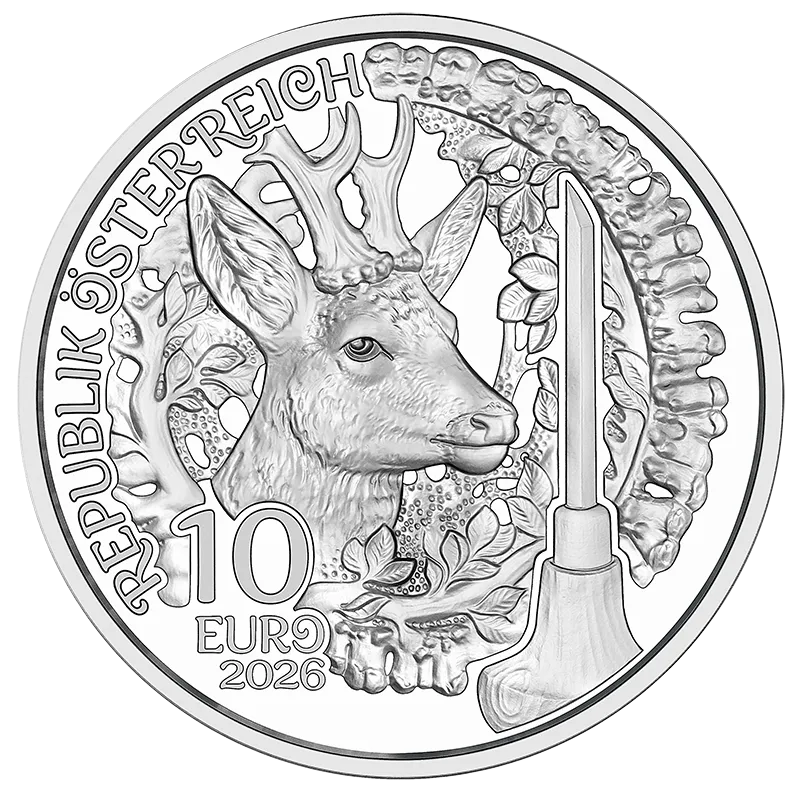
The obverse is the official side. The inscription REPUBLIK ÖSTERREICH runs around the rim, below it 10 EURO and 2026. On the field is the head of a roe buck within a wreath of leaves and twigs, and on the right a hunting knife stands upright: the hunting theme is already declared on the official side.
Reverse
The reverse is the artistic side. A young man in a hunting jacket with embroidered lapels and cuffs, a waistcoat and a hat covered with badges; the strap of a rifle is slung across his shoulder. The background consists of large scrolling leaves, and on the right the head of a stag with branching antlers looks out of the foliage. In the polished-plate version the clothing on the artistic side is coloured with printed colour, and the scene reads like a miniature in the folk spirit.