
The Basilisk
PDFGeneral information

Description
Its gaze can kill, and its breath stinks terribly! Truly, this hybrid creature evokes a pleasant feeling of horror and fear. However, if you want to defeat a basilisk, you need to get creative.
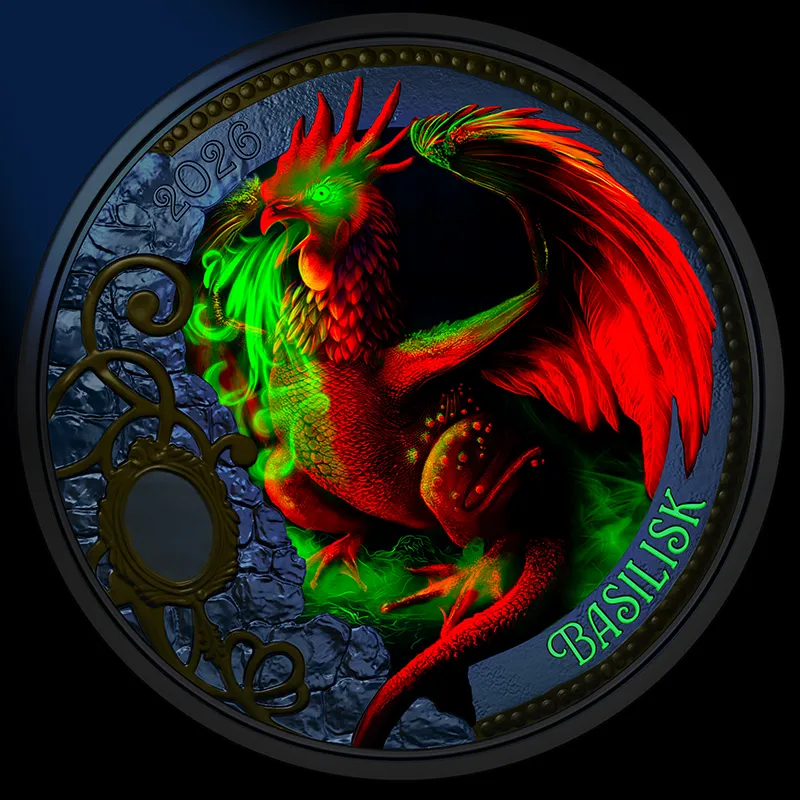
This little monster, hatched in a hen’s egg incubated by a snake or a toad, sows chaos. — Then, when ultraviolet light still penetrates the creature on our coin, you can sense its poisonous gaze and its beastly breath.
The Basilisk
The word basilisk comes from the Greek basilískos — a kind of snake, in fact a diminutive of basileús = king. The Roman scholar Pliny the Elder, in his encyclopaedic work “Natural History”, described the basilisk as a highly venomous snake with a white spot on its head resembling a crown. The only enemy Pliny names is the weasel, whose smell can defeat the basilisk.
In the Middle Ages the mythical creature turned into something between a rooster, a snake and/or a toad. Many legends revolve around the question: what is the right strategy against the deadly gaze? What remedy could stand against such a monster?
Deep beneath the School of Witchcraft and Wizardry, Hogwarts, Scotland. Even in J.K. Rowling’s “Harry Potter and the Chamber of Secrets” (1998) the basilisk plays an important role. There it is a giant snake controlled by Tom Riddle / Lord Voldemort. In Rowling too the creature has a deadly gaze. However, if you do not look it straight in the eyes but, say, through a mirror, you are “only” turned to stone.
Schönlaterngasse No. 7. About the legendary Basilisk House it is told that on 26 June 1212 an unknown animal was discovered in the well of the baker Martin Garhibl’s house.
Not only was the little monster’s breath poisonous, its gaze could kill people or turn them to stone. Again and again people vanished or died after approaching the well. Fear gripped the place until a brave baker’s boy descended into the well in a basket. He had a mirror with him. When the basilisk looked at him, its own deadly gaze met it. — This brings us to the realisation: ghosts are terrible too.
In the garden of fantastic mythical creatures. But what if there is no mirror at hand? In Thomas Brezina’s story the heroine knows how to help herself: “Violetta lifted a silver tray, turned the mirrored side towards the basilisk and took a step towards it...” — How it all turned out you will learn from the notes.
Images on the coin
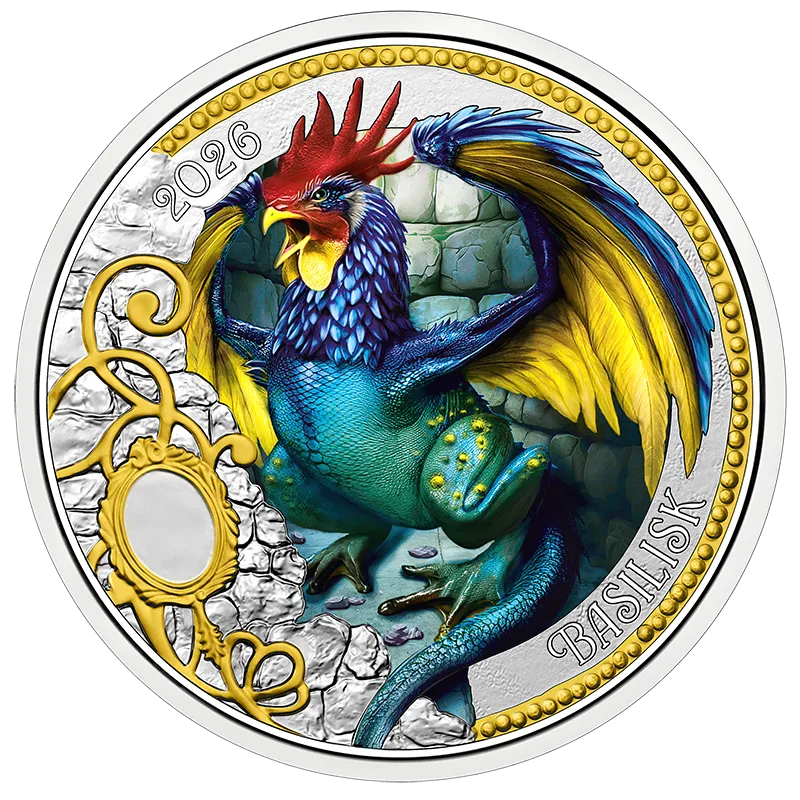
The coin shows a basilisk in colour print: the head and wings entirely resemble those of a rooster, but its legs are like those of a toad, and on its rump is a tail in the shape of a snake.
In the lower left corner an ornament and a mirror printed in gold ink can be seen. A band along the edge is also printed in gold ink.
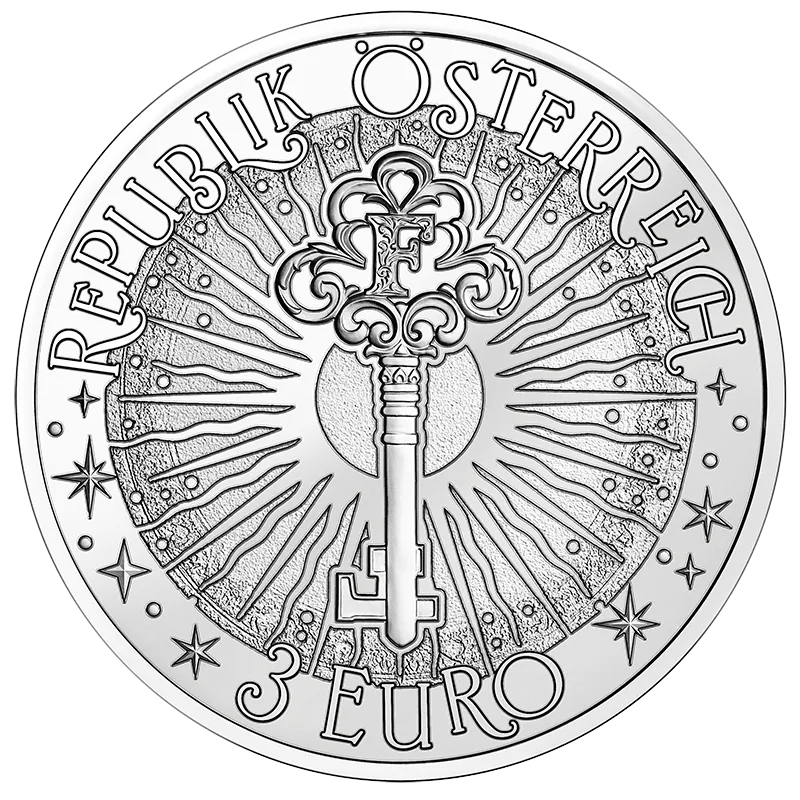
On the front side is a key with a richly decorated handle, on which the letter “F” is carved — “F” as in fantastic creatures. In the background, in a scissor-cut style, is a sun sunk into a round relief with a light texture. Stars twinkling along the edge and the perimeter, as well as irregularly shaped letters, seem enchanted.
The fourth coin of the series “Fantastic Mythical Creatures” is dominated by the basilisk: twelve coins, twelve mysterious creatures — lit by magical ultraviolet light, they seem to come alive. A matching torch is available as an accessory.
Thomas Brezina’s book “In the Garden of Fantastic Mythical Creatures” serves as an album for the twelve fairy-tale creatures.