
Tractor
PDFGeneral information
Description
The Belarus tractor is known on every continent: yellow-and-blue and green machines with this badge work in the fields of hundreds of countries. They come from the Minsk Tractor Plant, founded in 1946 in a city devastated by war. As early as 1953 the plant produced its first Belarus tractor, a light all-purpose machine that was to change the look of the Soviet village. From then on the plant became a symbol of how industry returned to the country: rebuilt from ruins, it quickly grew into one of the largest tractor makers in the world.
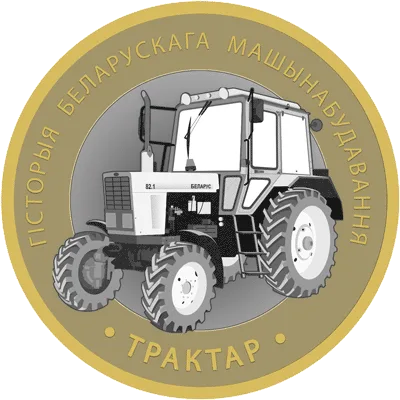
The coin Traktar shows the wheeled tractor MTZ-82.1. Its predecessors, the MTZ-80 and MTZ-82, which the plant began making in 1974, proved so successful that they received folk names, the "eighty" and the "eighty-second". An all-purpose row-crop tractor with enlarged driving wheels, hydrostatic steering and the ability to work with dozens of kinds of mounted and trailed equipment, it was equally confident in a field, on a farm, on a building site and in municipal work. The modernised MTZ-82.1 has been built since the 1990s and has gone to more than a hundred countries.
For the Belarusian village and town alike this tractor is part of daily life: with it people plough, mow, clear snow and haul silage. Village boys know the recognisable bonnet and tall cab from childhood, and many, once grown up, take the same levers. It is no accident that the tractor has been called the "horse of the twentieth century": it replaced draught animals and quite literally put the country on wheels. The image of a Belarus in the field has become as much a symbol of the country as the bison or the stork.
The tractor holds a central place in the series also because MTZ is one of the few Belarusian enterprises whose name is known in every corner of the world. The coin tells of it without complex symbolism: simply a machine, but the very one that feeds. For a collector it is a coin of memory about village childhood and the first post-war decades, when every tractor was an event: it was awaited, looked after, repaired by hand and passed on with the farm. Such a story explains why this very machine ended up on a state coin beside the coat of arms.
The tractor did not get the name Belarus at once: the first machines carried indexes, and the name that later became a trademark took hold in the 1960s and proved so apt that it was kept after the collapse of the USSR, when the plant entered foreign markets on its own. Over the decades MTZ produced dozens of models, from small orchard machines to powerful high-capacity tractors, but the structural basis remained recognisable: a rigid frame, oversized driven rear wheels and the ability to mount almost any implement. The tractor became so familiar that it entered proverbs and songs, and its silhouette appeared on badges and souvenirs. For a country where half the territory is farmland, such a machine long ago ceased to be merely equipment.
Obverse
The artistic side carries a relief image of the wheeled tractor MTZ-82.1 in profile: the tall cab, the characteristic bonnet and the pair of large rear wheels are easy to recognise. Around it run the inscriptions: at the top ГІСТОРЫЯ БЕЛАРУСКАГА МАШЫНАБУДАВАННЯ, at the bottom ТРАКТАР. The relief conveys the massiveness of the machine and its working character.
Reverse
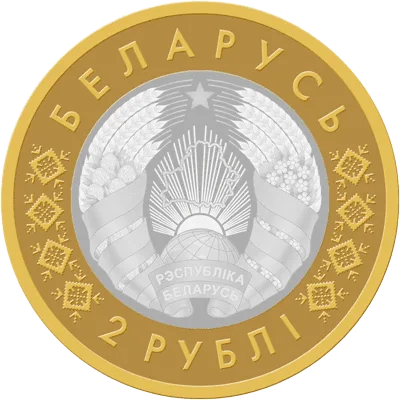
The official side carries a relief image of the State Coat of Arms of the Republic of Belarus; around it are engraved the name of the country, БЕЛАРУСЬ, and the mark of the currency unit, with a stylised national ornament between the inscriptions. The edge is decorated with the repeated word БЕЛАРУСЬ, the year 2025 and elements of the ornament. The strict state symbolism balances the lively industrial subject of the obverse.