
Truck
PDFGeneral information

Description
The lorry is the machine with which every industrial story begins. Before a country has motorways, warehouses and building sites in their modern form, everything has to be carried, and it is the truck that links factories, fields and cities. Belarusian motor-vehicle industry grew up around the Minsk Automobile Plant, founded in 1944 when the country still lay in ruins after the war. The enterprise was charged with producing heavy vehicles to rebuild the national economy, and over the decades it became one of the largest makers of load-carrying vehicles in the post-Soviet space.
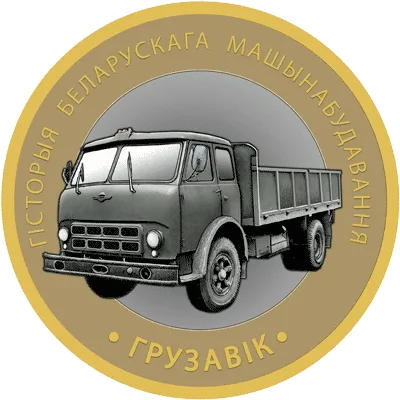
The coin Gruzavik shows the MAZ-500, a flatbed lorry whose serial production began in 1963. Its chief novelty was the cab-over layout: the cab sat above the engine, so for the same overall length the load platform became noticeably larger. For the Soviet motor industry this was a fundamentally new look, and a whole family was built on it, flatbeds, dump trucks, tractor units and chassis for special bodies. The lorry was produced until the end of the 1970s and became a familiar sight on roads from Brest to Vladivostok.
The choice of this very machine for the first coin of the series is symbolic. The MAZ-500 embodies the era when the lorry turned from a rarity into an everyday tool of the economy: it carried building materials to new factories, grain from the fields to the elevators, goods to the shops. For many generations of Belarusians the characteristic silhouette of this machine with its flat front remains an image of working childhood and youth. It is no accident that modern MAZ road tractors keep the same cab-over-engine layout.
The coin opens a whole story about Belarusian engineering: after the lorry the series continues with a quarry dump truck, a heavy tractor unit, a farm tractor, a trolleybus and a combine harvester. Each of these machines is the calling card of a separate enterprise of the country, and together they show how varied the equipment is that Belarus has learned to build itself.
Interestingly, the MAZ-500 was designed with an eye on late-1950s American trucks: engineers studied foreign catalogues and aimed at the same layout, but calculated for Soviet roads and fuel. The cab received a panoramic windscreen and a folding radiator grille hiding the engine, which made servicing easier. People recognised it by the characteristic 'face' with two headlights and a broad band of trim, and by those details photographs from the 1960s and 1970s are still identified today. For drivers of the time the MAZ-500 was a step forward in everyday terms too: a heater, ventilation and a more comfortable workplace appeared, things the earlier bonneted lorries never offered.
Obverse
At the centre of the field is a relief image of a MAZ-500 lorry in profile. Around it run the inscriptions: at the top ГІСТОРЫЯ БЕЛАРУСКАГА МАШЫНАБУДАВАННЯ, at the bottom ГРУЗАВІК. The composition is built so that the silhouette reads at once: the flatbed, the cab over the engine and the massive wheels form a recognisable picture of a lorry of the industrial boom.
Reverse
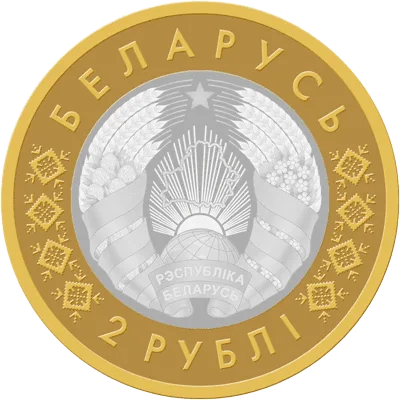
The official side carries a relief image of the State Coat of Arms of the Republic of Belarus; around it are engraved the name of the country, БЕЛАРУСЬ, and the mark of the currency unit, with a stylised national ornament placed between the inscriptions. The edge repeats the inscription БЕЛАРУСЬ, the year 2025 and elements of the ornament. This side confirms that the commemorative piece is legal tender issued by the National Bank.