
100th Anniversary of the Birth of Jiang Zemin (30 g silver)
PDFGeneral information

Description
On 17 August 2026 it was exactly one hundred years since the birth of Jiang Zemin, one of the leaders of China in the last quarter of the twentieth century. The People's Bank of China timed the release of a commemorative programme of four coins to that day: one ordinary commemorative coin of 1 yuan, two gold coins (500 and 100 yuan) and one silver coin (10 yuan). The bank announced the programme on 14 August and the issue began on 17 August. The gold coins and the silver coin are of proof quality; they were struck by the Shenyang, Shanghai and Shenzhen Guobao mints and are distributed by China Gold Coin Group through the China Gold Coin website and its own sales channels. The coins are legal tender of the People's Republic of China.
Jiang Zemin was born on 17 August 1926 in Yangzhou into a family of hereditary intellectuals: his grandfather practised traditional Chinese medicine and was fond of painting and calligraphy, while his father wrote poetry and during the war with Japan published patriotic magazines. In April 1946 he joined the Communist Party of China, and in 1947 he graduated from the Department of Electrical Machinery at Shanghai Jiaotong University and became an electrical engineer. The graduation photograph of 1947 was chosen by the People's Bank as the subject of the 8-gram gold coin of the commemorative programme. After the founding of the People's Republic he spent almost thirty years in the machine-building and electronics industries, rising from assistant engineer at a food factory to director of a major research institute. In 1955 he spent four months training in Moscow at the Stalin Automobile Plant, where he learned Russian, which he later readily used in conversations with Russian interlocutors.
In the 1980s Jiang's career was connected with foreign trade and foreign investment and then with the electronics industry: from 1982 he was Minister of the Electronics Industry and studied the experience of special economic zones in more than ten countries. In 1985-1989 Jiang Zemin led Shanghai, first as mayor and from 1987 also as secretary of the city party committee. In June 1989, after the events on Tiananmen Square, he was elected General Secretary of the Central Committee of the Communist Party on the proposal of Deng Xiaoping and held that post until 2002. At first he was regarded as a temporary, compromise figure, but he quickly took control of the party, the government and the army: from 1990 he chaired the Central Military Commission, and in 1993 he became President of the People's Republic, remaining in that post until 2003.
The years of Jiang Zemin's leadership coincided with a period of rapid economic growth and the opening of the country to the outside world. In 1992 the Fourteenth Party Congress formally adopted the course of a "socialist market economy"; the programme for developing the western regions and large infrastructure projects followed, among them the Three Gorges Dam and the Qinghai-Tibet Railway. Hong Kong returned to China in 1997 and Macao in 1999, in 2001 the country joined the World Trade Organization, and Beijing won the right to host the 2008 Olympic Games. In 2002 his theory of the "Three Represents" was written into the party constitution, opening the way for entrepreneurs to join the party. Assessments of the period differ: alongside the successes of the economy, researchers point to the growing inequality between coastal and inland regions, mass closures and privatisation of state enterprises, and criticism of the authorities on human rights. In 2002-2005 Jiang consecutively handed over the top party, state and military posts to Hu Jintao. He died on 30 November 2022 in Shanghai at the age of 96.
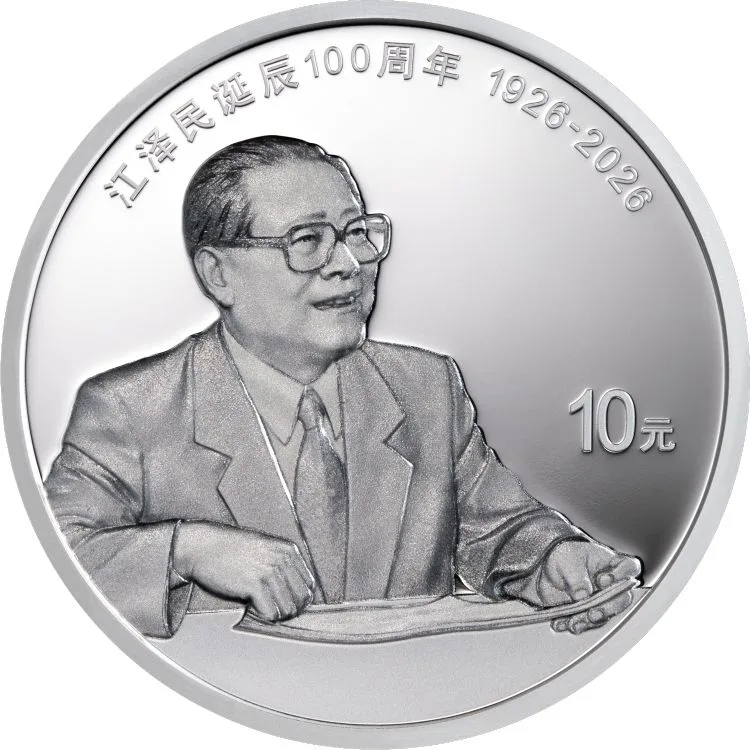
The 10 yuan silver coin reproduces a documentary photograph: in 2000 Jiang Zemin speaks at a meeting of leading cadres in Gaozhou in Guangdong province devoted to the campaign of the "Three Stresses" (emphasis on study, politics and a healthy moral atmosphere). He sits at a table and speaks, gesturing; the episode is one of Jiang's best-known public appearances at the turn of the millennium, when the party was running a campaign for the education of cadres. The silver coin is the largest of the programme by size, and its maximum issue is twenty thousand pieces.
Obverse
The artistic side is a photograph of Jiang Zemin of 2000: he sits at a table at a meeting in Gaozhou and speaks. Along the upper arc runs the inscription "江泽民诞辰100周年" ("100th anniversary of the birth of Jiang Zemin"), on the right "1926-2026", and at the lower right the face value "10元" (10 yuan).
Reverse
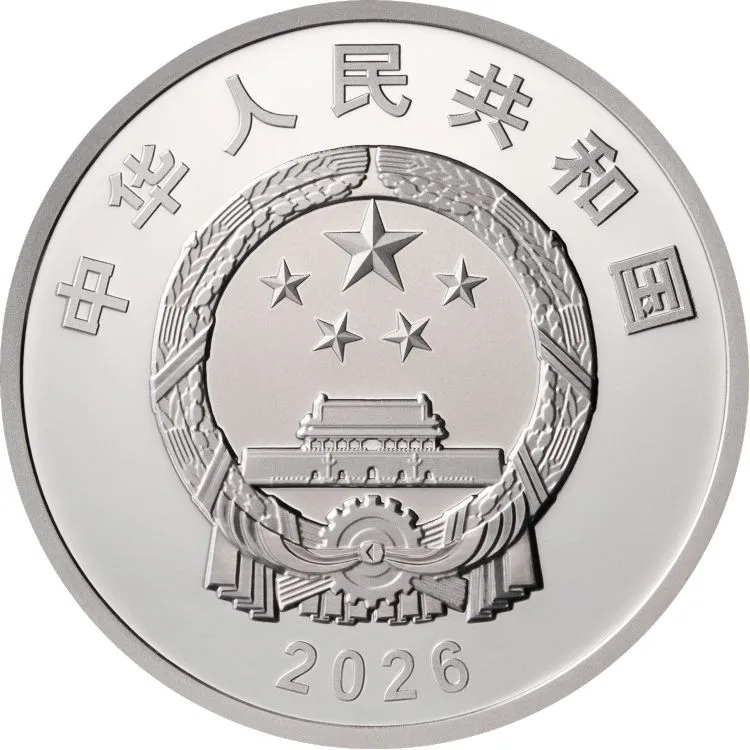
The official side shows the national emblem of the People's Republic of China: Tiananmen gate under five stars, framed by ears of wheat, with a cogwheel at the bottom. Along the upper arc runs the inscription "中华人民共和国" (People's Republic of China), and below it the year "2026".