
Embroidered Pouch
PDFGeneral information

Description
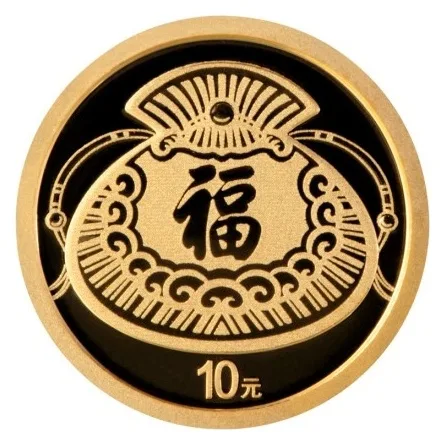
The 10 yuan gold coin is the third in the five-year cycle of Chinese New Year coins “Fu”. The People’s Bank of China released it on 22 December 2025 together with the silver one, for the Year of the Horse (bingwu). The mass of the coin is one gram, the gold is 999 fine, the diameter 10 millimetres. The maximum mintage is 150,000 pieces, as in the previous year. According to the Numista catalogue the coin was worked on by Huo Shengying (design) and Jiang Qianqian (engraving); the official pages of the issuer do not name the authors of the gold design.
The subject is the “fuzi hebao”, a “pouch with the character of happiness”. The idea comes from traditional embroidered pouches, hebao. In China such pouches are worn as a gift, as an amulet and as a purse; fragrant herbs, charms and money were put in them. The thread of the coin’s story is “hide happiness and receive wealth”, “cang fu na cai”. A pouch as a store naturally becomes a metaphor for accumulating well-being, and the character on it a sign that what has been accumulated is pleasant to open at the beginning of the new year.
In the centre of the coin is the character “fu” written by the brush of the Qianlong Emperor. Qianlong was famed for his calligraphy: by Qing tradition the ruler at the beginning of the year, “opening the brush”, wrote “fu” and gave this character to his courtiers — to own such a “fu” was considered a great honour. This is the hand the issuer names as the source of the character on the coin. Thus two layers of culture meet on a tiny gold disc: the domestic one, an embroidered pouch, and the palace one — the imperial brush.
The choice of a pouch for the gold coin is natural for the Year of the Horse: after the “ritual of opening the year” on the silver, where the holiday is shown as a procession with a lantern, the gold acts as its quiet, “domestic” pair — not a procession but an object put in a pocket or under a pillow. This contrast between “in the house” and “in the street” has been visible in the cycle from the start: on the gold an object and a sign, on the silver a scene and a character. The small diameter of 10 millimetres makes the masters simplify the folds of the cloth and the ornament of the border to a few clear lines, so the “fu” reads without magnification.
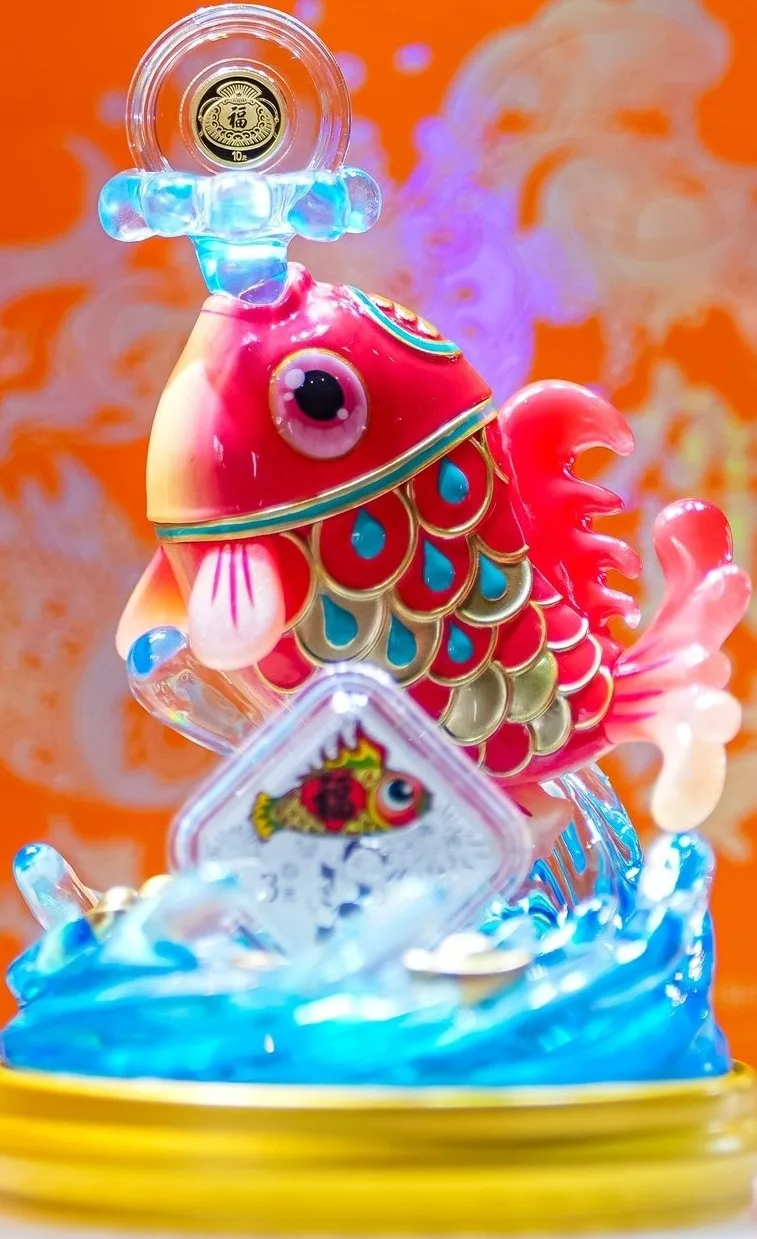
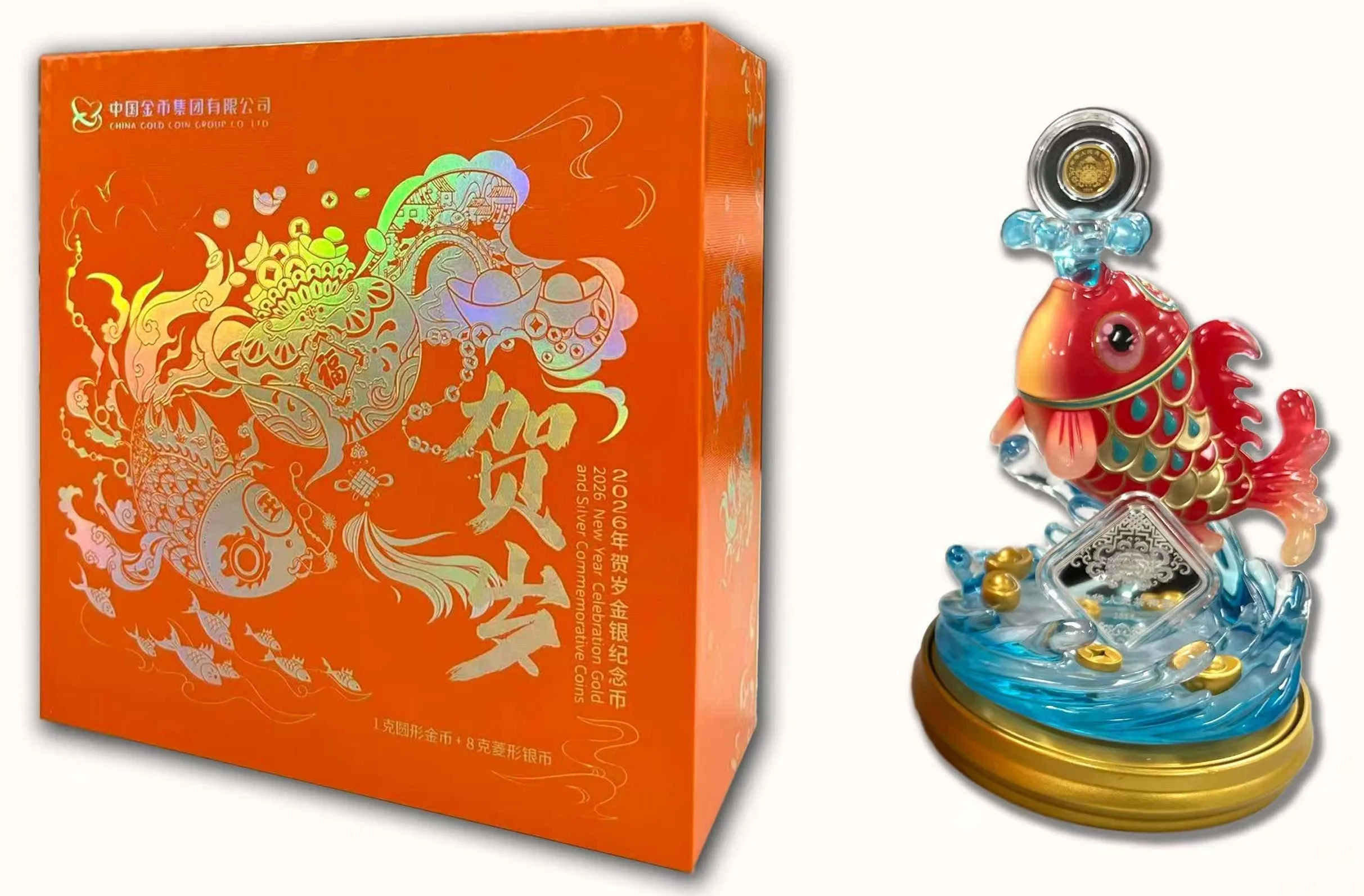
In 2026 the issuer named two packaging formats: a card-book and “wenchuang” — design with figurines. In the gold-and-silver “wenchuang” set a red carp figurine leaps from the waves above a “Jubaopen” (treasure bowl) stand, pushing up the gold coin like a pearl, with the silver one breaking out of the water beside it. The coin, like all the previous ones, is of ordinary quality, with the shared official side “fu shang jia fu”.
Obverse
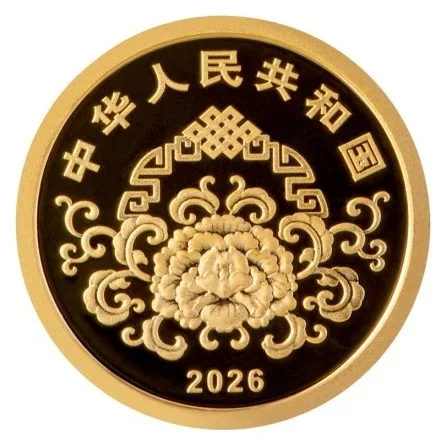
The official side (in the Chinese tradition the front) is shared in concept by the gold and silver coins of the year: traditional auspicious ornament — a peony, an interlaced floral scroll and a meander key pattern — forms the composition “fu shang jia fu” (“blessing upon blessing”). The ornament is fitted to the blank: on the round gold coin it sits inside a circle, on the silver coin inside a rhombus, so that the outer outline of the design recalls a longevity peach. The coin carries the name of the state and the year of issue.
Reverse
The artistic side: in the centre is the “fu” in the hand of the Qianlong Emperor, around it the rounded shape of an embroidered pouch (hebao) with folds and an ornamental border. The surface is divided into matt and mirror areas for depth. The face value is 10 yuan.
Packages. 2026 offers a card book, a 'cultural-creative' pack with a figurine (wenchuang) and an encapsulated version (encapsulated).
- Gold + silver, wenchuang: a red carp leaps out of spiralling waves on a 'treasure bowl' base; the gold coin sits like a pearl in its mouth, the silver coin comes out of the wave; ceramic-textured body, fins fading to transparent; the whole wave rotates on the base ('luck turns, wealth gathers').
- Single silver, wenchuang — golden carp (golden carp): ball (ball) — Jintuantuan and Jinyuanyuan; gem (gem) — Linian nian and Lishunshun; plush fish pendants with a transparent window for the coin on the official photos.
- Card book and sealed capsule (no figurine).
Silver mintage cut from 1.5 to 1 million. Gold: 'Fu bag' (fufu hebao) with the fu in Emperor Qianlong's hand. Silver: fish-lantern dance — colour print, laser sand-blasting, hand-applied beads. The 'coin + figurine' variants are listed as varieties.