
Trsat Dragon
PDFGeneral information


Description
Above the Croatian city of Rijeka, on a high hill, stands Trsat, a district that its residents regard as the heart of their city. Here, on a cliff above the Rječina river, a fortress has stood for centuries, Trsat Castle. It is said that on its site there were fortifications of the Illyrians and Romans in antiquity. Later it was owned by the noble Frankopan family, and beside it arose the shrine of Our Lady of Trsat, to which pilgrims have walked for centuries.
In 1826 the ruined fortress was bought by Field Marshal Laval Nugent von Westmeath, Irish by origin and a servant of the Austrian crown. He was a passionate lover of history: he turned the ruins into a romantic castle in the style of the age and built a family burial place on its grounds, a mausoleum in the form of an ancient temple. Two bronze guardians were set before it, and it is they who became famous. The statues were made by the renowned Viennese sculptor Anton Dominik Fernkorn, whose equestrian monuments adorn the squares of the capital.
In Rijeka these creatures are called the Trsat dragons, although in fact they are basilisks. In old bestiaries the basilisk is a mythical creature: the head and neck of a rooster, the wings and body of a dragon, the tail of a snake. It kills with its gaze, and its breath is poisonous. Fernkorn depicted it as it should be: with beak wide open, forked tongue and a fixed gaze directed into the distance. For the Nugents the basilisk became a family emblem, part of their coat of arms.
A pretty city legend is told about these guardians as well. A dragon is said to have lived on Trsat and a huge octopus in a canal in Rijeka. Every day a little girl sat by the water and drew dragons. One day the octopus wrapped a tentacle round her, but the dragon flew down and saved the child. The girl brought him a drawing as a gift, but the lair was already empty: the dragon had flown away so as not to grow attached to people. The grateful father, the mayor, commissioned a bronze statue in memory of the rescuer. Historically it was not so, but the city loves the tale. One of the sculptures was later taken down because of wear, restored and returned to its place in 2013.
Today the Trsat dragon is one of the symbols of Rijeka and part of Croatia's cultural heritage. The coin showing it was issued in November 2024 by the Croatian National Bank. It is a reminder that every city has its own guardian, real or invented, in bronze or in legend.
Obverse
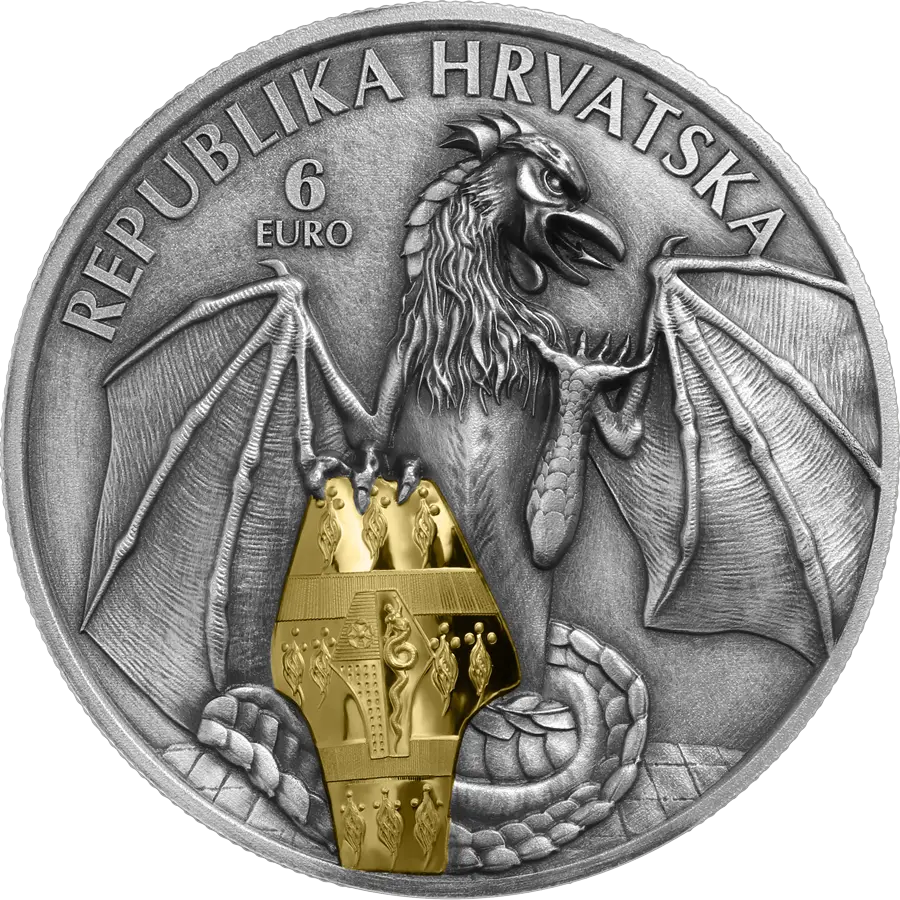
On the obverse a mythical creature resembling a basilisk stands in the centre: the head of a rooster with a sharp beak open in a cry, a comb and a beard of feathers, a scaly neck, bat-like membranous wings with long bony fingers and clawed feet. One foot is raised, while the claws of the other hold a small golden-coloured shield with an ornament of elongated stylised leaves or flame tongues, horizontal bands and the figure of a snake. The tail is coiled at its base like a snake's. Stonework lies under the creature. The inscription REPUBLIKA HRVATSKA follows the arc of the top edge, and the silver is aged.
Reverse
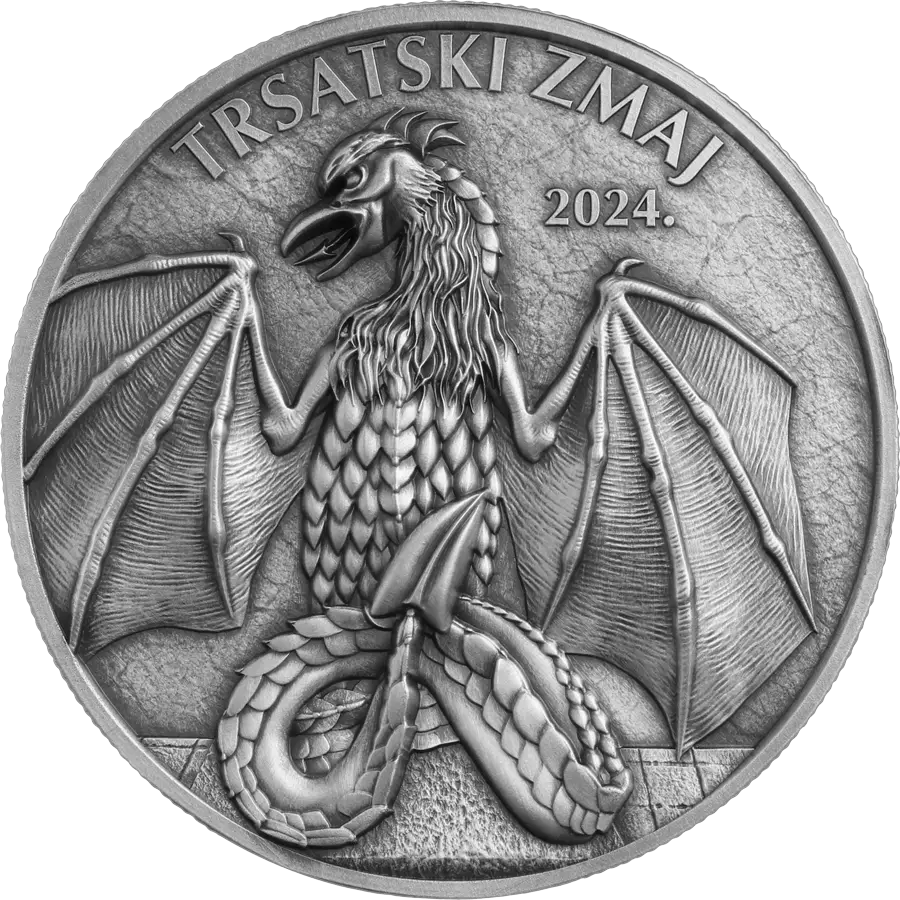
The reverse shows the same dragon, but without the shield, in close-up, in aged silver with dark patina in the recesses. The head is that of a bird with a powerful curved beak slightly open; above the head is a crest of spikes, and the neck is covered with a long tousled mane, either fur or feathers; the body is covered with large scales lying in rows; the wings are spread, with thin bony fingers and a folded membrane. The snake's tail is coiled in a loop at the bottom and its tip resembles a spearhead. The background resembles cracked stone, with tiles or stonework below. The inscription TRSATSKI ZMAJ follows the arc of the top edge and 2024. stands to the right of the head.