
Cuban Tody (1 Peso)
PDFGeneral information

Description
The subject “Cuban Tody” belongs to the Cuban Caribbean Fauna programme of 1996, in which every inhabitant of the region gets its own coloured composition. The story begins with the hero itself.
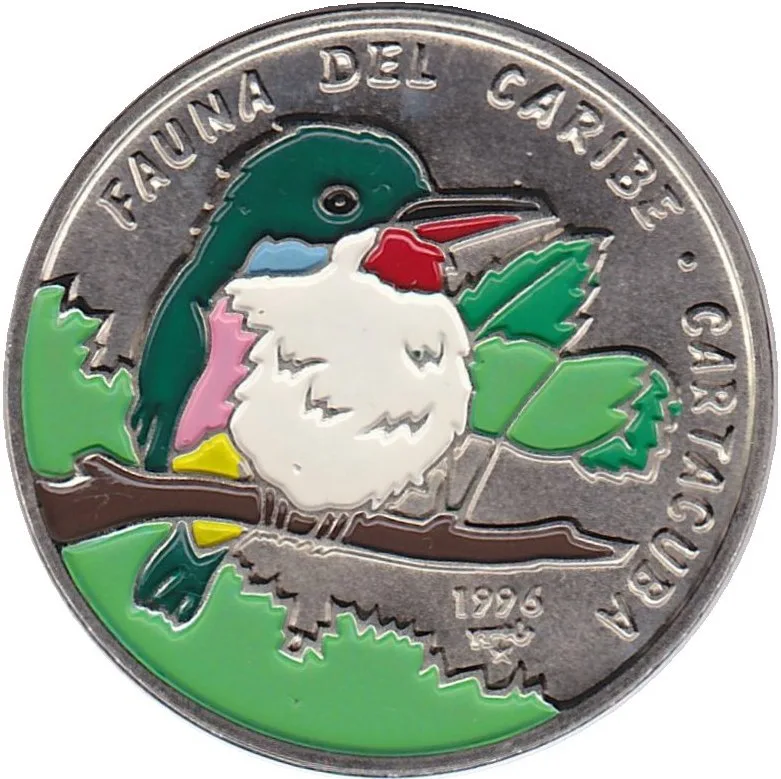
This coin is dedicated to one of the most recognisable birds of the island, the Cuban tody, Todus multicolor Gould, 1837. The reverse labels it CARTACUBA, the name used for the tody in eastern Cuba; in the west it is called “pedorrera”, and other names such as “barrancolí cubano” and “cortacubas” occur as well. The bird is an endemic: it lives only in Cuba, on the Isle of Youth and on the adjoining cays, and is rightly regarded as a living symbol of the island’s birdlife.
The tody is tiny, only ten to eleven and a half centimetres long. Its plumage is green above and pale below with pinkish flanks, the throat is red, the lores are yellow, there is a small blue patch by the ear, and the bill is long and flat with a reddish-orange underside. This mixture of colours makes the bird look like a jewelled brooch pinned to a branch.
The tody lives from the coast up to mountain forests, most often in wooded ravines and beside earthen banks. Birds keep in pairs and feed almost entirely on insects and spiders, picking them from the underside of leaves in short sallies. Because the diet is so narrow, they do not survive in captivity. The nest is a burrow up to twenty-five or thirty centimetres long, dug by the pair in a clay or sandy bank, sometimes in the hollow of a rotten trunk.
The clutch is three or four white eggs, incubated by both parents for eleven to thirteen days. The IUCN lists the species as Least Concern, so the Cuban tody faces no direct threat at present. The drawing on the coin is stylised but conveys what matters: the compact body, the long straight bill and the contrasting colour patches by which this bird cannot be mistaken for any other.
The family Todidae lives only on the Greater Antilles: five species are shared among Cuba, Hispaniola, Jamaica and Puerto Rico, and there are no such birds outside the Caribbean region or anywhere else in the world. The Cuban tody is the only member of the family on its island, so the picture on the coin speaks not merely of a bird but of the individuality of the island’s whole nature.
Obverse
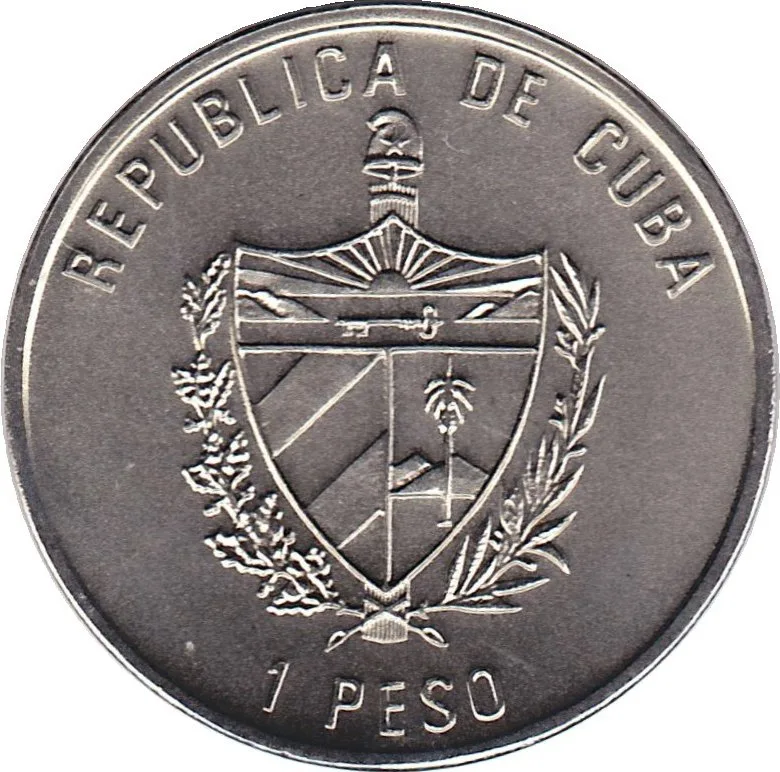
The official side carries the national coat of arms of the Republic of Cuba, drawn by Charles Edward Barber: a shield with a key between two capes, a royal palm and mountains, topped by a Phrygian cap on a bundle of fasces. The legend REPUBLICA DE CUBA arcs above it and the words “1 PESO” stand below. The symbolism of the arms is traditional: the key recalls the island’s position as the “key to the Gulf of Mexico”, the palm the country’s own nature, and the cap above the fasces freedom and unity.
Reverse
The reverse shows the tody in colour: a small bird with a green back, red throat and long straight bill. Beside it stand the legend CARTACUBA, the inscription FAUNA DEL CARIBE and the year 1996, while at the edge sits the mint mark, a key with a star. The colours were laid over the relief by hand, so shades differ a little from coin to coin. In this way the official and artistic sides form a single story: the arms of the state and a portrait of a member of its wildlife.