
Orchid (1 Peso)
PDFGeneral information

Description
If you ask which plant best shows the wealth of tropical nature, many will name the orchid. The family includes tens of thousands of species worldwide, and Cuba is one of the centres of their diversity in the Caribbean. Orchids can be met everywhere here: on tree trunks in mountain forests, on coastal rocks, on old fences and even on wires. They do not harm the tree they sit on: they take moisture and nutrients from air and rain, and the roots serve only as a support. That is why the orchid is called a flower that lives “in the air”.
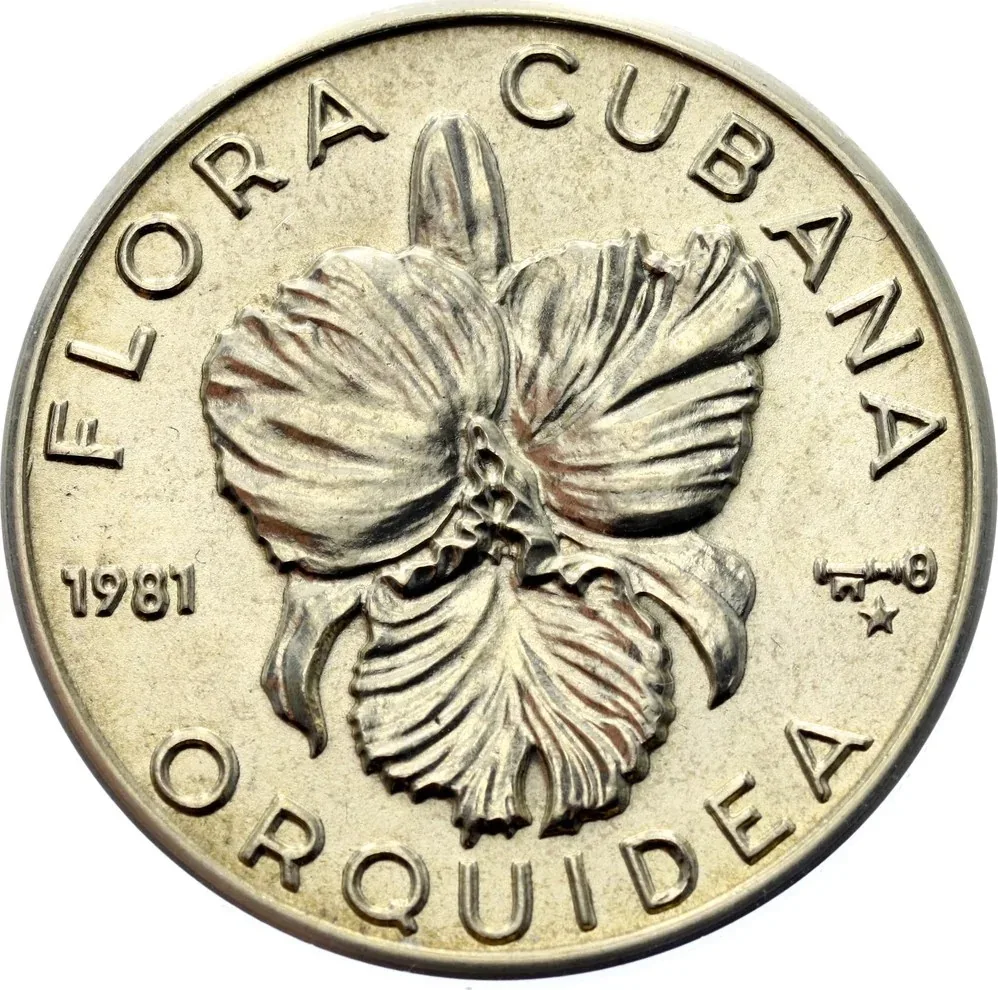
The beauty of the flower is explained by its structure. Three outer petals and two inner ones surround a large lip, which serves as a landing platform for pollinating insects. The colouring and pattern on it show the insect the way to the nectar, and the complex shape of the flower is designed so that pollen sticks exactly to the right visitor. The coin’s subject reproduces this symmetry in strict relief, showing the flower as a perfect natural mechanism.
The coin completes the “Flora Cubana” series, which has three plants: the butterfly flower, orange blossom and the orchid. The series was issued in 1980–1981 in Havana for collectors; meant for collectors, it did not enter circulation. The orchid was struck in 1981. The sketches of the artistic sides were prepared in Spain, and the sources do not name the artists.
On the coin the flower is shown large, like a poster, and the leaves lie beside it in thin ribbons. Such a composition helps one see both the beauty of each detail and the integrity of the image. For a collector the orchid is the most elegant subject of the series, and for a lover of botany it is a miniature from which the structure of the flower can be read.
If one looks at the coin as a page from a plant identification guide, it fills that role well: the forms of the flower are not simplified into a sign but rendered so that they can be compared with a living specimen. That accuracy distinguishes the issue from decorative coins where a flower serves merely as an ornament. Here the plant is the main and only subject of conversation, and for this reason the “Flora Cubana” series remains for a collector a valuable small compendium of Cuban plants.
Obverse
The obverse is the artistic side. It shows an open orchid flower with leaves: a large lip, petals at the sides and narrow leaves lying in ribbons beside the flower. The relief is low but deep enough to convey the symmetry distinctly. The inscriptions are FLORA CUBANA, ORQUIDEA and the year 1981, with the mint mark beside them. The flower is set a little left of centre, and the free field on the right is balanced by the leaves.
Reverse
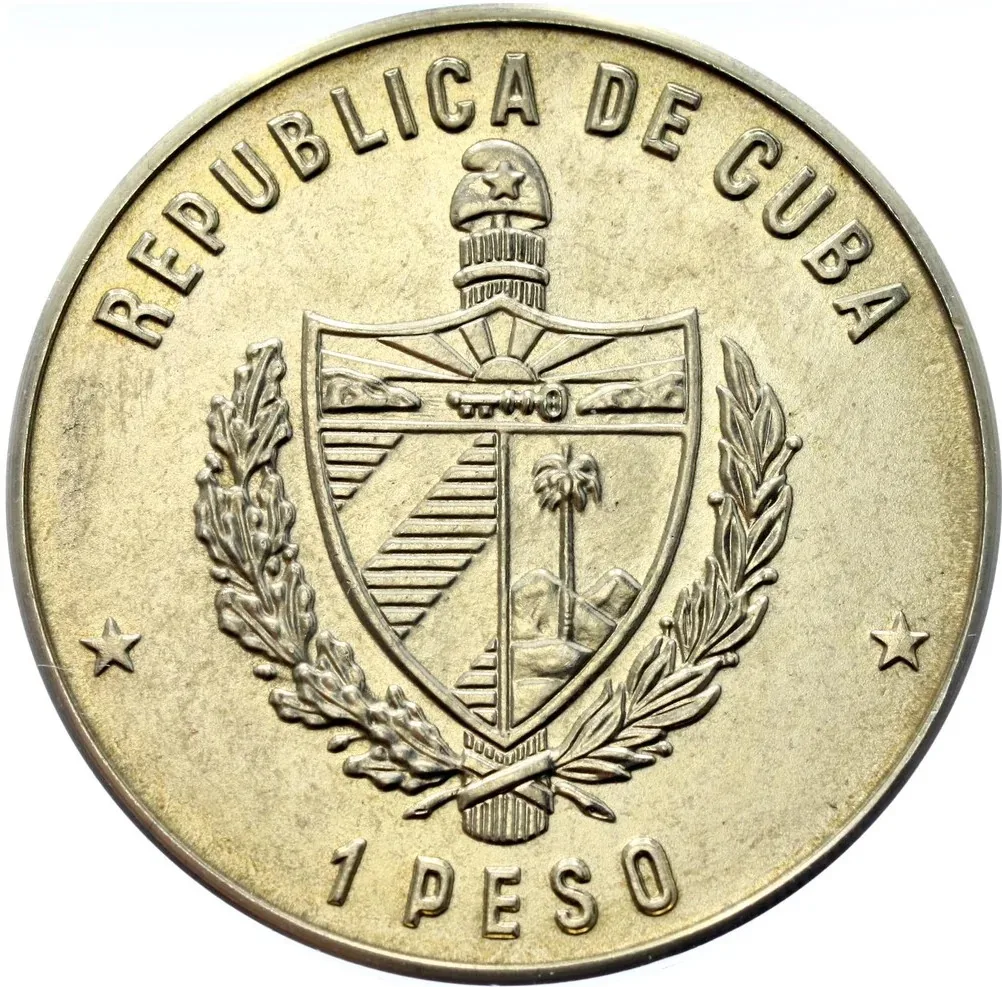
The reverse is the official side. The national arms of the Republic of Cuba in Charles Edward Barber’s drawing: a shield divided into three fields, a Phrygian cap with a star above it and branches of laurel and oak on the sides. The inscription REPUBLICA DE CUBA runs along the arc and the coin’s denomination is marked below. The arms are identical for all coins of the series and serve as a common frame uniting three different flowers into a single programme.