
SIAI Marchetti S.55 (1 Peso)
PDFGeneral information


Description
The Italian flying boat S.55 had a special place in the hearts of contemporaries: people crossed oceans aboard it, and countries were proud of it as a sign of technical progress. Alessandro Marchetti designed the aircraft for the firm SIAI in the first half of the 1920s; in 1924 the prototype took to the air. The very look was unusual: two boat hulls set apart to the sides and a broad wing between them, with the crew cabin in the centre. Above the wing on a pylon stood two motors working in tandem — one pulled, the other pushed.
Such a design solved several problems at once. The double hull gave stability on water and a large reserve of buoyancy, the wide centre section carried the crew and cargo, and the motors, raised above the surface, were not flooded by spray. The aircraft was built in several variants: passenger, with a cabin in the nose of the hulls, and military, as a torpedo bomber and marine reconnaissance aircraft. But real fame came to it not from combat but from record and demonstration flights.
In 1931 the air marshal Italo Balbo led a group of S.55s across the South Atlantic — the route from Italy to Brazil — and in 1933 he headed a squadron of two dozen such aircraft flying to North America, to the exhibition in Chicago. These flights aroused delight: many believed that such things were beyond the powers of the pilots and machines of the era. Resounding associations cling to the S.55 to this day, which is why it was chosen for the coin.
The series “Famous Aircraft”, issued by the Cuban mint in 1994–1995 for collectors, includes two German First World War fighters and an Italian flying boat. The S.55 in this company looks the most atypical and so especially interesting: it cannot be set beside the others by class, but it reminds us that aviation is not only war but also long roads.
The special charm of the S.55 is that it looks almost toy-like, though in reality it was a serious machine. The two hulls resemble a pair of catamaran boats joined by a bridge, and this image is remembered at once. Passengers of the S.55C and S.55P variants sat in the forward parts of the hulls, and the crew in a common cabin on the wing; for the 1920s this was a new word in comfort and safety. The coin conveys this look so that the aircraft can be recognised even by someone unfamiliar with the history of aviation.
Obverse
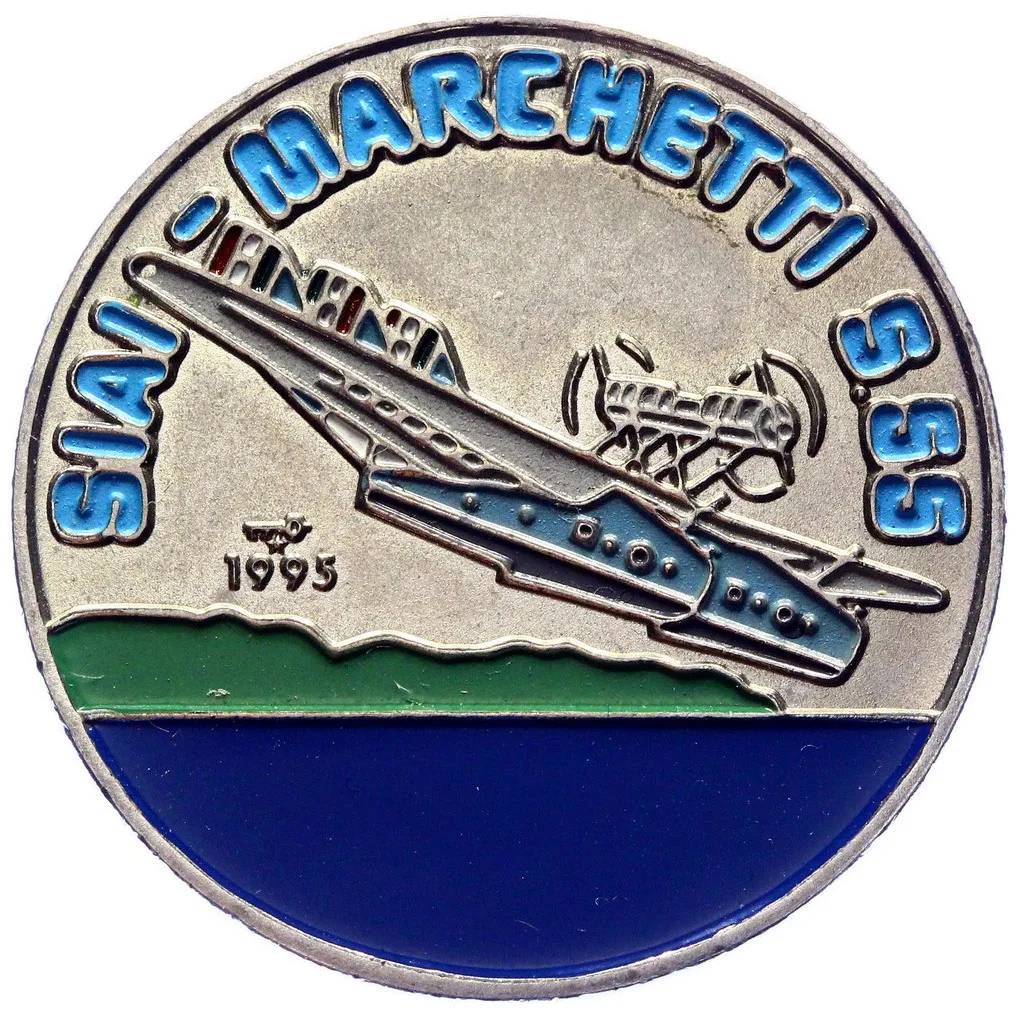
The obverse is the artistic side. A hand-painted image of the flying boat in flight: both hulls joined by the carrying wing are visible, and a nacelle with two engines above the centre section. The relief conveys the lines of the hulls and floats, and colour sets off the aircraft against the sky. Along the upper arc runs the name SIAI MARCHETTI S.55, with the year 1995 and the mint mark below; the lower part of the field is taken by painted bands of water and shore.
Reverse
The reverse is the official side common to all coins of the “Famous Aircraft” series: the national arms of the Republic of Cuba in a drawing that goes back to Charles Edward Barber’s work. A shield with a landscape, a key, a royal palm and a rising sun is surrounded by oak and laurel branches and topped with a fasces bearing a Phrygian cap and a star. The inscription REPUBLICA DE CUBA runs along the upper arc, and below the arms the coin’s denomination is marked. The strict heraldry balances the bright painted scene on the other side.