
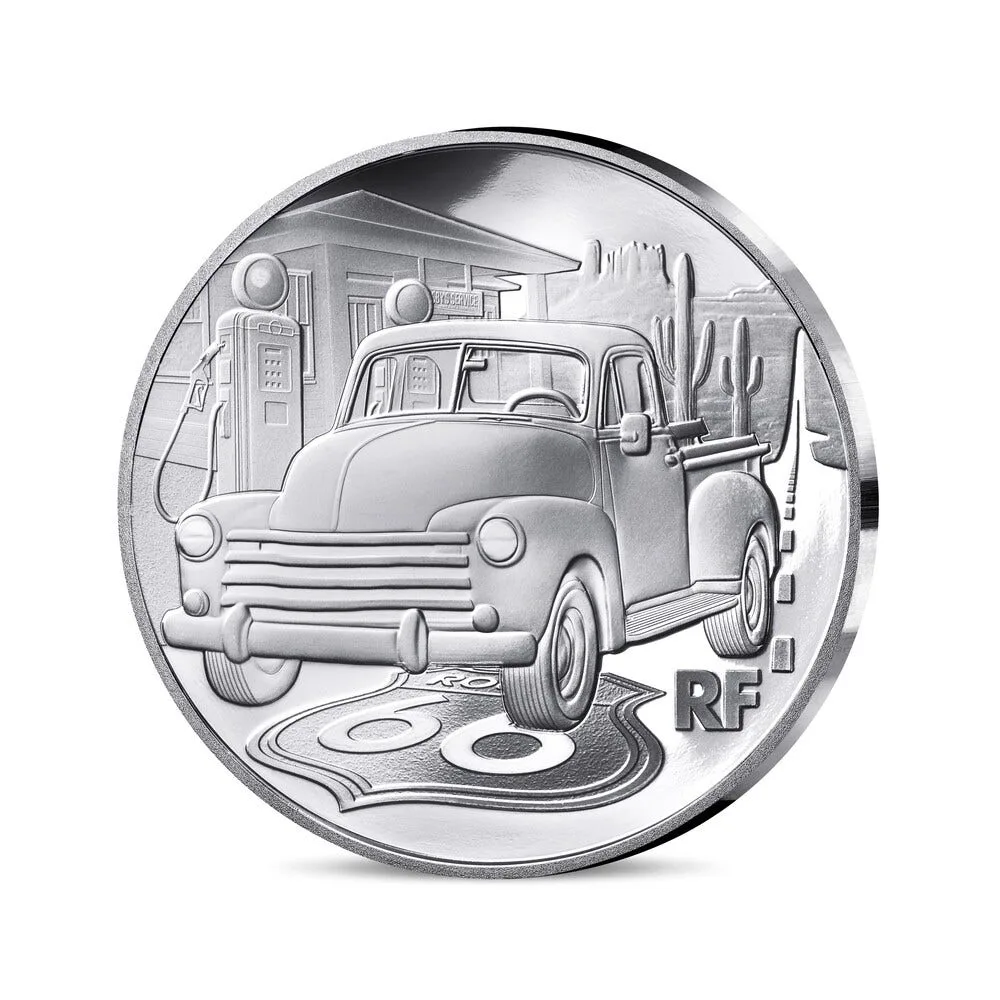
Pickup at the Gas Station on Route 66 (10 euro, Proof)
PDFGeneral information


Description
Route 66 is one of the most famous roads in the United States. Linking Chicago with the California coast, it crosses the country from east to west for more than 3,900 kilometres, passing through Illinois, Missouri, Kansas, Oklahoma, Texas, New Mexico and Arizona to end in Santa Monica. The highway officially came into being in 1926, when the United States adopted a unified system of numbered federal highways, and signs bearing the number 66 went up the following year, in 1927. The road was not built from scratch: it was assembled from existing local, county and state roads, older auto trails and an old transport corridor that people and goods had followed for generations. The number 66 was the outcome of a numbering dispute: the businessman Cyrus Avery, a leading champion of a Chicago–Los Angeles route, wanted the number 60, but Kentucky successfully claimed it for its own highway, and the Oklahoma engineer John Page then found the unassigned number 66. In 1927 a highway association was founded to promote the route across the country, and by 1938 Route 66 became the first US federal highway to be fully paved. It earned the nickname «Main Street of America» because towns, cafés, motels, gas stations and roadside attractions sprang up along it. The nickname «the Mother Road» was fixed to it by John Steinbeck in his novel The Grapes of Wrath (1939). In the 1930s, at the height of the Great Depression and the Dust Bowl, hundreds of thousands of ruined farmers travelled along Route 66 to California in search of a better life; this great migration is the subject of the novel. After the Second World War the highway became a symbol of American prosperity and social mobility: families began to take holidays by car in large numbers, and the culture of the road trip — travelling on the open road — was born. The road was celebrated in Bobby Troup's song «(Get Your Kicks on) Route 66», first recorded by Nat King Cole in 1946, it gave its name to the television series Route 66 (1960–1964), and the animated film Cars (2006) told of a small town bypassed by a new highway. From the late 1950s the construction of the modern Interstate Highway network gradually pushed Route 66 aside. Section by section it was bypassed, and on 27 June 1985 the highway was officially removed from the national road network. Today, however, as Historic Route 66 it remains a symbol of traditional America: the surviving stretches attract travellers from all over the world who come for the varied landscapes, the iconic towns, the road heritage and the spirit of freedom. Route 66 is a true cultural monument, bearing witness to the great migrations, economic growth and the changing American society of the twentieth century. To mark the centenary of the road, Monnaie de Paris has issued a collection of coins in its honour: the series highlights the historical and cultural heritage of the route, a symbol of freedom, travel and the American pioneering spirit.
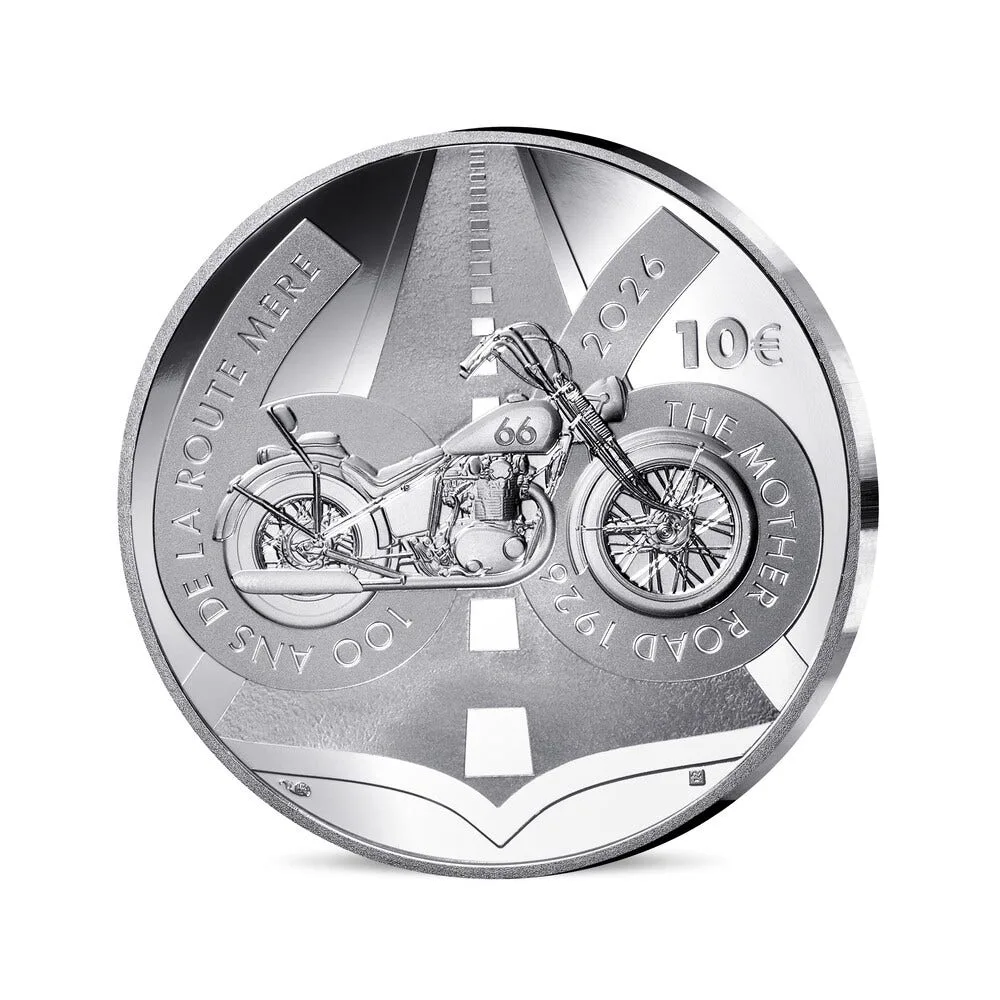
This coin is struck in «Belle Épreuve» — the highest collector finish — so what comes to the fore is the interplay of texture: the raised details of the pickup, the fuel pump and the mountain backdrop gleam while the fields stay matte. Unlike the coloured issue, there is no paint here — the picture is «drawn» only by light and shadow on polished and frosted metal. The scene with the pickup by the gas station against mountains and a roadside cactus conveys the feel of a hot day on the south-western stretch of the road, while the other side with the motorbike gives the same subject as the mass-market coin, but in a refined finish. The coin is meant for collectors who gather the full set of finishes of the anniversary collection.
Obverse
The official side with the face value «10 €»: a motorbike with the number 66 forming its wheels, against a road with white markings stretching into the distance. The number 66 is built into the design and forms the wheels of the motorbike. The inscription «La Route Mère» recalls the historical and cultural significance of the route; the inscription «100 ans» celebrates the centenary of the road. The hallmarks and the face value are also featured on this side.
Reverse
The artistic side: The scene on the other side is assembled from recognisable details of the road. In the background are the mountains near Amarillo, Texas, evoking the wide open spaces the highway crosses. A typical gas station with a fuel pump recalls the many stops that once dotted the travellers' route. The words «Route 66» painted on the tarmac in the shape of the familiar road shield are one of the most recognisable symbols of this road. A pickup car stands at the centre of the composition, a tribute to the millions of people who have travelled along Route 66 over decades and generations. The letters «RF», for «République Française», complete the design.