
Ariane 6
PDFGeneral information


Знак A — Берлин (штемпельгланц)
Отличие — знак монетного двора «A»: монета отчеканена Государственным монетным двором Берлина (Staatliche Münze Berlin). Качество — штемпельгланц (Stempelglanz), монета распространяется по номиналу.

Знак D — Мюнхен (штемпельгланц)
Отличие — знак монетного двора «D»: монета отчеканена Баварским главным монетным двором в Мюнхене (Bayerisches Hauptmünzamt). Качество — штемпельгланц (Stempelglanz).

Знак F — Штутгарт (штемпельгланц)
Отличие — знак монетного двора «F»: монета отчеканена Государственным монетным двором Штутгарта (Staatliche Münze Stuttgart, объединение Staatliche Münzen Baden-Württemberg). Качество — штемпельгланц (Stempelglanz).
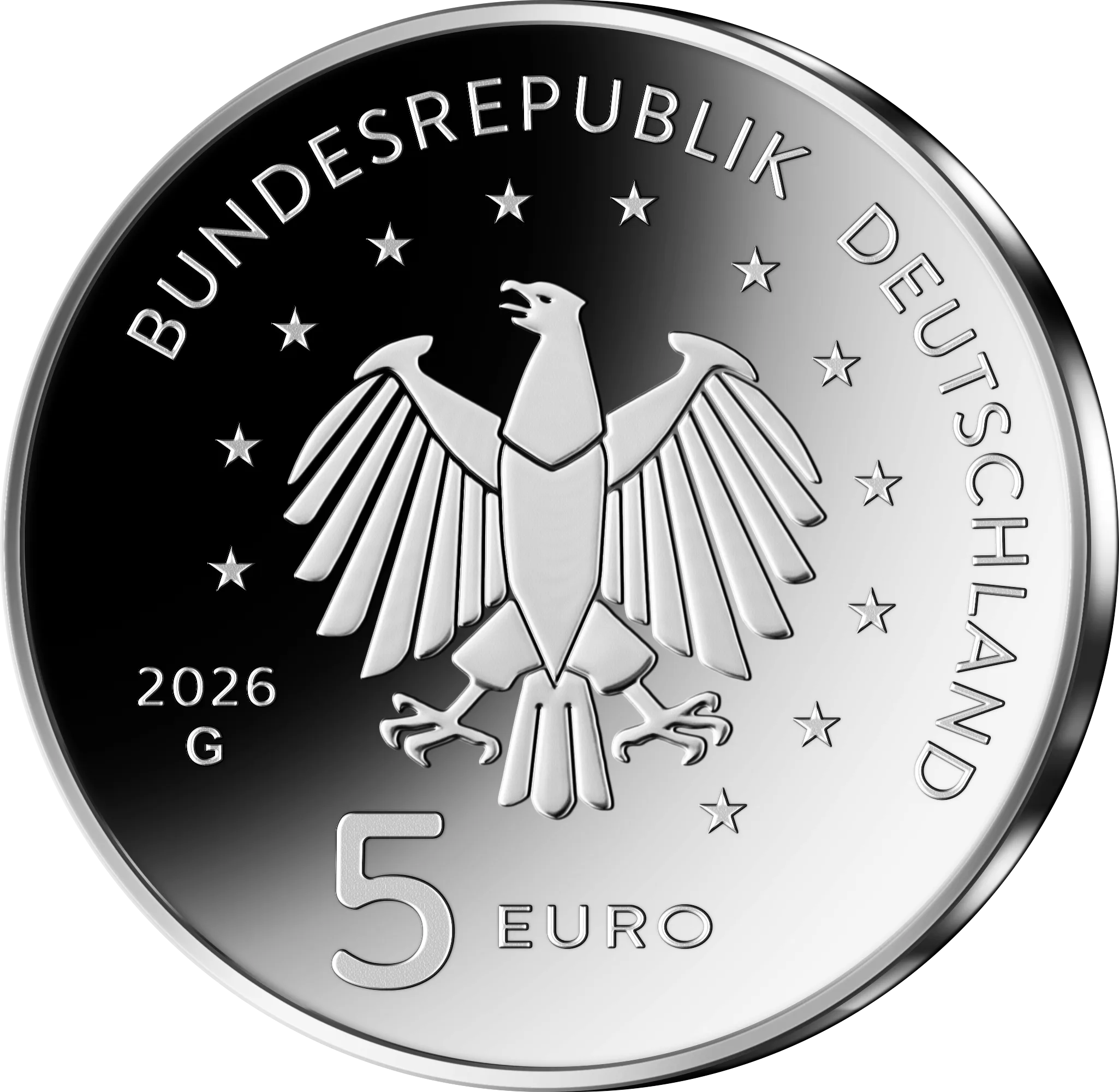
Знак G — Карлсруэ (штемпельгланц)
Отличие — знак монетного двора «G»: монета отчеканена Государственным монетным двором Карлсруэ (Staatliche Münze Karlsruhe, объединение Staatliche Münzen Baden-Württemberg). Качество — штемпельгланц (Stempelglanz).

Знак J — Гамбург (штемпельгланц)
Отличие — знак монетного двора «J»: монета отчеканена Гамбургским монетным двором (Hamburgische Münze), старейшим монетным двором Германии. Качество — штемпельгланц (Stempelglanz).
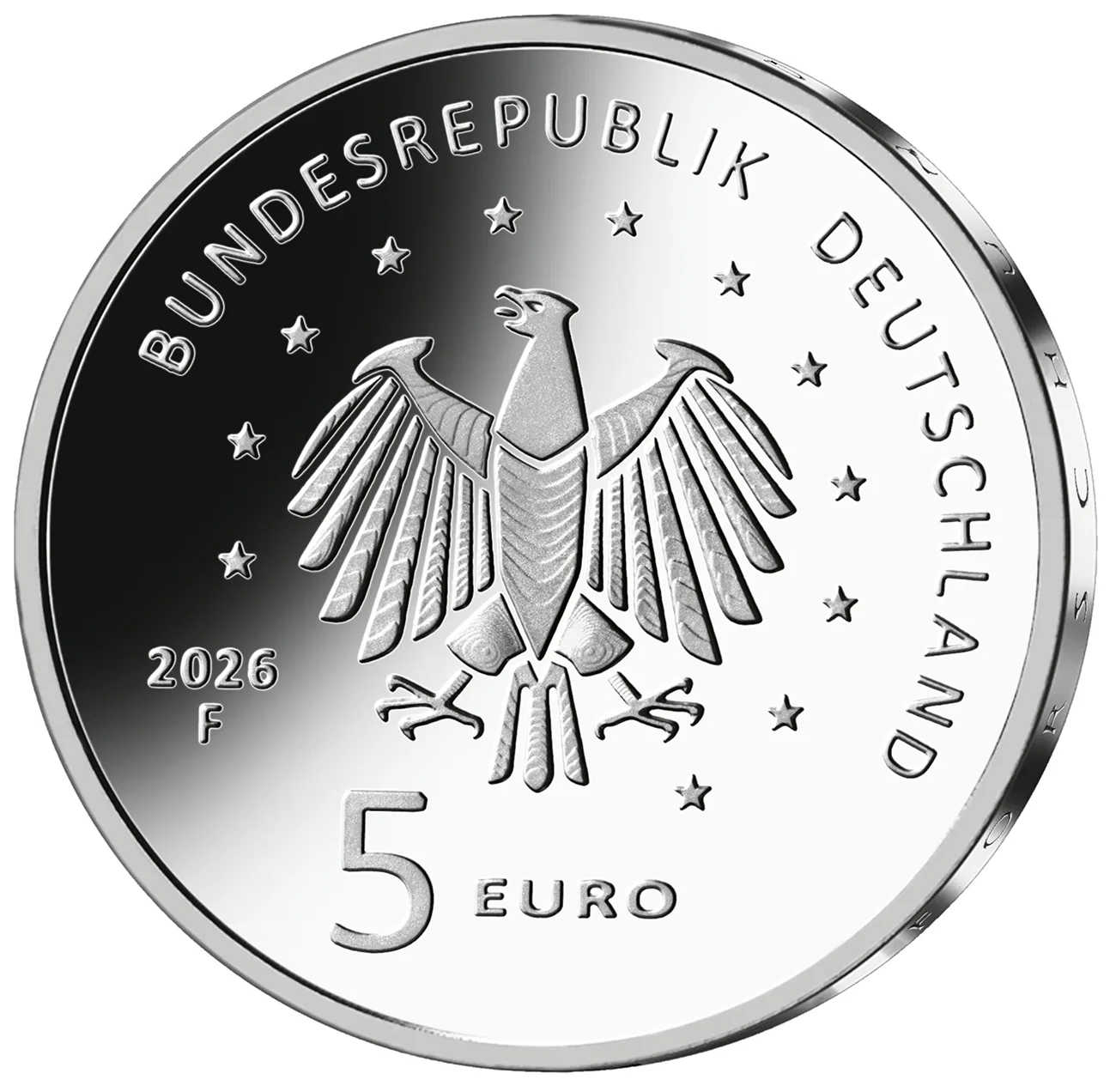
Пруф (шпигельгланц) — Штутгарт (F)
Отличие — качество чеканки: вариант в качестве пруф (Spiegelglanz) с зеркальным полем и матовым рельефом. Чеканится монетным двором Штутгарта (знак «F»), тираж — 75 000 экземпляров; продаётся через официальный магазин «Münze Deutschland» по цене выше номинала.
Description
“Ariane 6” opens the new German state series “Exploration of Space” (Erforschung des Weltraums), devoted to the most significant projects of modern spaceflight, and tells of the European next-generation launch vehicle Ariane 6.
Ariane 6 is a European launcher created under the programme of the European Space Agency (ESA) to replace Ariane 5, which for decades remained Europe’s most reliable and competitive heavy rocket. ArianeGroup is the prime contractor, the launch complex was built by the French space agency CNES, and Arianespace handles the commercial marketing of launches. Thirteen states take part in the programme. The first launch of Ariane 6 took place on 9 July 2024 from the Guiana Space Centre at Kourou, while the history of European launchers of this family began as early as 1979.
The rocket is built in two configurations: Ariane 62 with two solid-fuel boosters for medium payloads and Ariane 64 with four boosters for heavy missions. The core stage runs on liquid oxygen and hydrogen, and the restartable upper stage with the Vinci engine makes it possible to place several spacecraft in different orbits and to bring the stage down from orbit in a controlled manner once the mission is complete. In 2026 the programme developed rapidly: on 17 June, on flight VA269, Ariane 6 placed 36 satellites of the Amazon Leo constellation in orbit at once, setting a European payload-mass record, and on 27 August, on mission VA270, the rocket for the first time sent a spacecraft to geostationary orbit — the new-generation Meteosat weather satellite MTG-I2.
Obverse
The artistic side shows both versions of the rocket. On the left and in the centre of the composition are graphic technical schemes of Ariane 62 and Ariane 64 with two and four solid-fuel boosters, nozzles, payload fairing and details of the upper stage, while on the right is a large silhouette of the launcher itself, soaring upward. The background is the planet Earth, its surface partly coloured: the blue of the oceans and the outlines of the continents, over which a grid of parallels and meridians is applied. It is precisely this colour accent in the area of the planet that sets off the shape of the rocket and creates depth in the image. The inscription “ARIANE 6” runs along one of the orbits, and orbital trajectories bind the separate elements into a single dynamic composition. In the lower part of the coin the engine nozzles and elements of the rocket’s launch configuration can be seen, giving the subject technical authenticity.
Reverse
The official side is adorned with the heraldic eagle of the Federal Republic of Germany with outspread wings, placed in the centre of the field. Around the top and right runs the inscription “BUNDESREPUBLIK DEUTSCHLAND”, accompanied by twelve European stars symbolising the European Union. On the left beneath the eagle’s wing are the year of issue “2026” and the mint mark — “A” (Berlin), “D” (Munich), “F” (Stuttgart), “G” (Karlsruhe) or “J” (Hamburg), depending on the place of minting — and in the lower part the numeral of the face value “5” and the word “EURO”. The composition of the official side is the same for all coins of the “Exploration of Space” series.