
100th birthday of Aisha Galimbayeva (blister)
PDFGeneral information


Description
Aisha Galimbayeva was the first professional Kazakh woman artist, a painter and film designer whose name is firmly written into the history of Kazakhstan's fine arts. In 2017 the country marked the centenary of her birth, and the National Bank of the Republic of Kazakhstan responded to the anniversary with a commemorative 100 tenge coin. The coin belongs to the series “Outstanding Events and People”: the Bank's press release No. 35 of 7 November 2017 announced that commemorative coins dedicated to the 100th anniversary of A. Galimbayeva would be released into circulation on 8 November 2017.
The artist was born on 29 December 1917; sources name the birthplace differently — the Nadezhdinskaya settlement of the Przhevalsk district of the Semirechye region, or the village of Esik (Issyk) in today's Almaty region. A pull towards drawing showed in early childhood: it is said that she painted her grandfather, grandmother and everyday scenes in paints on canvas, and these works came out almost like carpets. In 1943 Aisha Galimbayeva graduated with distinction from the N. V. Gogol Alma-Ata Art School, where her teachers were L. P. Leontiev, A. I. Bortnikov and A. M. Cherkassky. She then went to Moscow and in 1949 graduated from the art and decoration department of the All-Union State Institute of Cinematography (VGIK), studying under B. Shpenel and K. Morozov. Her diploma work was a set of stage designs, costumes and a storyboard for Mukhtar Auezov's film script “Songs of Abai”; the film was not made at the time, but the work was highly praised.
From 1949 Galimbayeva lived and worked in Alma-Ata, took part in exhibitions and from 1951 was a member of the Union of Artists of Kazakhstan. She began at the Kazakhfilm studio, where she made sketches for the films “A Poem of Love” (1954), “The Girl-Horseman” (1955) and “It Happened in Shugla” (1955). In the 1960s she created a cycle of works on subjects from “Songs of Abai” — “The Court of Biys”, “Wedding Evening”, “Toi”, “Aitys” and “Meeting”. For many years the artist studied traditional Kazakh decorative and applied art and national dress: in 1958 her album “Kazakh National Costume” appeared with sixty drawings of costumes for different occasions, and in 1976 it was reissued. In 1949–1966 Galimbayeva taught at the Alma-Ata Art School, and in 1966–1969 at the Abai Kazakh Pedagogical Institute.
Her mature work consists of landscapes, still lifes and portraits. In the 1960s and 1970s she painted “Ayak-Kalkan”, “The Road to the Jailyau”, “Ancient Ceramics”, “Kobyz”, “Yellow Apples” and “Red Aport”; among her decorative and monumental compositions are “We Are Proud of Our Time” (1965) and “A Bowl of Kumis” (1967); among her portraits are “Portrait of the Son” (1964), “Portrait of the Writer G. Mustafin” (1965), a portrait of the singer K. Baiseitova (1974) and “Kelin from the Urals” (1978). Art critics note that in her canvases colour becomes a hero in its own right: it lives its own life and sounds almost like a musical theme.
Galimbayeva's merits were marked with the highest awards: the titles of Honoured Art Worker of the Kazakh SSR (1961) and People's Artist of the Kazakh SSR (1967), the Chokan Valikhanov State Prize of the Kazakh SSR (1972), the Orders of the Badge of Honour and of the Red Banner of Labour, the Order of Parasat (2007), and in 2002 the independent Tarlan prize awarded by the patrons' club. The artist died on 21 April 2008 in Almaty at the age of 90. The 2017 anniversary coin recalls her as a person who combined national tradition and professional training in her art.
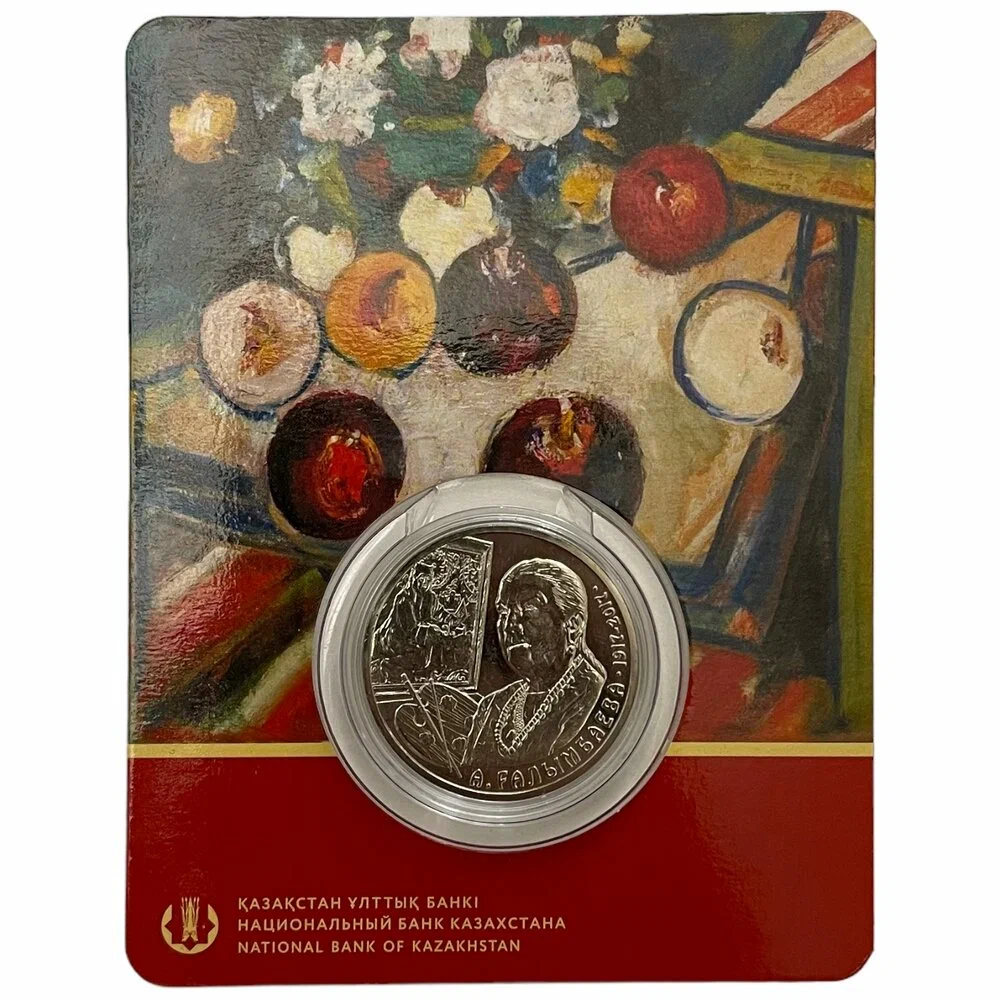
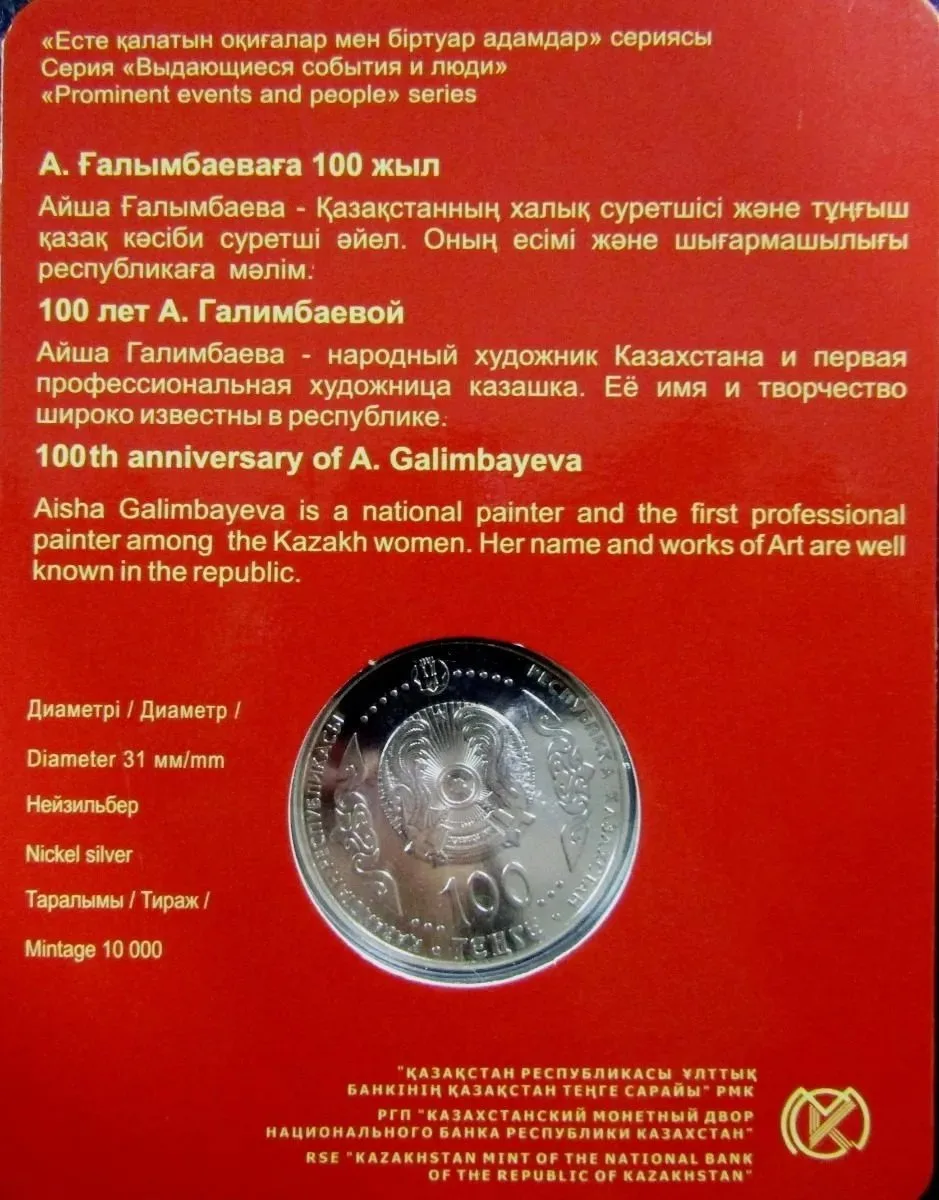
This coin is presented in the original packaging of the National Bank — a blister, that is, a printed cardboard card with a window in which the coin itself is placed. According to the NBK press release, the nickel silver coins were made in improved quality and packed for sale in special printed packaging; the front of the card reproduces a work by the artist and the logo of the National Bank, and the back carries text about the coin with its metal, diameter and mintage. The coin is struck in nickel silver, weighs 11.17 g, is 31 mm in diameter, has UNC quality and a mintage of 10,000 pieces, and was released into circulation on 8 November 2017 by the Kazakhstan Mint. Nickel silver is a copper-nickel-zinc alloy of silvery colour that the NBK uses for mass commemorative issues; later the series for collectors moved to cupronickel. The coin is catalogued as KM# 356 and N# 128370.
Obverse
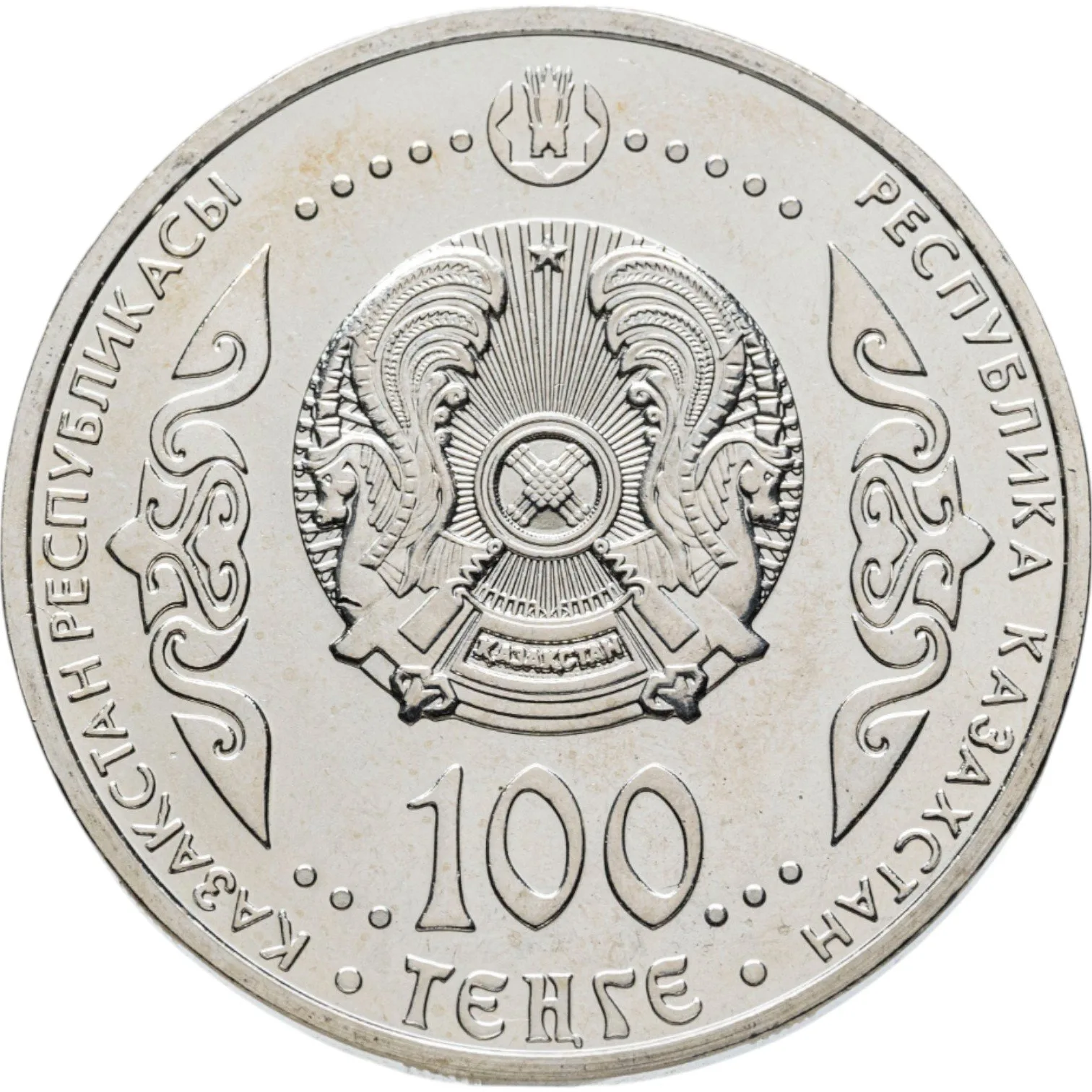
In the central part of the coin is the State Emblem of the Republic of Kazakhstan on an ornamental background; in the lower part are the number “100” and the inscription “TENGE” denoting the face value. In the left and right sectors, elements of the national ornament are placed symmetrically, and around the circumference run the inscriptions “QAZAQSTAN RESPUBLIKASY” in the state language and “REPUBLIC OF KAZAKHSTAN” in Russian. At the top is the logo of the National Bank of the Republic of Kazakhstan. The images and inscriptions are in relief, a raised rim runs around the circumference, and the edge is reeded.
Reverse
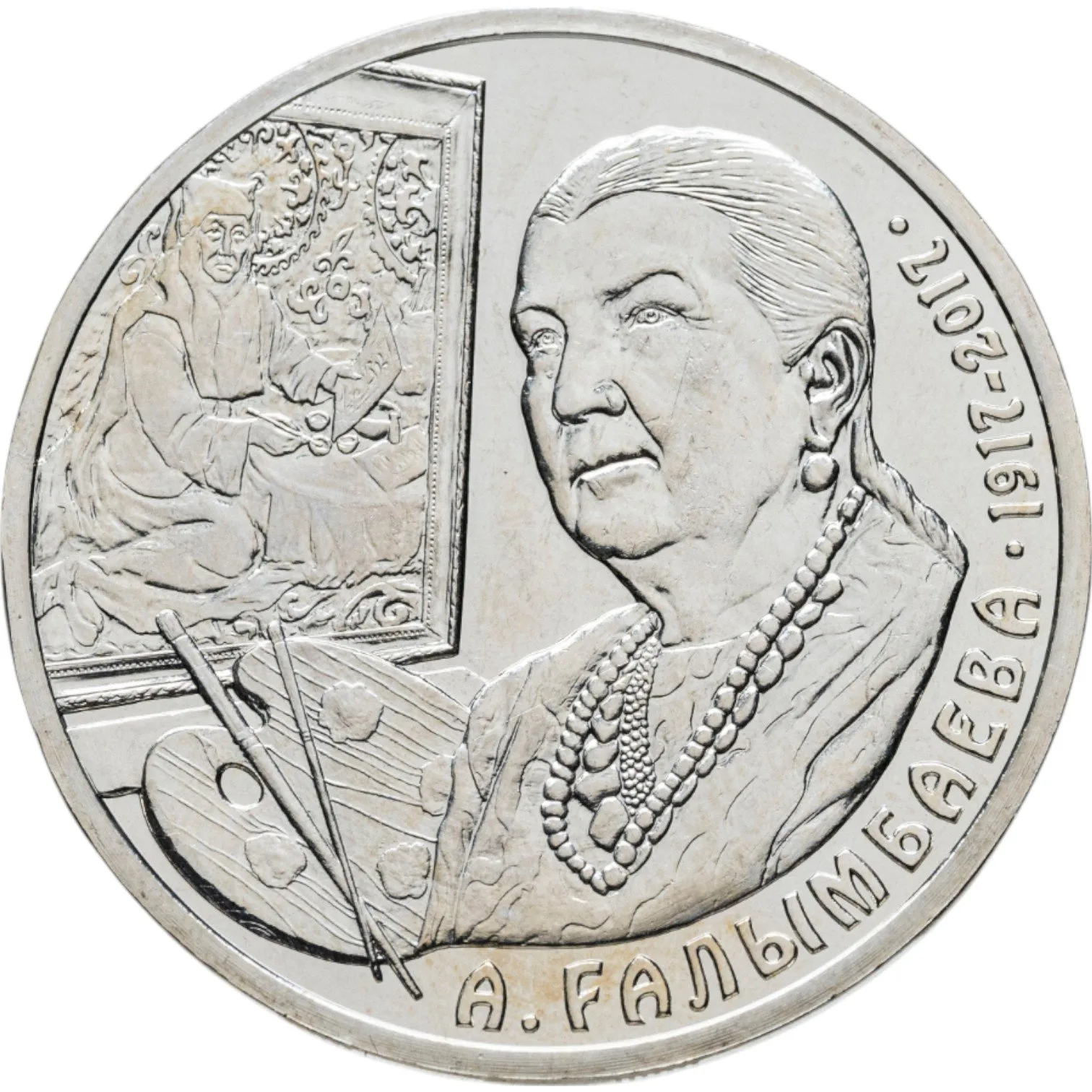
The reverse shows a portrait of the People's Artist of Kazakhstan Aisha Galimbayeva, an artist's palette and one of her works. Around the circumference is the inscription “A. GALYMBAEVA” in the state language, the number “1917” marking the year of birth and the number “2017” marking the year of minting. The palette and the fragment of a painting are chosen as a sign of the profession: the composition shows the artist not as a formal portrait but as a master whose instrument is colour.