
175th birthday of Zhambyl Zhabayev
PDFGeneral information

Description
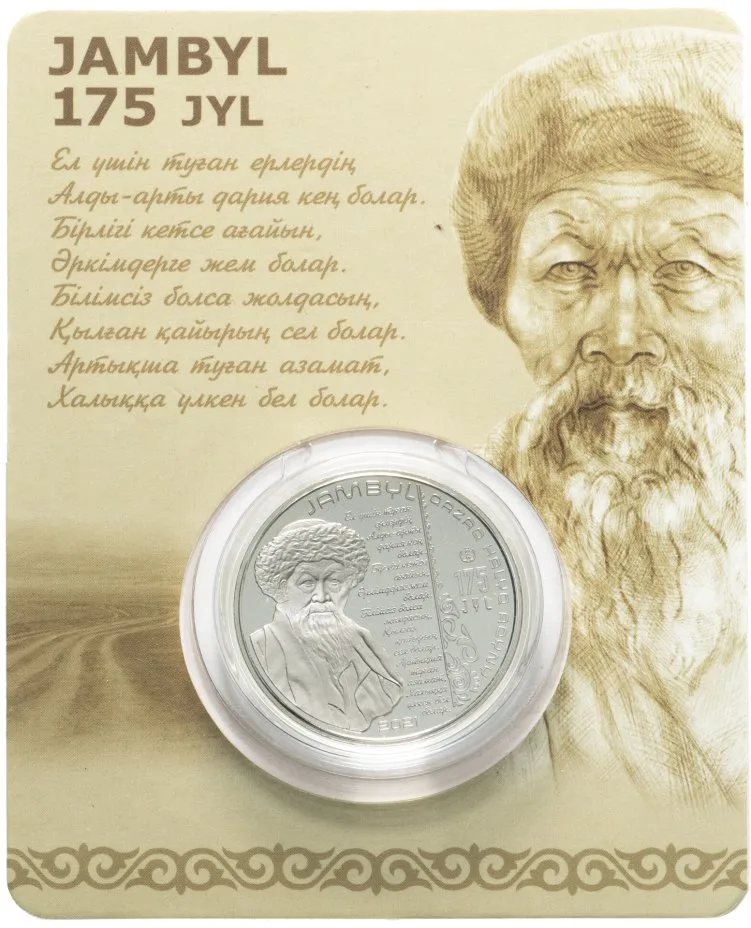
Zhambyl Zhabayev is one of the best-known Kazakh akyns, an improvising poet whose name became a symbol of the folk song tradition in the twentieth century. 2021 marked the 175th anniversary of his birth, and the National Bank of the Republic of Kazakhstan marked it with the collector coin “JAMBYL. 175 JYL” with a face value of 100 tenge. The Bank announced the issue in press release No. 19 of 29 September 2021, and sales through the NBK online store kazcoins.nationalbank.kz began on 17 November 2022. The coin belongs to the series “Outstanding Events and People” and is placed among the figures of Kazakhstan in the catalogue.
Zhambyl was born on 28 February 1846 (16 February old style) into the nomadic family of Zhabay of the Shaprashty clan of the Senior Zhuz. According to family tradition, this happened near Mount Zhambyl in the upper reaches of the Chu River, in what is now the Moiynkum district; his father gave the boy the name of the mountain. His mother was called Uldan, and the family had three sons. As a boy Zhambyl learned to play the dombra — his uncle was a well-known dombra player. At 14 (other sources say in 1858, at 12) he left home to become an akyn and earn his living by singing, and he learned the art of improvisation from the akyn Suyunbai. Zhambyl sang exclusively in Kazakh, in the tolgau manner — a recitative accompanied by the dombra.
Fame came to him in the akyn contests known as aitys. In 1881 he defeated Kulmambet, in 1895 Sarbas, in 1902 Dosmagambet and in 1909 Shashubai; he was also regarded as a master of denunciatory songs. The epics “Suranshi-batyr” and “Utegen-batyr”, the tales “The Khan and the Akyn” and “The Tale of the Lazy Man” were written down from him. In Soviet years Zhambyl’s fame spread far beyond the steppe: from 1938 he was a deputy of the Supreme Soviet of the Kazakh SSR, in 1941 he received the Stalin Prize of the second degree, and his songs of the Great Patriotic War, among them “Leningraders, My Children”, were widely printed and broadcast. A separate page of his biography is the dispute over the authorship of part of the verses of the 1930s, produced from interlinear translations; it is reflected in scholarly literature and does not change the akyn’s contribution to oral poetry.
Zhambyl Zhabayev died on 22 June 1945 in Alma-Ata, about eight months short of his hundredth birthday, and is buried in the village that bears his name near Uzynagash. The house of the akyn, which now holds a museum, and the garden he planted himself have been preserved there. The philharmonic hall in Almaty, regional theatres and hotels are named after him, postage stamps of the USSR and Kazakhstan are dedicated to him, and the city of Taraz long bore the name Dzhambul. By issuing the coin for the 175th anniversary, the National Bank continued its line of portrait jubilee coins in cupronickel that put the emphasis on the portrait and the text rather than on elaborate finishing.
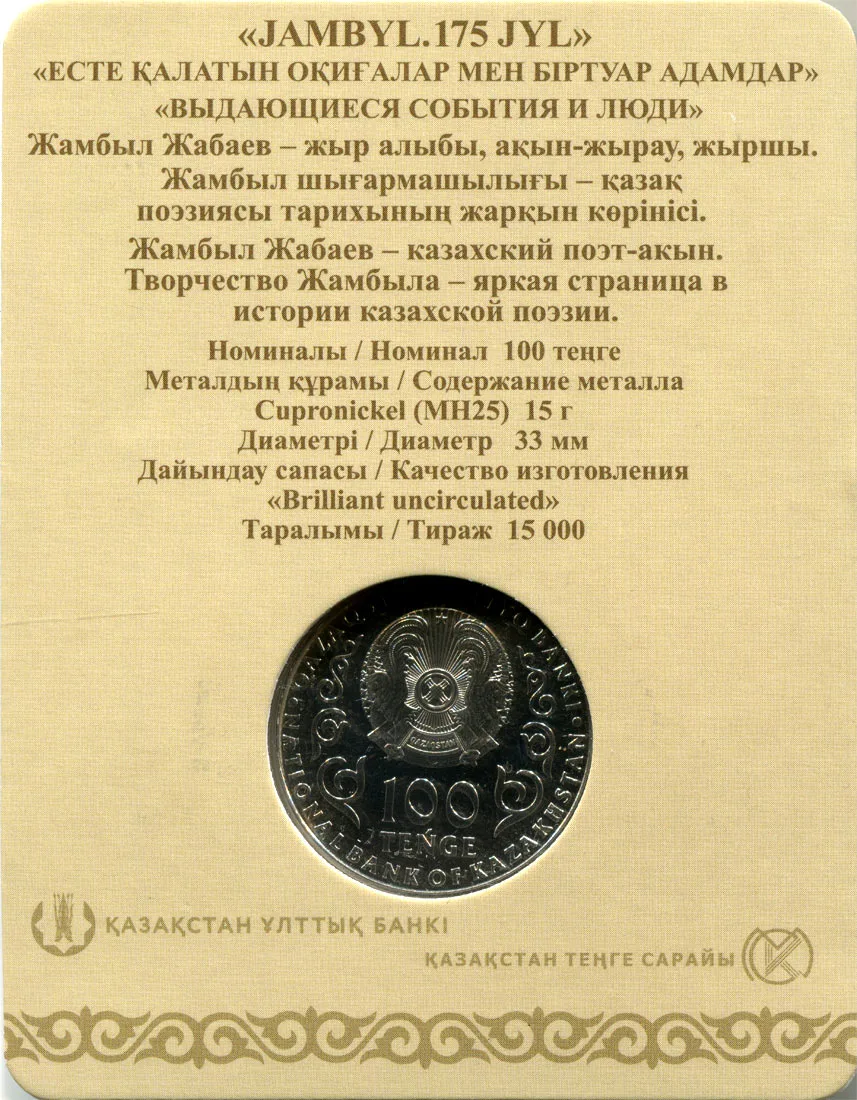
The coin is struck in cupronickel (CuNi 25), weighs 15 grams, measures 33 mm in diameter, is 2.35 mm thick according to Numista, has brilliant uncirculated quality and a mintage of 15,000 pieces. Collectors receive the coin in a capsule placed inside a sealed blister (according to the dealer kazcoins.com). Catalogue numbers: KM# 525 and N# 347881. A mintage of fifteen thousand is the standard for the base-metal commemorative coins of the NBK in these years, so the coin is bought as a collectible rather than for everyday use, even though at face value it must be accepted throughout Kazakhstan. The coin exists in a single version; there are no silver, gilded or Proof versions of this issue, as confirmed by the Bank’s press release and by the Numista catalogue.
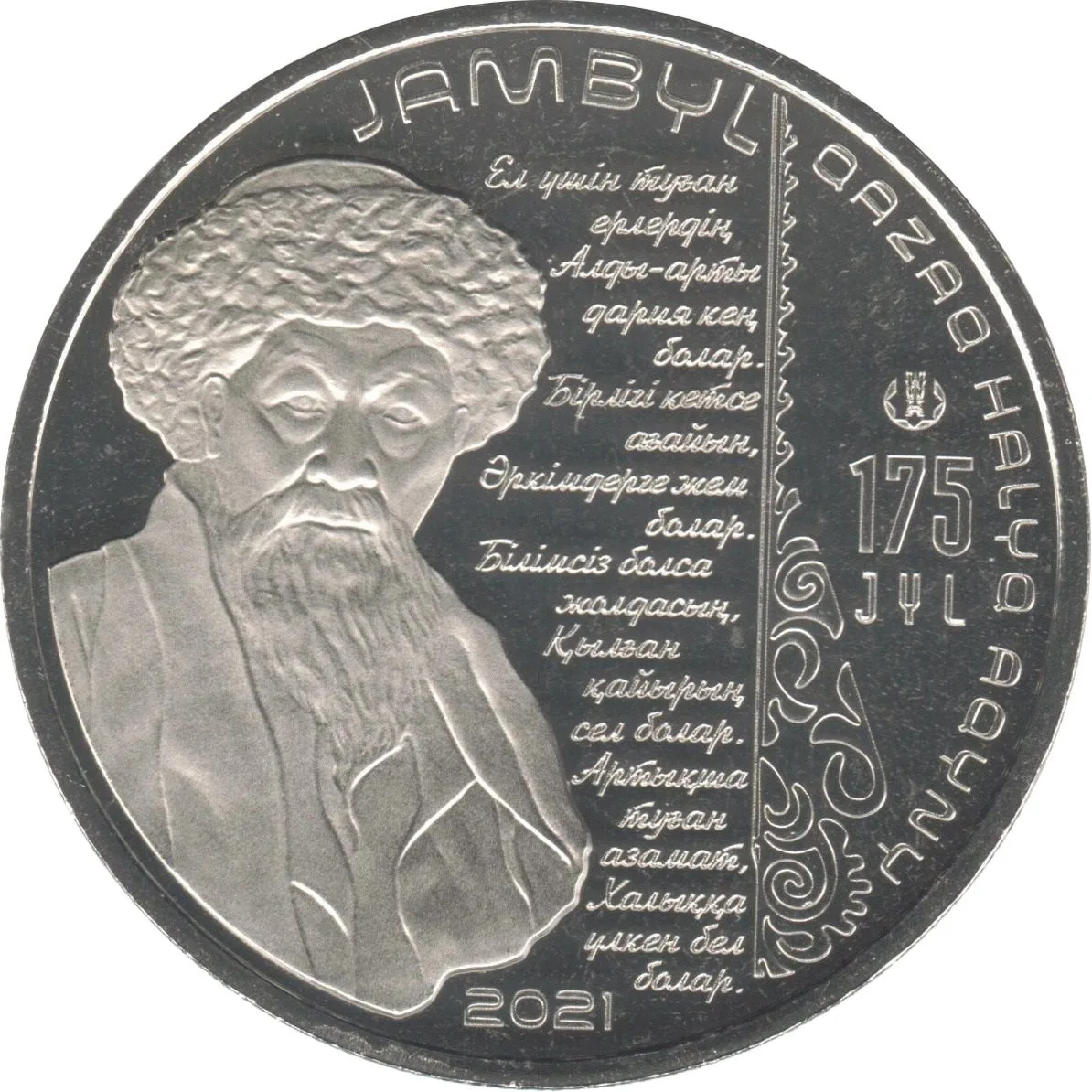
Obverse
This is the artistic side. It carries a portrait of Zhambyl Zhabayev turned to the right; in the centre of the field are lines from his poem “Artyqsha tuğan azamat”, and to their right is a stylised outline of a dombra assembled from ornamental fragments. Further right are the logo of the National Bank of Kazakhstan and the inscription “175 JYL” marking the anniversary. Around the rim run the inscriptions JAMBYL and QAZAQ HALYQ AQYNY (“Kazakh people’s akyn”), and the year “2021” stands at the bottom. The dombra beside the portrait recalls the main instrument with which the akyn sang all his life.
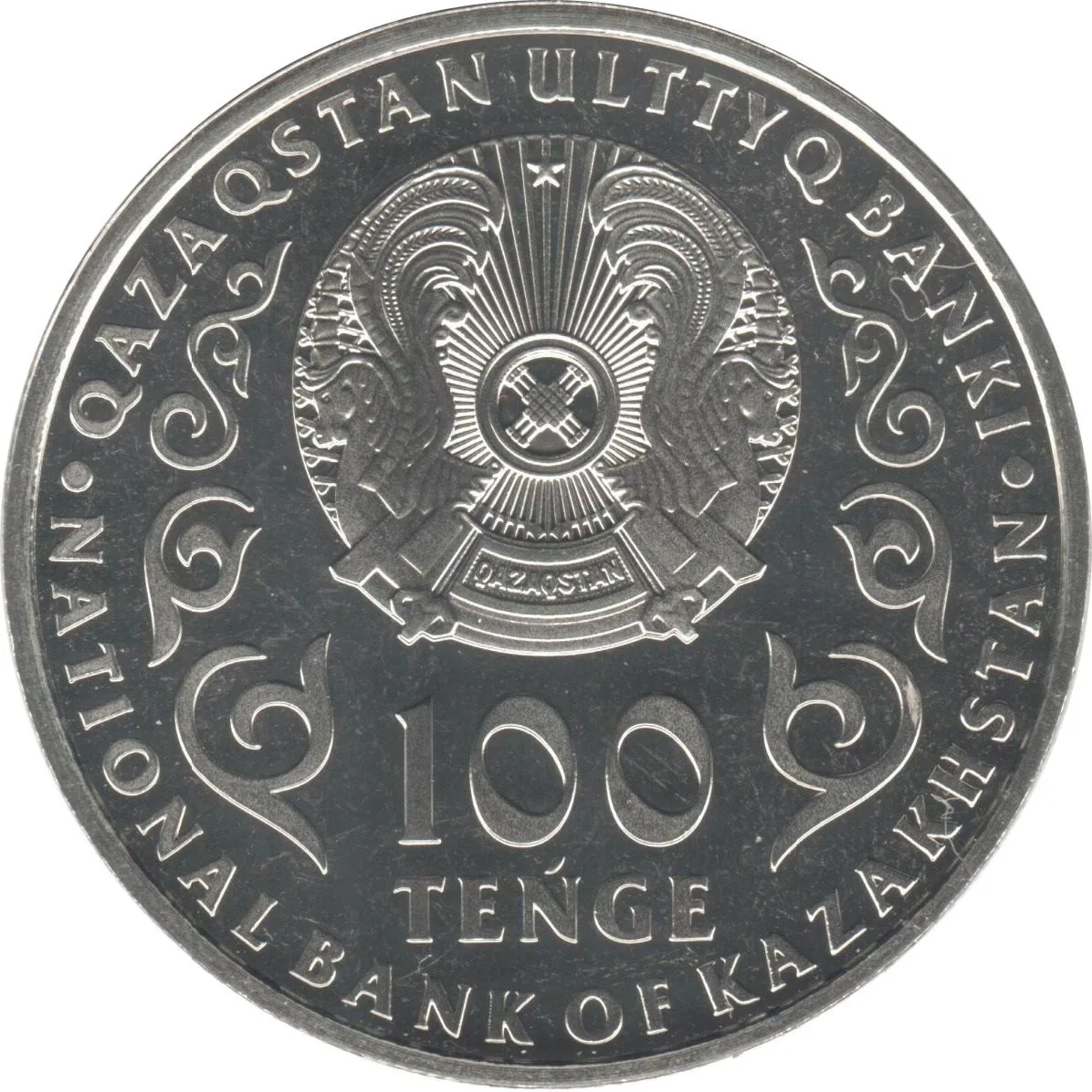
Reverse
The official side shows the State Emblem of the Republic of Kazakhstan in the central part, with elements of the national ornament to the left and right. The inscription QAZAQSTAN ULTTYQ BANKI • NATIONAL BANK OF KAZAKHSTAN runs around the circumference, and the face value “100 TEŃGE” is at the bottom. The coin was made at the Kazakhstan Mint.