
7th Asian Winter Games (5000 Tenge)
PDFGeneral information


Description
The 7th Asian Winter Games were the first continental tournament of this scale ever hosted by Kazakhstan, and an event the country prepared for over several years. The right to host the 2011 Games went to Almaty: the choice was made on 5 January 2006 in Kuwait at a session of the Olympic Council of Asia. The plan then grew. On 29 October 2007 the Olympic Council of Asia supported Kazakhstan’s request to widen the geography of the competition, and part of the programme was moved to the capital, Astana. That is how the double name appeared that is printed on the reverse of the commemorative coins: Astana — Almaty 2011.
The distribution of venues came out naturally. In Astana, at the indoor Astana Arena stadium, the opening ceremony took place on 30 January 2011, and the Games were opened by President Nursultan Nazarbayev. The capital hosted the “ice” disciplines: speed skating at the purpose-built Alau Ice Palace, short track and figure skating at the Republican Velodrome, and men’s ice hockey at the Kazakhstan Sports Palace. The “snow” sports stayed in Almaty: cross-country skiing, alpine skiing at Shymbulak, ski jumping, biathlon, ski orienteering and bandy at the famous high-altitude Medeu rink. The closing ceremony was held on 6 February 2011 in Almaty at the Baluan Sholak Sports Palace.
Athletes from 26 Asian countries took part — more than eleven hundred competitors. Sixty-nine sets of medals were contested in eleven sports. For the first time in the history of the Asian Winter Games the programme included bandy and ski orienteering, while short track drew particular attention from spectators. The winners’ medals were struck by the Kazakhstan Mint of the National Bank. The hosts finished first in the medal table with 32 gold, 21 silver and 17 bronze medals, 70 in all, followed by Japan, the Republic of Korea and China.
The Games had a distinctive identity of their own. Their symbol was the cub Irbi, a young snow leopard, an animal of the high mountains of the Tien Shan and Alatau. For the first time at the Asian Winter Games a full torch relay was held: over twenty days it covered every region of Kazakhstan, and more than a thousand people carried the torch. The flame of the Games was lit on 11 January 2011 in Kuwait City, the Olympic “capital” of Asia. A hymn of the Games, “Asiada Alauy”, was written for the celebration, and the competition for it drew more than a hundred performers. Transport infrastructure was upgraded as well: the modernisation of Almaty airport was completed by December 2008.
The National Bank of Kazakhstan marked the event with a whole set of commemorative money: besides the precious-metal coins, a banknote went into circulation on 17 January 2011 whose reverse shows a skier against a mountain backdrop, Kazakh ornaments and the symbols of the Games. The coins were issued in 2010, before the start of the competition, and became a kind of herald of the tournament the country was waiting for. The images on them are designed to convey the setting — the snowy slopes of the Zailiysky Alatau where part of the events took place: a stylised ski track, the Tien Shan spruce, a symbol of these mountains, an ancient image of a solar deity framed by snowflakes, and the Games logo on a matt background imitating ice.
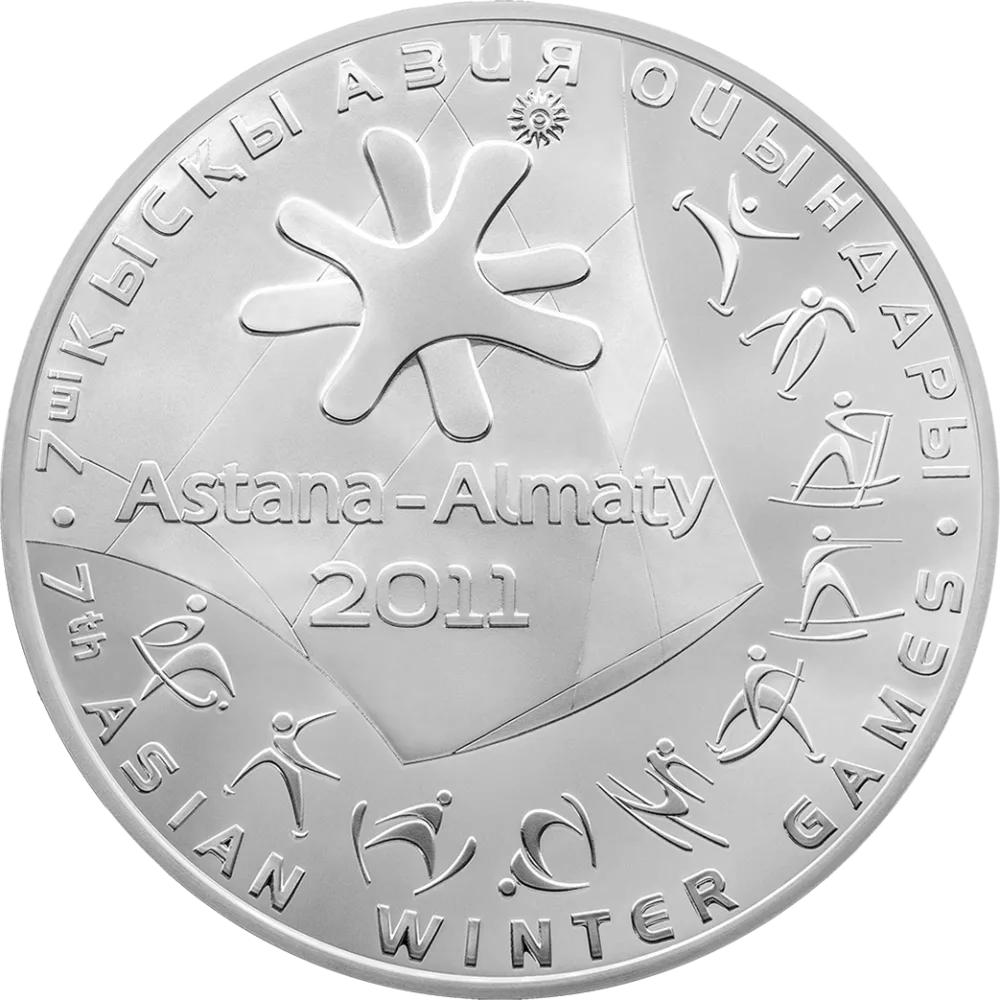
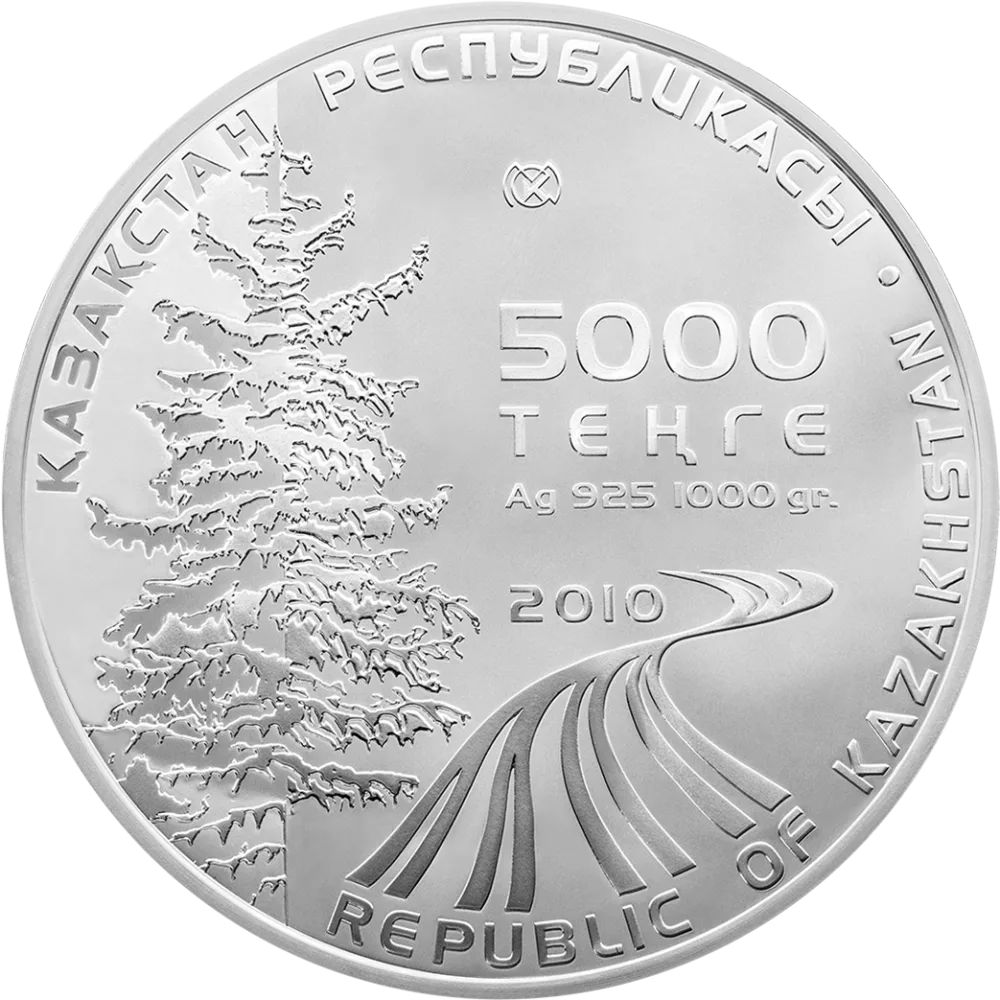
This is the large-format “medal-coin” of the issue, intended for display and as a gift. The large surface allowed the design to be laid out with scope: on the left the Tien Shan spruce is shown large, with frost lying on its branches, and at lower right runs the ski track. The reverse carries a relief logo of the Games with ideograms of winter sports around the circumference. Coins of this size are issued in small numbers and, as a rule, for institutional collections, official gifts and serious collections; here it belongs to a line together with the small gold denominations and lets one see the concept of the issue at maximum scale, where the details of the spruce and the play of light on the matt background imitating ice read well.
Obverse
In the central part are the value “5000 TENGE” and the inscription “Ag 925 1000 gr.” naming the metal. Below are a stylised ski track and the number “2010”, above — the trademark of the Kazakhstan Mint. In the left sector is the Tien Shan spruce. Around the rim are the inscriptions “QAZAQSTAN RESPUBLIKASY” and “REPUBLIC OF KAZAKHSTAN”, with a raised rim.
Reverse
In the central part of the reverse is the logo of the 7th Asian Winter Games 2011 on a matt background stylised as ice. The logo is framed by ideograms of winter sports. Around the circumference runs the inscription “7 shi QYSQY AZIA OYYNDARY” in Kazakh and “7 th ASIAN WINTER GAMES” in English; the coin is surrounded by a raised rim.