
Bremen Town Musicians (silver)
PDFGeneral information



Description
"The Town Musicians of Bremen" is a German folk tale collected by the Brothers Grimm and published in 1819 in the second edition of their Children's and Household Tales (number 27). It was taken down from the storyteller Dorothea Viehmann, one of the chief narrators from whom the Grimms drew material. In the international index of tale types it is listed as ATU 130, "The Animals in Night Quarters". The tale is about four ageing domestic animals, a donkey, a dog, a cat and a rooster, whom their masters no longer valued and meant to get rid of: the donkey was too weak to carry sacks, the dog too old to hunt, the cat was to be drowned and the rooster was being readied for the pot.
Each of them decides to run away and become a musician in Bremen: Bremen is known for its freedom, and one can live there without a master. The donkey meets the dog, then they find the cat, then the rooster, and the four set off. At night they notice a house in the forest where robbers are feasting. Standing on one another's backs, the animals strike up their "song" of braying, barking, mewing and crowing, and the dumbfounded robbers flee. The animals take over the house, eat their fill and go to sleep. When the robbers return to scout the place, their leader is scratched by the cat, bitten by the dog and kicked by the donkey, while the rooster crows from the roof. He tells his comrades that he was attacked by a witch, a monster with a knife, a giant with a club and a judge, and the robbers abandon the house for good.
The most surprising thing about the tale is that the heroes never reach Bremen: they are so well off where they are. Scholars note the kinship of this plot with Eastern stories of outcast animals, and in one medieval variant the robbers are a brown bear, a lion and a grey wolf. The idea of the tale is simple and timeless: old age does not cancel dignity, and the weak, when united, can cope with the strong. That is why the story is read to children and staged in theatres, and the four standing on one another's backs have become a figure known the world over.
The presence of a German tale on a Kazakhstani coin is explained by the country's history: Germans have lived on Kazakh land for a long time, and after the deportations of 1941 there were especially many of them. They contributed to crafts, music and education, and the Bremen Town Musicians became for many a sign of this shared heritage. The silver 500-tenge coin, put into circulation on 11 October 2017, is a collector's issue in souvenir packaging with a numbered certificate. It was released in a small quantity, which is why it is regarded as the principal coin of this subject: here the high relief best conveys the character of each of the four heroes, and the mirror-like field sets off their figures. The base-metal 100-tenge coin released the same day is intended for the mass collector; the silver one is for those prepared to collect the whole issue and who value the certificate and the packaging.
Obverse
The official side carries Kazakhstan's state symbols. In the centre is the emblem of the Republic of Kazakhstan in a circle, with a star shining above the shanyrak. On the left along the arc is the inscription "QAZAQSTAN RESPÝBLIKASY", on the right "REPUBLIC OF KAZAKHSTAN". In the lower part of the field the denomination "500" stands large, with the word "TENGE" beneath it. The free field is filled with small curling ornament, vertical cartouche ribbons run down the sides, and the whole composition is enclosed in a toothed rim.
Reverse
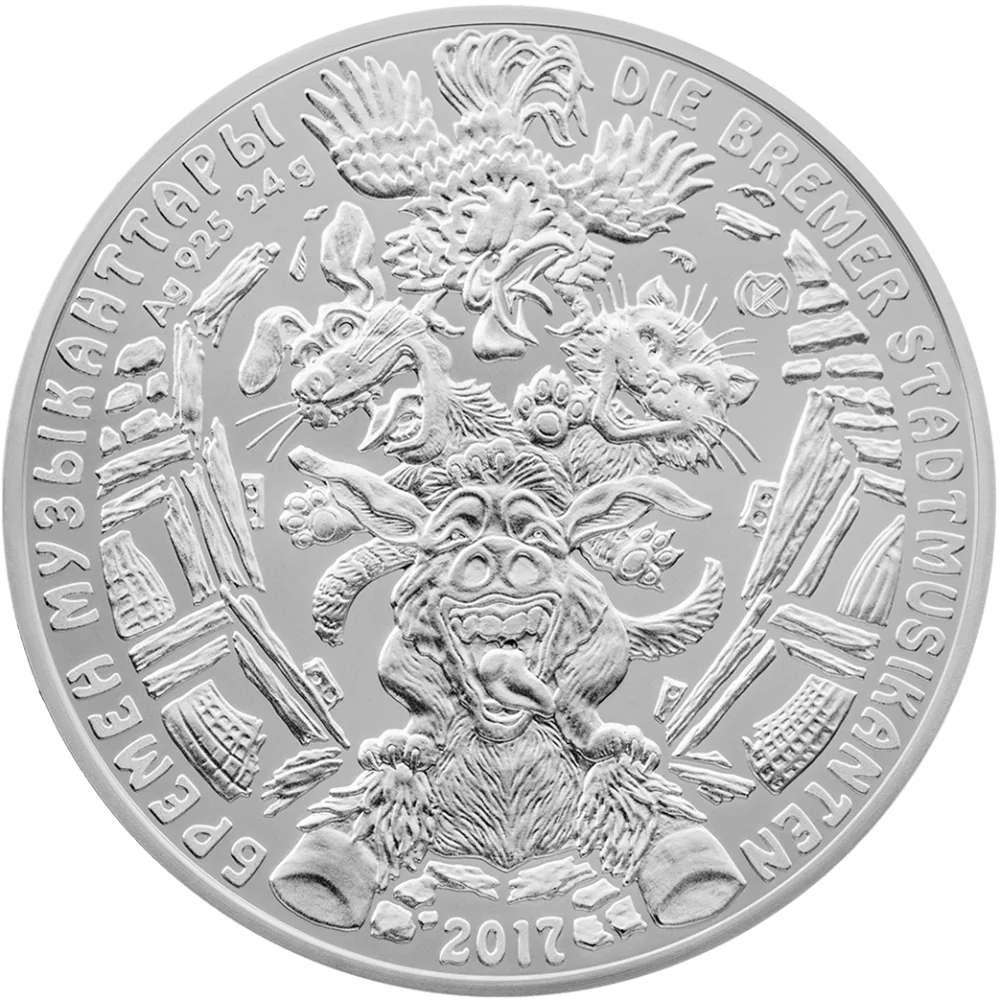
On the story side four animals are stacked in a living pyramid. At the bottom, hooves planted on the ground, stands the donkey with its large head and long ears; on him is the dog, above that the cat with a raised paw, and at the top the rooster, spreading a huge fan of tail. All four seem to be singing: mouths and beaks are open. Behind them are stylised details of an old town. Along the left arc is "BREMEN MUZYKANTTARY", along the right the German title "DIE BREMER STADTMUSIKANTEN", and at the bottom the year "2017".