
First Artificial Earth Satellite (cupronickel)
PDFGeneral information


Description
The 50 tenge coin "First Artificial Earth Satellite" is part of the space theme of collector issues by the National Bank of the Republic of Kazakhstan. The "First Satellite" coin marks the 50th anniversary of the launch of the world's first artificial Earth satellite. The PS-1 vehicle, "Prosteyshiy Sputnik-1" (Simplest Satellite-1), was placed into orbit on October 4, 1957, by an R-7 rocket from the Baikonur launch site. The creation of the rocket and satellite was led by Chief Designer Sergey Pavlovich Korolev. The satellite was a polished aluminum sphere 58 centimeters in diameter and weighing about 83.6 kilograms, with four whip antennas. Inside were a radio transmitter and power sources.
For twenty-one days, the vehicle broadcasted the famous "beep-beep" signals, which could be received by any radio amateur in the world. Orbiting the Earth in about 96 minutes, the satellite remained in orbit until January 4, 1958, when it burned up in the dense layers of the atmosphere. This launch opened humanity's space age: it became a political and scientific event of global scale, launched the competition between space powers, and led to the creation of national space programs. For Kazakhstan, the date is special because the launch pad from which the rocket departed is located on its territory, and the 2007 numismatic issue is dedicated to the 50th anniversary.
Obverse
The official side of the coin bears the state designations. Around the circumference are inscriptions: at the top, "ҚАЗАҚСТАН РЕСПУБЛИКАСЫ" in the Kazakh language, and at the bottom, "REPUBLIC OF KAZAKHSTAN" in English. To the right of the center is the face value: the digit "50" and below it the word "ТЕҢГЕ" – fifty tenge. The central field continues the space theme: a vertical line divides it into two parts; on one side, a starry sky with orbits and stars is shown, and on the other, a full-length silhouette of a person against the background of a spiral galaxy, with small dots scattered in the upper part. This composition is uniform for all coins in the series, making it easy to recognize the issue and distinguish it from regular circulation coins.
The unity of the design on the official side emphasizes that these are parts of a common thematic project: the drawing on the artistic side changes, while the state portion remains recognizable. The strict arrangement of the inscriptions along an arc and the clear relief of the digits ensure the readability of the face value, and the mint mark indicates the place of minting. The contrast between the smooth field and the relief elements preserves the expressiveness of the composition under any lighting. This side serves simultaneously as a document of the coin and part of its design, which is why it is as important in a collection as the artistic side.
Reverse
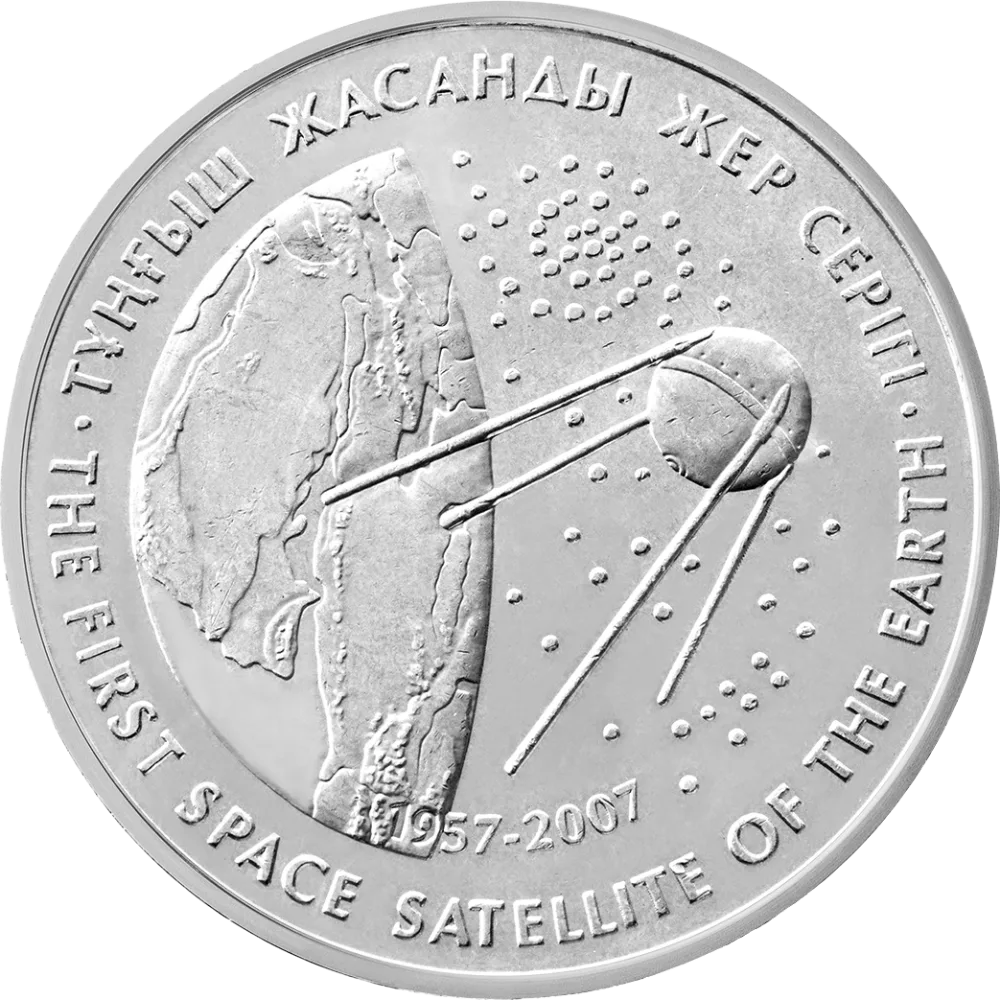
The artistic side is dedicated to the satellite itself. In the center of the coin is a sphere with four long antennas pointing backward along the direction of travel – exactly how PS-1 looked in orbit and in famous photographs. To the left is a fragment of the globe with relief outlines of the continents, over which the vehicle made its orbits. The rest of the field is occupied by a starry sky made of small dots.
Along the top circumference is the inscription in the Kazakh language "ТҰҢҒЫШ ЖАСАНДЫ ЖЕР СЕРІГІ" ("First Artificial Earth Satellite"), and at the bottom is its English version, "THE FIRST SPACE SATELLITE OF THE EARTH". Below the image of the satellite are the dates "1957-2007", marking the anniversary. The laconic composition conveys the main point: a small sphere that changed humanity's perception of itself and space.