
International Space Station (cupronickel)
PDFGeneral information


Description
The 50 tenge International Space Station (cupronickel) coin is part of the space-themed collector series issued by the National Bank of the Republic of Kazakhstan. The International Space Station coin is dedicated to the largest international project in space. The first module, the Russian "Zarya," was launched into orbit on November 20, 1998, by a Proton-K rocket from Baikonur, and two weeks later, the American "Unity" module was attached to it. The first long-term crew, consisting of William Shepherd, Yuri Gidzenko, and Sergei Krikalev, arrived at the station in November 2000. Since then, the ISS has been continuously inhabited.
Space agencies from Russia, the USA, Europe, Japan, and Canada are participating in the project. The station orbits at an altitude of about 400 kilometers, completing a revolution in approximately an hour and a half, and serves as a laboratory for research in microgravity, medicine, biology, and technology. Manned spacecraft and cargo ships are still launched to it from Baikonur to this day. Among the cosmonauts associated with Kazakhstan are Toktar Aubakirov, who flew in 1991; Talgat Musabayev, who visited the "Mir" station and flew on the Soyuz TM-27 spacecraft; and Aidyn Aimbetov, who worked on the ISS in 2015. The 2013 issue emphasizes the international nature of space exploration.
Obverse
The official side of the coin bears the state designations. Inscriptions are located along the circumference: "ҚАЗАҚСТАН РЕСПУБЛИКАСЫ" in Kazakh at the top, and "REPUBLIC OF KAZAKHSTAN" in English at the bottom. To the right of the center, the face value is indicated: the number "50" with the word "ТЕҢГЕ" — fifty tenge — below it. The central field continues the space theme: a vertical line divides it into two parts; on one side, a starry sky with orbits and stars is shown, and on the other, a full-length silhouette of a person against the background of a spiral galaxy, with small dots scattered in the upper part. This composition is uniform for all coins in the series, which allows one to immediately recognize the issue and distinguish it from regular circulation coins.
The uniformity of the design on the official side emphasizes that we are looking at parts of a common thematic project: the design on the artistic side changes, while the state portion remains recognizable. The strict arrangement of inscriptions along the arc and the clear relief of the digits ensure the readability of the face value, and the mint mark indicates the place of minting. The contrast between the smooth field and the relief elements maintains the expressiveness of the composition under any lighting. This side serves simultaneously as a document of the coin and as part of its design, which is why it is just as important in a collection as the artistic side.
Reverse
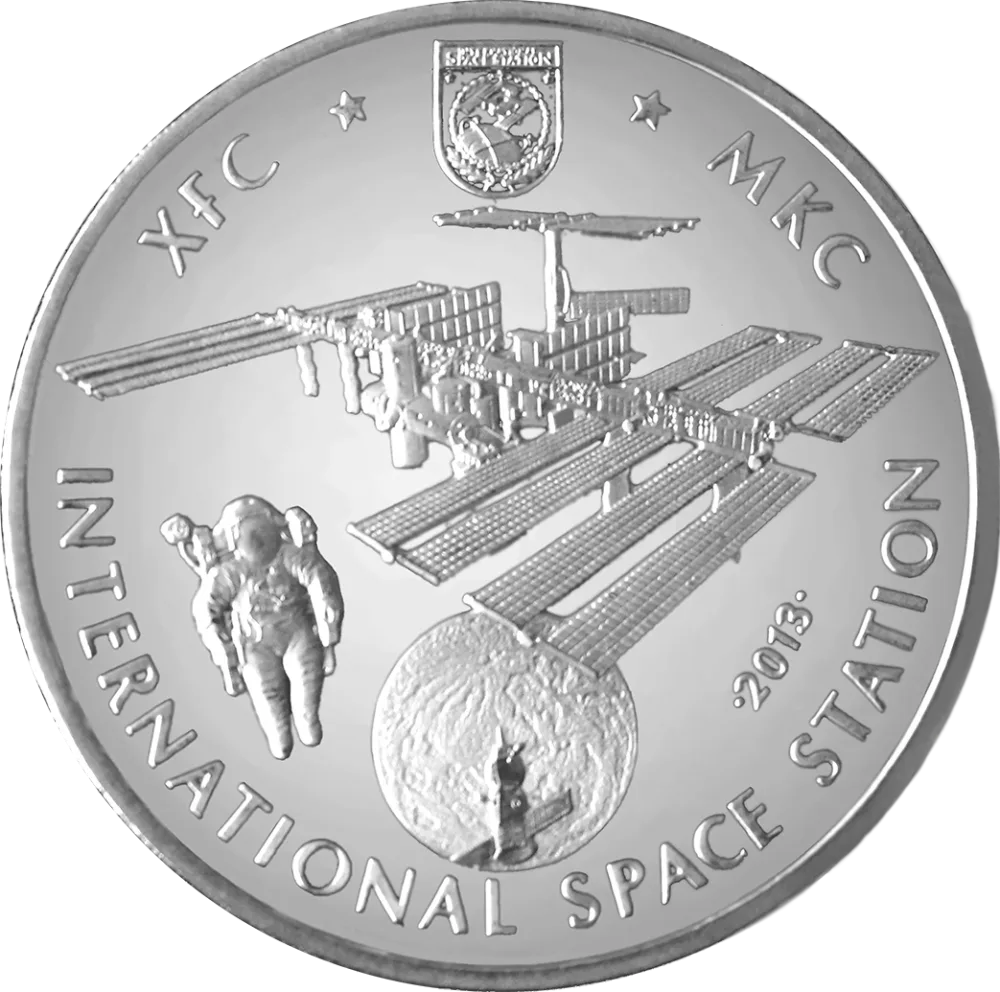
The central field of the artistic side is made of blue tantalum and framed by a silver ring. The blue background shows the ISS in perspective: the truss with solar arrays and the modules. In the lower left, a cosmonaut in a spacesuit is working in open space, and in the lower part, a stylized fragment of the Earth with the outlines of continents is visible. This gives the composition depth and scale.
The silver ring features inscriptions: "ХҒС" — the Kazakh abbreviation for the station — at the top left, "МКС" — the Russian abbreviation — at the right, "INTERNATIONAL SPACE STATION" along the arc at the bottom, and the year "2013" to the right of the station. Two five-pointed stars on the ring and a small symbol at the top complete the design. The combination of silver and dark blue tantalum makes the coin one of the most expressive in the thematic series.