
Space (nickel silver)
PDFGeneral information


Description
The 50 tenge coin "Space" is part of the space theme of collector issues by the National Bank of the Republic of Kazakhstan. In 2006, the National Bank of Kazakhstan launched a thematic series of coins dedicated to space exploration, with the "Space" coin being the first to be released. Unlike subsequent issues dedicated to specific spacecraft and missions, it sets the overall theme: humanity, the Solar System, and the journey beyond. For Kazakhstan, the theme of space is not abstract. Located on its land, in the steppe near Tyur-Tam, is the Baikonur Cosmodrome, from which the world's first artificial Earth satellite was launched into flight on October 4, 1957, and Yuri Gagarin blasted off on April 12, 1961. It is from here that heavy Proton, Soyuz, and Zenit rockets are launched, and since 1994 the site has been leased by Russia.
The year of the coin's issue coincided with a significant event for the republic itself: on June 18, 2006, Kazakhstan's first communications satellite, KazSat-1, was launched into orbit from Baikonur by a Proton-K rocket. The country, on whose territory the spaceport had been operating for half a century, acquired its own spacecraft in geostationary orbit, and the space-themed coin became a natural occasion to recall this journey. The theme of planets and stars is also close to Kazakh culture: steppe nomads navigated by the sky for centuries, and the word "ғарыш" ("space") is included in the coin's name in the state language.
Obverse
The official side of the coin bears the state designations. The inscriptions run along the circumference: "ҚАЗАҚСТАН РЕСПУБЛИКАСЫ" in the Kazakh language at the top, and "REPUBLIC OF KAZAKHSTAN" in English at the bottom. To the right of the center is the face value: the digit "50" and beneath it the word "ТЕҢГЕ" — fifty tenge. The central field continues the space theme: a vertical line divides it into two parts; one side shows a starry sky with orbits and stars, while the other features the full-length silhouette of a person against the background of a spiral galaxy, with small dots scattered in the upper part. This composition is uniform for all coins in the series, making it easy to recognize the issue and distinguish it from standard circulation coins.
The uniformity of the design on the official side emphasizes that we are looking at parts of a common thematic project: the design on the artistic side changes, while the state portion remains recognizable. The strict arc arrangement of the inscriptions and the clear relief of the digits ensure the legibility of the face value, while the mint mark indicates the place of coining. The contrast between the smooth field and the relief elements preserves the expressiveness of the composition under any lighting. This side serves simultaneously as the coin's document and part of its design, which is why it is just as important in a collection as the artistic side.
Reverse
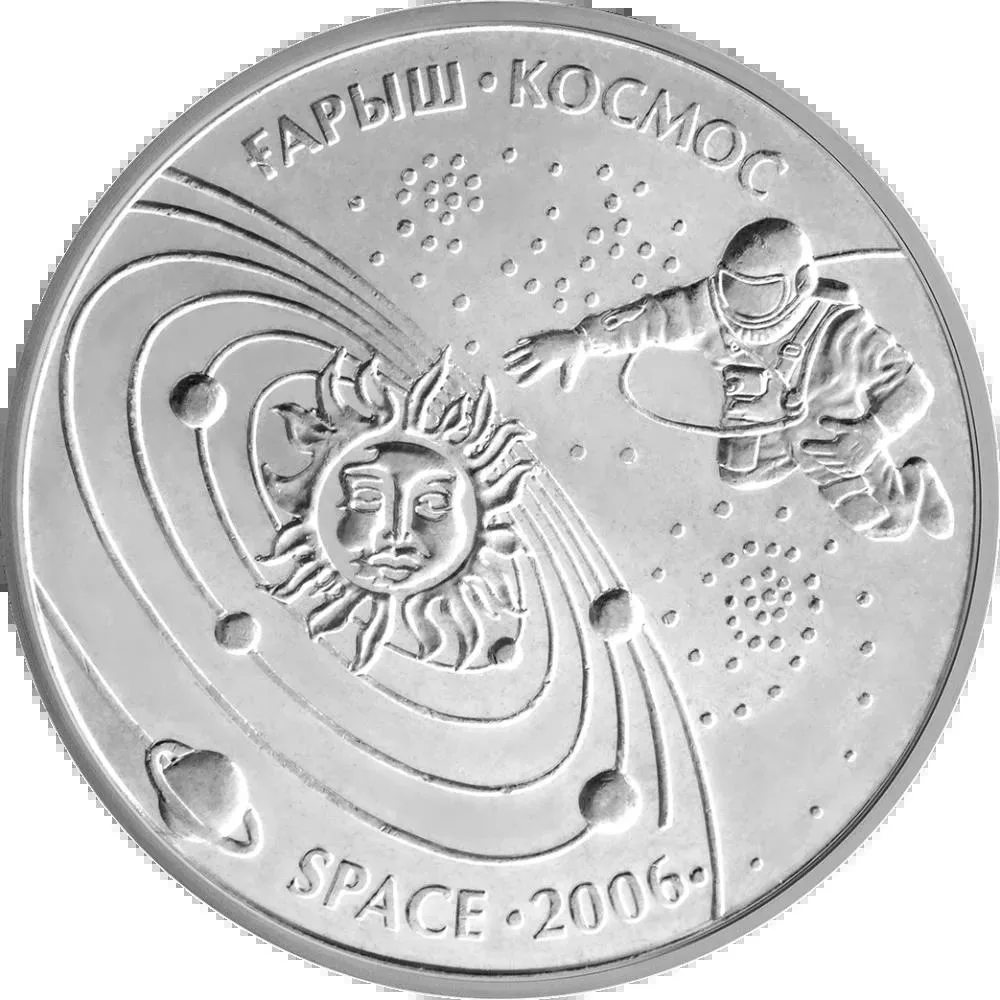
The artistic side depicts the Solar System in a simplified, almost symbolic form. The Sun is located in the center, rendered with a face reminiscent of children's drawings and old engravings, and planets move around it along thin arcs. On the right, against a dark matte field, a cosmonaut in a spacesuit floats, with part of the figure extending beyond its boundary onto the light ring. This technique creates a sensation of weightlessness: the person appears to drift outward from the drawing.
The dark oxidized field is dotted with groups of points representing star clusters, and thin arcs of orbits run along the coin's light rim. Inscriptions are placed along the circumference: "ҒАРЫШ • КОСМОС" in Kazakh and Russian at the top, and "SPACE • 2006" in English at the bottom. Three languages emphasize that space is a common endeavor rather than the exclusive domain of a single country. The matte dark center contrasts well with the glossy relief of the planets and the cosmonaut figure, ensuring the design remains legible even across a small diameter.