
Space Station Mir (cupronickel)
PDFGeneral information


Description
The 50 tenge coin "Space Station Mir" is part of the space-themed collector issues of the National Bank of the Republic of Kazakhstan. The "Space Station Mir" coin commemorates the world's first long-term modular orbital station. The station's core module was launched into orbit on February 20, 1986, by a Proton rocket from Baikonur, after which scientific modules were successively docked to it. Mir operated in orbit for about fifteen years and hosted more than a hundred cosmonauts and astronauts from various countries. A record for the longest single flight was set on the station: physician Valeri Polyakov spent 437 days in space from 1994 to 1995.
In the mid-1990s, Mir became a platform for international cooperation: under the Shuttle-Mir program, American reusable spacecraft docked with the station multiple times, and NASA astronauts worked as crew members. The operating experience of Mir formed the basis for the International Space Station. On March 23, 2001, the station was intentionally deorbited and sunk in the southern Pacific Ocean. The 2012 issue recalls this stage of space exploration history; citizens of Kazakhstan also traveled aboard Mir.
Obverse
The official side of the coin bears the state designations. Inscriptions are placed along the circumference: at the top, "ҚАЗАҚСТАН РЕСПУБЛИКАСЫ" in Kazakh, and at the bottom, "REPUBLIC OF KAZAKHSTAN" in English. To the right of the center is the face value: the numeral "50" and below it the word "ТЕҢГЕ" — fifty tenge. The central field continues the space theme: a vertical line divides it into two parts; one side shows a starry sky with orbits and stars, while the other features the full-length silhouette of a person against the background of a spiral galaxy, with small dots scattered in the upper part. This composition is uniform for all coins in the series, making the issue instantly recognizable and distinguishing it from standard circulation coins.
The uniformity of the design on the official side emphasizes that these are parts of a general thematic project: the design on the artistic side changes, while the state portion remains recognizable. The strict arc-like arrangement of the inscriptions and the clear relief of the numerals ensure the legibility of the face value, while the mint mark indicates the place of minting. The contrast between the smooth field and the relief elements maintains the expressiveness of the composition under any lighting. This side serves simultaneously as the coin's identification document and part of its design, which is why it is just as important in a collection as the artistic side.
Reverse
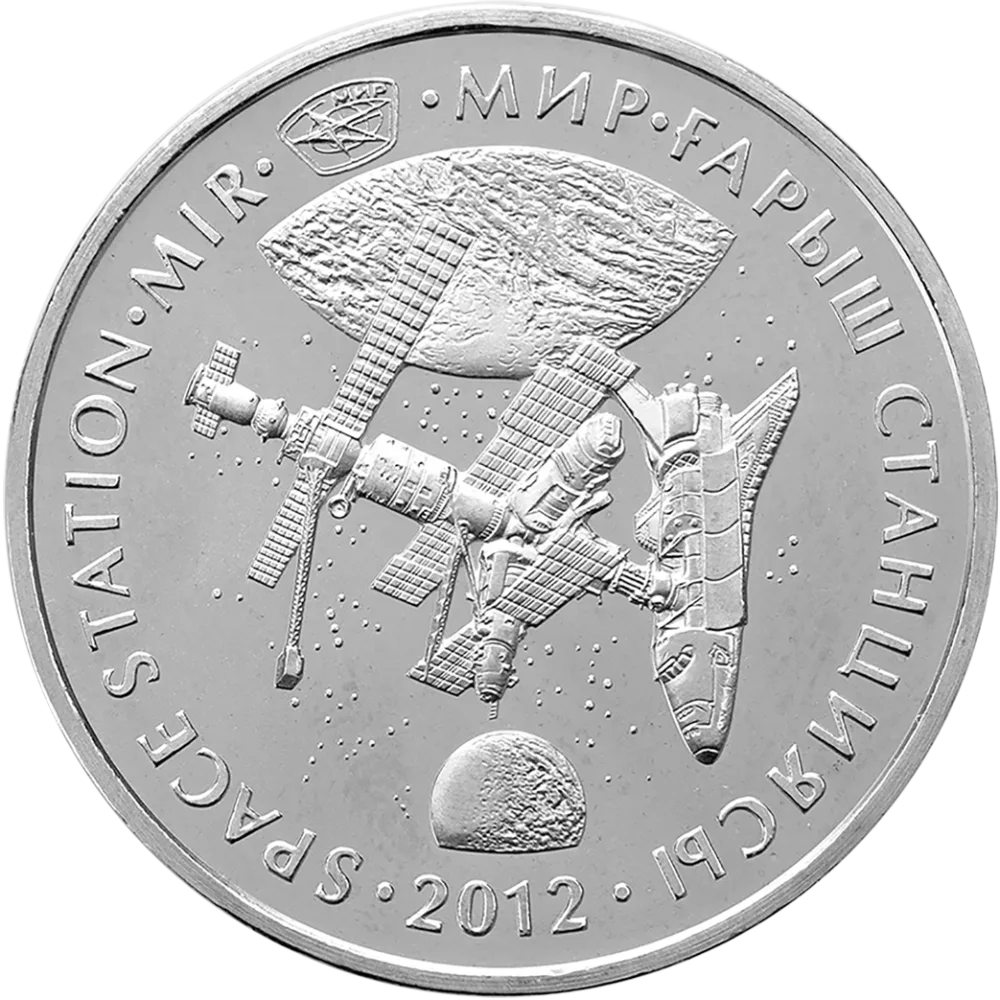
The artistic side depicts the Mir orbital station with a Space Shuttle-type spacecraft docked to it — this is how dockings looked within the framework of the American-Russian program. The background features a large planet disk with relief in the upper part, a second, smaller planet in the lower left corner, and a scatter of dots simulating stars. A round logo of the station with its name is placed in the upper part of the composition.
The inscriptions run along the circumference: "SPACE STATION • MIR • 2012" in English and "МИР • ҒАРЫШ СТАНЦИЯСЫ" in Kazakh. The detailed rendering of the modules and solar panels allows for the recognition of the station's characteristic T-shaped silhouette. The two-tone execution — a light ring and a dark center — highlights the spacecraft against the backdrop of outer space.