
The Sun God. Tamgalytas
PDFGeneral information


Description
The coin is dedicated to one of the best-known images of Kazakh rock art: the solar deity of the Tamgaly site. Tamgaly lies at the southern end of the Chu-Ili Mountains in the Almaty region and has long been called an open-air stone gallery. Thousands of images are pecked into its dark rock slabs and boulders — hunting scenes, ritual processions, sacred animals and clan signs. In 2004 the Tamgaly landscape was inscribed on the UNESCO World Heritage List, confirming its worldwide significance.
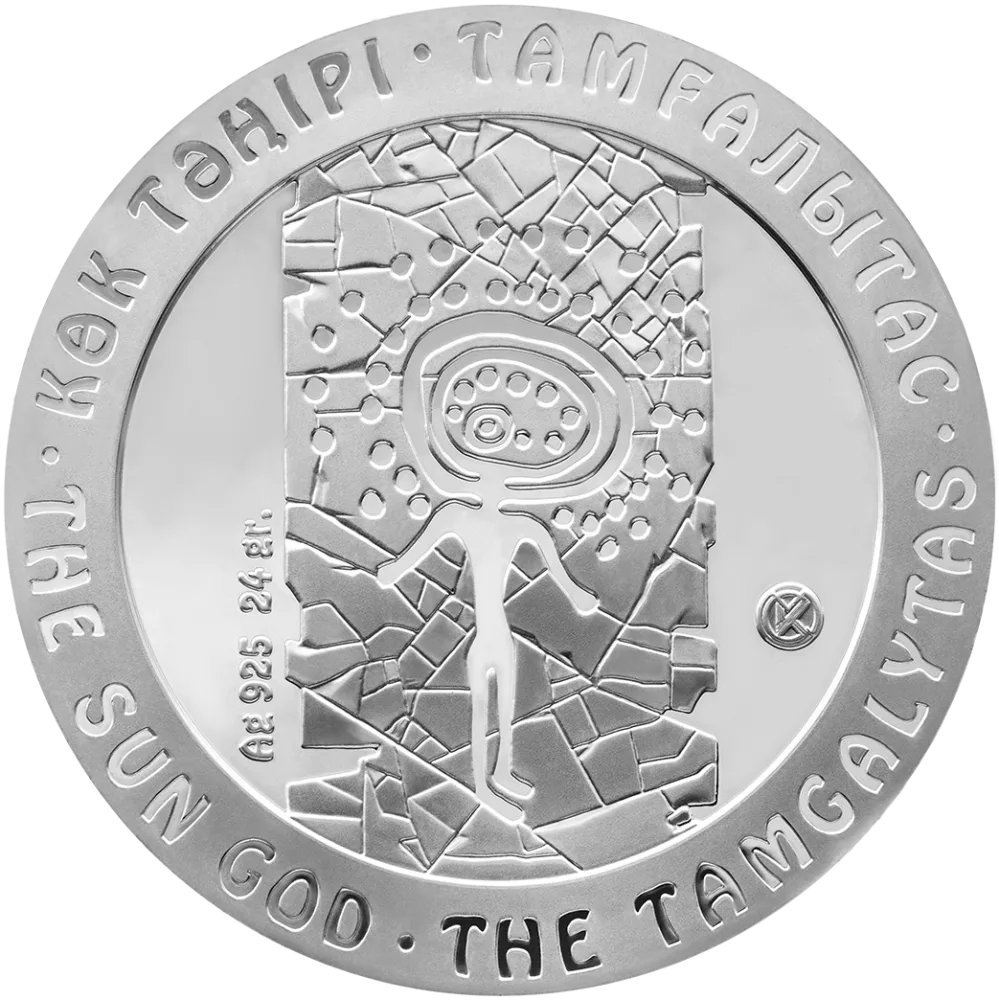
The central figure is an anthropomorphic being with a round, sun-like head surrounded by concentric circles and small hollows, its arms and legs spread wide. Scholars read such sun-headed figures as the supreme sky deity; in the Kazakh tradition he is linked with Kök Täñiri, or Tengri, the lord of heaven worshipped by the nomadic herders of the steppe. The drawing is attributed to the Bronze Age, the second half of the second millennium BC, so it is more than three and a half thousand years old. The contour pecked stone against stone has hardly faded: the dark crust that formed on the rock over the centuries makes a natural backdrop against which the pale hollows can still be read today.
According to tradition and to scientific observation, Tamgaly was not merely a scatter of drawings but a sanctuary. Sacrificial platforms and ancient burials survive beside the petroglyphs, and the solar figures were placed so that participants in rituals could see them. People asked the sky here for rain, for the fertility of their herds and for the well-being of the clan, and the image of the sun-headed god stood at the centre of these beliefs. The discovery of the gallery in the middle of the twentieth century and decades of study since have made Tamgaly one of the calling cards of Kazakhstan.
The 2000 coin belongs to the National Bank programme Petroglyphs of Kazakhstan. Each coin reproduces one specific rock image and names the place where it was found. In this way the memory of the world view of people who lived on this land four thousand years ago was carried onto a collector coin, and the solar deity became its first hero.
Obverse
The artistic side reproduces the petroglyph against a stylised stone slab: a human-like figure with a round solar head ringed by concentric circles and hollows, with arms and legs spread wide. A raised broad rim, styled as fragments of stone slabs, carries recessed inscriptions in Kazakh and in English naming the Sun God and Tamgalytas. On the left are the marks of the metal, and on the right the trademark of the Kazakhstan Mint.
Reverse
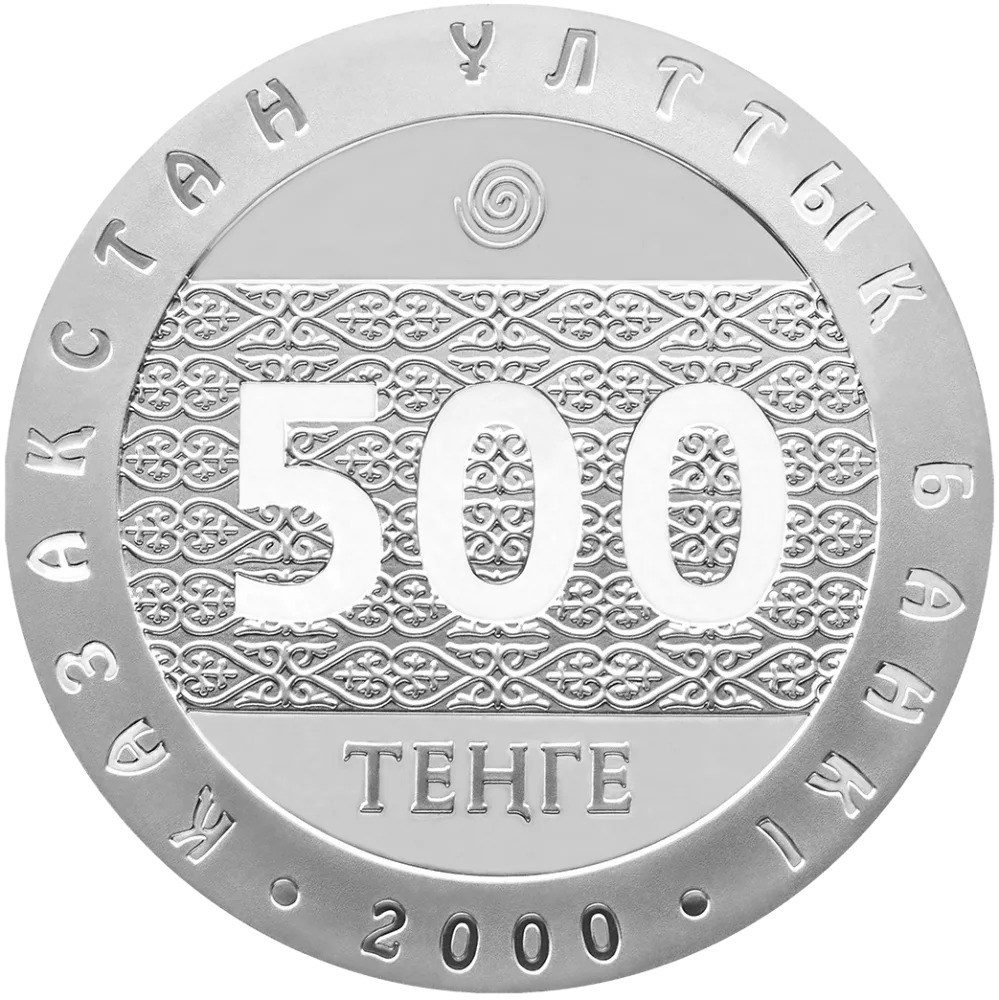
The official side shows elements of national ornament with a heraldic spiral above them. A broad rim carries the recessed inscription of the National Bank of Kazakhstan in the state language and the year 2000. Thus the oldest image of the steppe sky becomes part of modern numismatics: the austere graphics of the rock drawing are kept, and the inscriptions on the rim tie it to the place where it was found. The coin reads as a short tale of what the people of the Bronze Age believed.