
Vostok Spacecraft (tantalum)
PDFGeneral information


Description
The silver 500 tenge coin Vostok Spacecraft (tantalum) is part of the space-themed collector issues of the National Bank of the Republic of Kazakhstan. The Vostok coin is dedicated to the spacecraft that carried the first human into space. Vostok-1 launched from Baikonur on April 12, 1961, with pilot Yuri Alekseyevich Gagarin on board. The flight lasted 108 minutes: the spacecraft completed one orbit around the Earth, after which the descent module entered the atmosphere. At an altitude of about seven kilometers, the cosmonaut ejected and landed by parachute near the village of Smelovka in the Saratov Region, while the spherical capsule descended separately.
The Vostok spacecraft was developed in the design bureau of Sergey Korolev. It consisted of a spherical descent module about 2.3 meters in diameter and an instrument compartment containing the braking propulsion system. The flight was fully automatic: control was in the hands of ground services, and the cosmonaut was given a sealed code in case manual mode became necessary. The TASS report on the first manned space flight spread around the world in a matter of minutes and became a turning point of the 20th century. The 2008 anniversary issue reminds us that the launching pad for this event was the Kazakhstan steppe.
Obverse
The official side of the coin bears the state designations. Inscriptions are located along the circumference: at the top, "ҚАЗАҚСТАН РЕСПУБЛИКАСЫ" in the Kazakh language; at the bottom, "REPUBLIC OF KAZAKHSTAN" in English. To the right of the center, the face value is indicated: the number "500" and below it the word "ТЕҢГЕ" — five hundred tenge. Below the face value, in small print, are the designations of the metals and the weight of each — 925 fineness silver and tantalum — thus indicating the bimetallic composition of the coin on the coin itself. Next to the technical data is the trademark of the Kazakhstan Mint. The central field continues the space theme: a vertical line divides it into two parts; on one side, a starry sky with orbits and stars is shown, and on the other, the full-length silhouette of a person against the background of a spiral galaxy, with small dots scattered in the upper part. This composition is unified for all coins in the series, making it easy to recognize the issue and distinguish it from standard circulation coins.
The uniformity of the official side's design emphasizes that these are parts of a common thematic project: the drawing on the artistic side changes, while the state side remains recognizable. The strict arrangement of the inscriptions along the arc and the clear relief of the numbers ensure the legibility of the face value, and the mint mark indicates the place of minting. The contrast between the smooth field and the relief elements maintains the expressiveness of the composition under any lighting. This side serves simultaneously as the coin's document and part of its design, which is why it is just as important in a collection as the artistic side.
Reverse
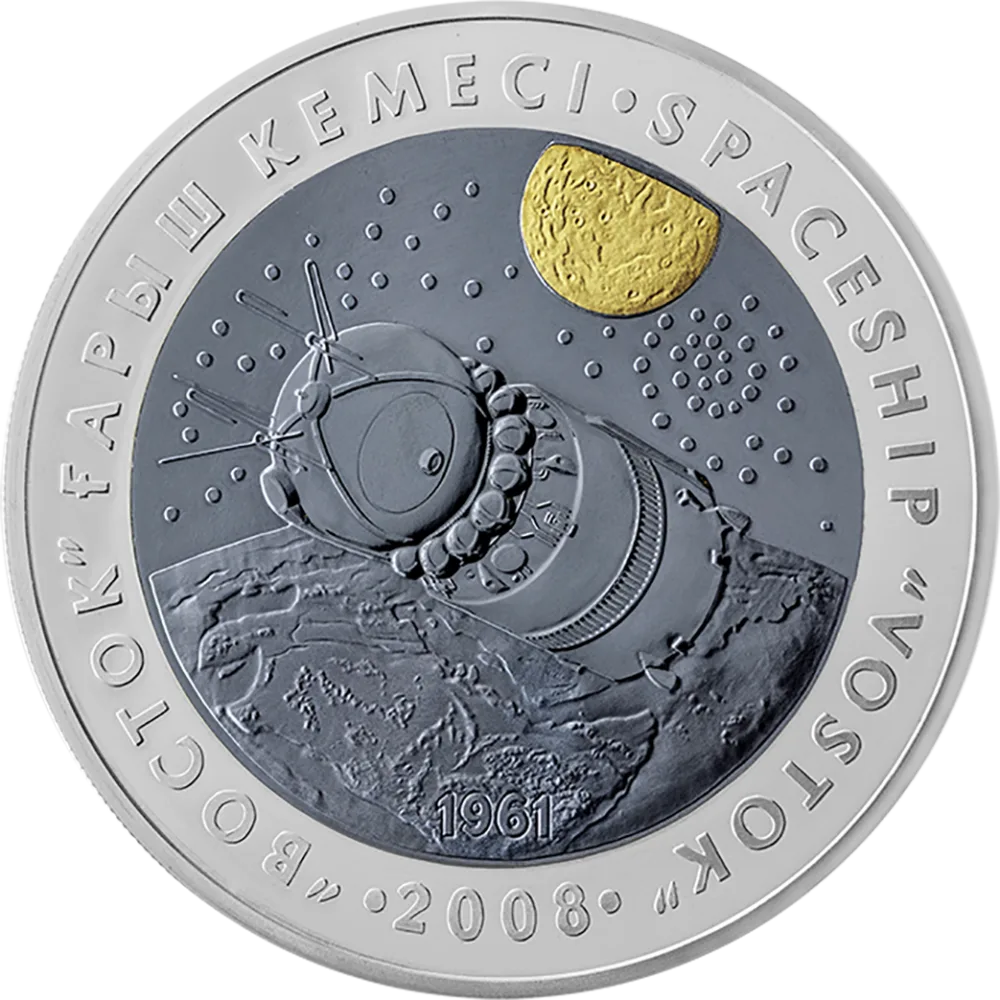
The artistic side depicts the Vostok spacecraft in flight above the surface of a celestial body. The hull is shown with antennas and portholes, a rocky relief with craters is visible at the bottom, and in the upper part of the field, the round disc of the Moon shines, executed with gilding, making it a prominent accent of the composition. The background is filled with dots of stars.
Inscriptions run along the circumference: "ҒАРЫШ КЕМЕСІ • SPACESHIP" at the top and "ВОСТОК • VOSTOK • 2008" at the bottom. Below the spacecraft is the number "1961" — the year of the first manned flight. The combination of the Kazakh, Russian, and English languages demonstrates the international significance of the event, and the detailed elaboration of the spacecraft's features allows one to examine the shape of the apparatus as it was known from photographs of museum exhibits.