
The Cave Lion
PDFGeneral information



Description
The image of the lion has existed in human culture since deep antiquity, from cave paintings to coats of arms and state emblems, and the cave lion is one of its first heroes. It symbolises courage, strength and the primeval power of nature. On the coin this symbol appears not as a heraldic figure but as a living animal in its natural setting, which lets us see in it not only a legend but a real inhabitant of a vanished world.
The disappearance of the cave lion is linked to climate change at the end of the last Ice Age and to the shrinking herds of large herbivores on which it fed. The species died out roughly thirteen thousand years ago, leaving only bones, skulls and rare finds in permafrost, including frozen cubs from Yakutia. These discoveries let scientists study the animal's appearance and habits, and allow artists to reconstruct its look with a fidelity that most extinct animals do not enjoy.
The cave lion (Panthera spelaea) was one of the most formidable predators of the Ice Age. It lived across vast areas from Western Europe to Asia and reached north-eastern Eurasia, and it was noticeably larger than today's African lions. It hunted large herbivores such as deer, wild horses and bison, and stood at the top of the food chain of the steppes and forest-steppes of its day. The coin takes us back to an age when giants roamed icy plains and humans were only beginning to settle these harsh lands.
The people of the Ice Age knew the cave lion well and left its image in their art. Among the cave paintings of Chauvet in France there are depictions of lions, and from Germany comes the famous mammoth-ivory figurine of the lion-man, one of the oldest known works of art, joining a human and a big cat. For ancient hunters the lion was at once a dangerous rival and a symbol of strength, and the memory of that admiration and fear survives in painted stone across thousands of years.
The release belongs to the Megafauna series by Germania Mint, issued on behalf of the Republic of Liberia. The series tells of the giants of the prehistoric world that lived on Earth in the age of glaciers, and each coin presents a separate species. The cave lion design is the work of the artist Kinga Sabatowicz. Her work combines scientific plausibility and expressiveness: the musculature, jaws and claws are shown so that the predator seems ready to leap straight off the surface of the coin.
The special value of the cave lion image is that it links us to a real world that existed not in fairy tales but on our own planet. From bones and finds, scientists reconstruct how the animal looked, what it ate and how it hunted, probably in prides like modern lions, although this is not certain. Each new discovery changes ideas about the extinct predator, and a coin bearing its portrait becomes not only an ornament of a collection but a reminder of how much remains to be learned about prehistoric nature.
Obverse
The cave lion is presented in full readiness against a backdrop of mountains and ancient forests. The powerful body, sharp fangs and claws convey the strength and superiority of the predator, and its pose suggests it is about to attack.
Reverse
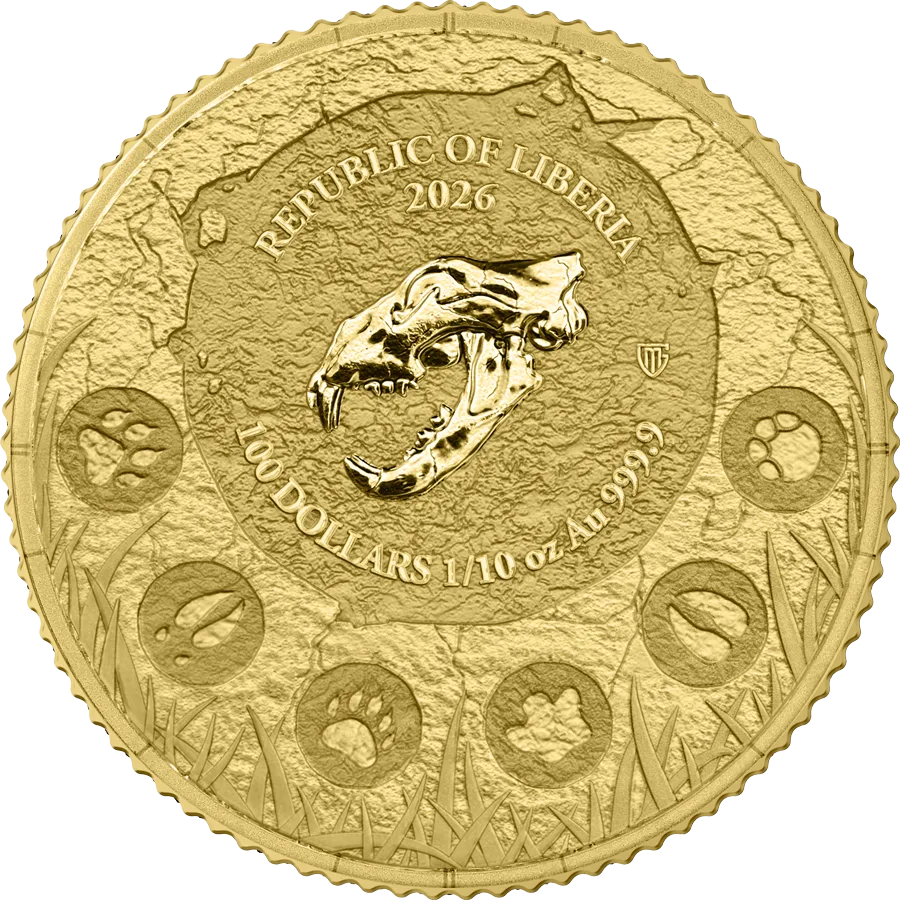
The official side shows a lion skull and a paw print, surrounded by the tracks of other prehistoric animals to which later coins of the series are devoted. The emblem of the Republic of Liberia and the Germania Mint mark confirm the authenticity of the coin.