
Beemster Polder (5 euro, silver proof)
PDFGeneral information
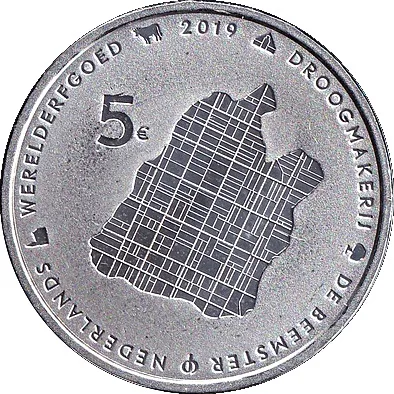
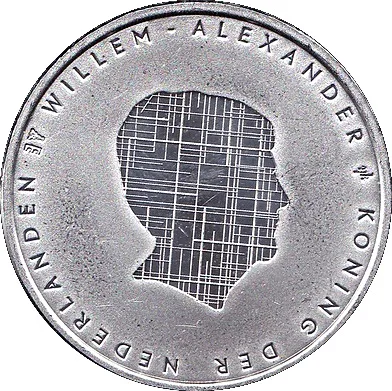

Description
The Beemster is a polder north of Amsterdam, the first in the Netherlands to be reclaimed not from the sea but from a lake. Around the year 800 the area was covered in peat, and the name comes from “Bamestra”, a small river that between 1150 and 1250, through peat-digging and storm floods, grew into an inland sea connected with the Zuiderzee. By the seventeenth century Lake Beemster threatened the surrounding towns while the Dutch were short of arable land, and in 1607 the States of Holland and West Friesland gave permission to drain it to several Amsterdam burgomasters and wealthy merchants, among them Willem Usselincx, Jacob Poppen and Dirck van Os. The money came from investors: the project was commercial.
The work went like this. A ring dike was built around the lake, a ring canal — the Beemsterringvaart — was dug along its outer edge, and then the lake was pumped out by windmills. Adviser and supervisor of the mill building was a carpenter and millwright from De Rijp, Jan Adriaanszoon Leeghwater; the Dutch Wikipedia points out that to regard him as the leader of the whole project is a common misconception. In early 1610 the work was almost finished, but on 23 January the Waterland sea dike broke and the lake filled again. It was then decided to make the ring dike a metre higher than the surrounding land. On 19 May 1612 the polder finally ran dry: there were 43 mills on it then, and in the end fifty were needed.
What makes the Beemster a UNESCO site above all is its plan. The land was laid out in a strict geometric scheme built on squares, following the principles of classicism and the Renaissance: the basis is oblong lots, five of which make up a square module, and four modules form a larger square. Roads and canals run north–south and east–west, houses stand along the roads, and the direction of the squares was chosen to match the shoreline of the former lake so as to leave no unusable plots. Avenues of trees were planted beside the roads. Typical of the land are the “stolp” farms with pyramid-shaped roofs, and their square base repeats the geometry of the polder itself. The land proved so fertile that the project paid for itself: the investors, according to the Dutch Wikipedia, got their money back in about a year.
For three hundred years fifty windmills kept the polder dry; at the end of the nineteenth century they were replaced by three steam pumping stations and the mills disappeared, and in the twentieth century two electric stations took over. The settlements of the polder — Middenbeemster, Noordbeemster, Westbeemster and Zuidoostbeemster — gave the world the painters of the Fabritius family: Carel Fabritius, a pupil of Rembrandt, was born in Middenbeemster. Today the Beemster is also known for cheese sold under its name. Curiously, the polder holds five forts of the Defence Line of Amsterdam, so two UNESCO sites are combined here: between the forts at Nekkerweg and Middenweg there is a sluice by which part of the polder can be inundated, which was done twice, in 1940 and 1944.
In 1999, at the 23rd session of the Committee, the Beemster was inscribed on the World Heritage List under criteria (i), (ii) and (iv). UNESCO calls it a masterpiece of creative planning in which the ideals of antiquity and the Renaissance were applied to a reclaimed landscape, and stresses that it had a profound influence on reclamation projects in Europe and beyond. The Beemster is a visible lesson that the Dutch landscape is conceived and drawn: people still live and work here below sea level, and order is given to the fields by dikes, canals and regular squares.
The silver proof reveals Korfmann’s idea better than the basic coin. The design is built on borders and lines, and the mirror field makes the hollows — the “depth” of the lake — noticeable: the shiny field reads as water and the matte relief of the grid of fields as land, and the king’s profile lies exactly on the boundary between them. The fine lines of the plot boundaries separate from the background on the proof and read as an engraved grid. This is a coin one wants to look at from an angle: as light slides across the mirror the polder is by turns filled with water and dry. It suits both those who value the history of the subject and those who care about the engraver’s precision of line.
Obverse
The story side shows the polder itself as a drawing. The shape of the Beemster — the irregular oval of the former lake with an even grid of plots, roads and canals inside it — reads as a schematic map, and its outline is the main image. Portrait, landscape, icons and letters lie deeper than the field — the artist’s own site says so: the area of the former lake goes into the coin. The inscription “DROOGMAKERIJ DE BEEMSTER NEDERLANDS WERELDERFGOED 2019” (“Reclaimed land Beemster, Dutch World Heritage, 2019”) and the value “5 €” were set together with the typographer Céline Hurka, with whom the artist worked. All the lines are the borders and lines that define the landscape: the design is more a plan than a view.
Reverse
The official side bears the profile of King Willem-Alexander facing right — an abstract but recognisable silhouette. Inside it show the same lines and borders of the Beemster landscape as on the story side, so that portrait and landscape merge into a single picture. Korfmann deliberately “deepened” the whole image — portrait, landscape, icons and letters lie below the general level of the field, as the former Lake Beemster lay below the surrounding old land. On the 2018 Schokland coin it was exactly the other way round, since the island stood above the Zuiderzee, and the lines around the king’s portrait there continue on the Beemster portrait if one coin is laid exactly over the other. Around runs the legend “WILLEM-ALEXANDER KONING DER NEDERLANDEN” (“Willem-Alexander, King of the Netherlands”), and on the edge the motto “GOD * ZIJ * MET * ONS *” (“God be with us”).