
Defence Line of Amsterdam (5 euro)
PDFGeneral information

Description
The Stelling van Amsterdam, or Defence Line of Amsterdam, is a ring of fortifications about 135 kilometres long that runs 15–20 kilometres from the centre of the capital. It comprises 45 forts, together with dikes, sluices, pumping stations, batteries and casemates. It was built between 1880 and 1920. It was conceived not as a chain of impregnable fortresses but as a water barrier, closed by forts at those places where dikes, roads and railways crossed the water.
The idea rested on an old Dutch habit of fighting with water. As early as 1629 an inundation around Amsterdam was prepared against an expected attack from the south; in 1672, the “Disaster Year”, water lines halted an invasion; and in 1787 the polders around the city were flooded by the Patriots. The engineer Cornelis Krayenhoff took part in all the defence plans for Amsterdam from 1787 onward: his “Posts of Krayenhoff”, built in 1809–1810 some 8–12 kilometres from the city, were the direct predecessors of the line. By the 1870s they were no longer adequate, and a law of 1874, passed soon after German unification, opened the way to the new Stelling.
The principle was simple: in wartime the lowlands around the city were flooded to a depth of about thirty centimetres — too little for boats and too much for infantry and cavalry. Buildings within a kilometre of the line could only be made of wood, so that they could quickly be burned and the field of fire cleared. Where the ground stayed dry — on dikes, roads and railway embankments — stood forts that were to shell the enemy. Inside the ring lay a “national redoubt”: this was where the army, the government and the king were to withdraw if the country was attacked, and its stores of food, water and fuel were meant to last a six-month siege.
Construction began with setbacks. The first fort, Fort bij Abcoude, was begun in 1883 still in brick and earth, but it was out of date by the time it was finished: high-explosive shells had appeared and brickwork was easy to shatter. Builders had to switch to concrete, and the Dutch had no experience of it, so concrete structures were first shelled with the heaviest guns of the day. Another delay came from the soil: many forts stand on peat, which was dug out and replaced with sand, and the sand embankments had to settle for several years before building could start. Real construction got under way only from 1897. A standard fort is a long concrete building surrounded by a moat, with casemates and two armoured gun turrets that could be raised; about three hundred men served in each.
The Stelling never saw combat. It was mobilised in the First World War, and in 1922 it became part of Fortress Holland. The aeroplane made it obsolete even before it was finished; in May 1940 the Germans took the country in a matter of days and never reached the line itself. Its military status was lifted only in 1963, after which the forts served as storehouses, and later museums and art centres moved in. Today it is one of the best-known Dutch combinations of water, military engineering and landscape.
In 1996, at the 20th session of the World Heritage Committee, the Defence Line of Amsterdam was inscribed on the UNESCO list under criteria (ii), (iv) and (v). In 2021 the New Dutch Waterline was added to it, and the combined site is now called the Dutch Water Defence Lines. UNESCO notes that the forts of the line stand at a turning point in military architecture: they move away from the masonry casemated forts of the Montalembert tradition towards the steel and concrete structures that were later brought to perfection in the Maginot Line and the Atlantic Wall. The 2017 coin is devoted to this Amsterdam ring, and in 2025 a coin showed the whole system together.
This is the most widely distributed version of the issue — a coin for those who collect the “Netherlands World Heritage” coins one piece per year. It belongs to a line that began in 2012 with the Amsterdam Canal Ring, and in that chain the Stelling is the only site about war rather than a house, a windmill or a factory, so on a shelf it stands out at once. The design works well on the basic coin because it does not try to show a “pretty view”: the main effect comes from the text rings of fort names, which on a small disc read as a pattern and, on a closer look, as a list. Silver-plated copper gives a light, even field against which the concrete relief of the tower and the small lettering look sharp. Two finishes were offered — ordinary UNC and a more carefully made BU; the design is identical and the difference lies in the quality of the surface. Collectors like this coin for its unusual subject and for the fact that the king’s portrait is handled more boldly here than on many neighbouring issues.
Obverse
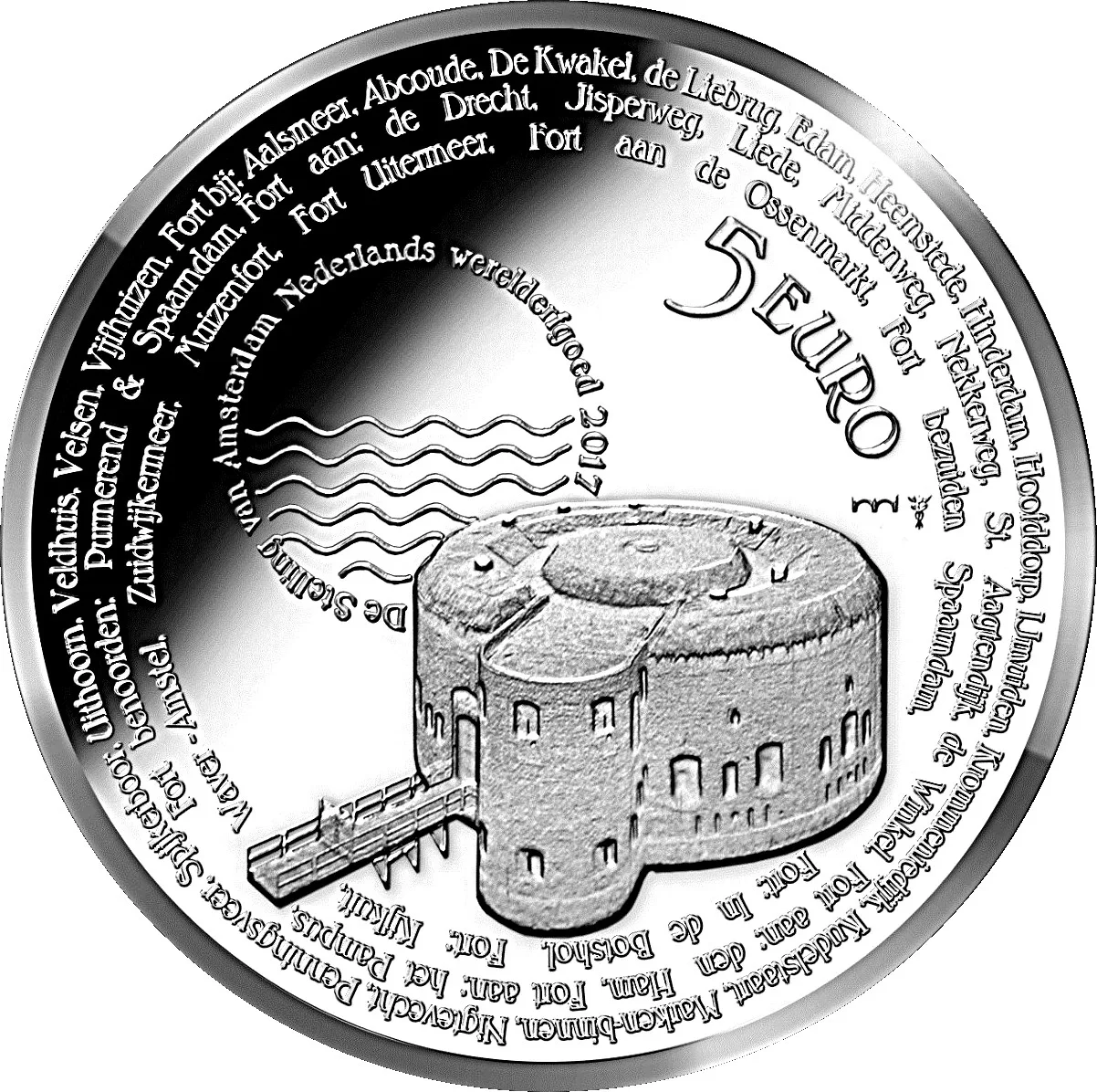
The story side is given over to the Fort aan de Ossenmarkt, a tower fort in Weesp that formed one of the eastern links of the ring. Its image fills the centre, and around it, in three rings, run the names of the forts and batteries of the line: Fort bij Aalsmeer, Abcoude, Edam, Heemstede, IJmuiden, Hoofddorp, Uithoorn, Veldhuis, Vijfhuizen and dozens of others, including the Muizenfort, Fort Kijkuit and Fort aan het Pampus. The result is a kind of map-cum-roll-call: the list of forts is itself the ornament that frames the picture. Below runs the inscription “De Stelling van Amsterdam Nederlands werelderfgoed 2017” (“The Defence Line of Amsterdam, Dutch World Heritage, 2017”) and the value “5 EURO”. On the right are the denomination mark, a water symbol alluding to the principle of inundation, and the privy mark and mint mark.
Reverse
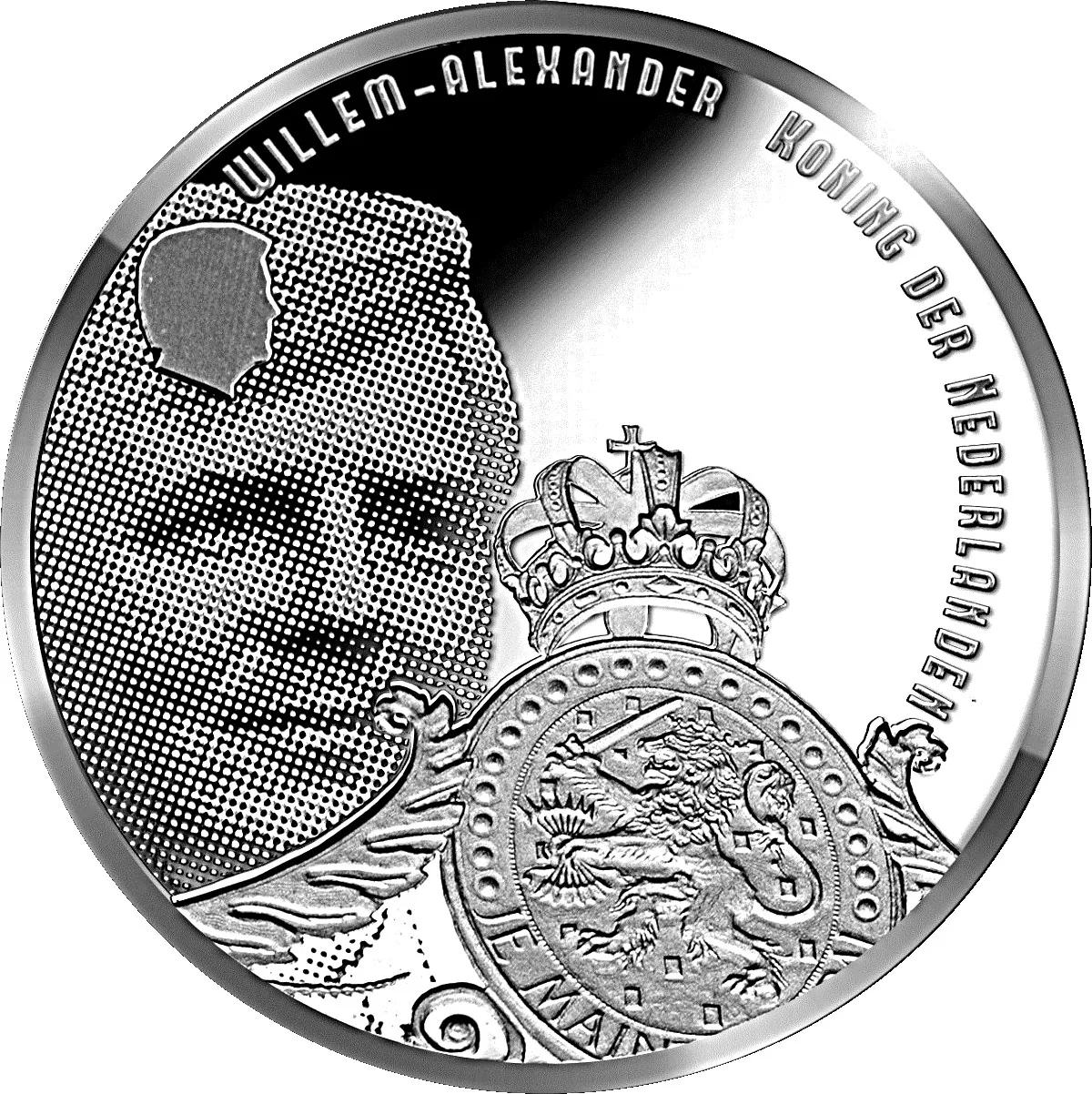
The official side is a portrait of King Willem-Alexander in three-quarter view facing right. The composition is dynamic, which is unusual for coins bearing a monarch’s portrait: the king’s face is partly overlaid by the crowned coat of arms of the Kingdom, and beside it runs the silhouette of the king himself. In this way the coin conveys the idea of “defence”: the coat of arms as a shield, and the silhouette as the trace of the person who stands behind it. Around the edge runs the legend “WILLEM-ALEXANDER KONING DER NEDERLANDEN” (“Willem-Alexander, King of the Netherlands”). The edge carries the motto “GOD * ZIJ * MET * ONS *” (“God be with us”). The design is by Kianoosh Motallebi.