
Eise Eisinga Planetarium (10 euro, gold)
PDFGeneral information
Description
The Eise Eisinga Planetarium in Franeker is the oldest working planetarium in the world. It was built between 1774 and 1781 in his own living room by a simple wool carder, Eise Eisinga. Born on 21 February 1744 in the Frisian village of Dronrijp, the son of a craftsman, he was drawn to mathematics and astronomy from boyhood and from the age of fifteen walked to Franeker every week for extra lessons. Later he settled there himself, married and became a wool carder, devoting all his free time to the sky.
The occasion for the project was a general scare. In 1774 rumours of the imminent end of the world spread through Friesland: in May several heavenly bodies were due to come very close together in the sky, and pamphlets linked this with a collision of the planets. Eisinga was not a professional scientist but he could calculate: he made his computations and satisfied himself that no catastrophe would happen. To show everyone plainly, he decided to build a working model of the solar system, so that anybody could see how the planets really move. He put the model on the ceiling of the living room: the Sun in the centre, the planets known at that time on circles around it, and on the ceiling and wall dials showing the positions of the heavenly bodies, the phases of the Moon and the dates of eclipses.
The chief marvel of the planetarium is its mechanism. The whole cosmos spread across the ceiling is driven by a single pendulum clock, chosen together with a Frisian clockmaker; Eisinga’s father and brother worked on the project with him. Distances and sizes of the planets are reduced a trillion-fold, and the speeds are set so that the planets go round the Sun in the exact proportion of their real orbital periods. The work took seven years and was finished in 1781 — the year that appears on the coin. Since then the intricate mechanism has run almost without interruption for two and a half centuries, and the room with the planetarium is still a working museum today, with Eisinga one of the best-known Frisians.
In 2023 the Eise Eisinga Planetarium was inscribed on the UNESCO World Heritage List, and it is to this site that the latest coin in the “Netherlands World Heritage” series is devoted. The series has been issued since 2012: each 5-euro coin tells of one site from the UNESCO list — from the Amsterdam Canal Ring, the Rietveld Schröder House and the Kinderdijk windmills to the Wadden Sea, the polders, colonial Willemstad and the Dutch Water Defence Lines. The 2026 issue is the twelfth coin of the series; its design was created by Armand Mevis, and it was issued on behalf of the Dutch Ministry of Finance by the Royal Dutch Mint in Utrecht. The Eisinga five-euro piece is a coin that tells a story: it shows at once an eighteenth-century living room with a ceiling-universe and the modern view of space — a black hole and the Milky Way.
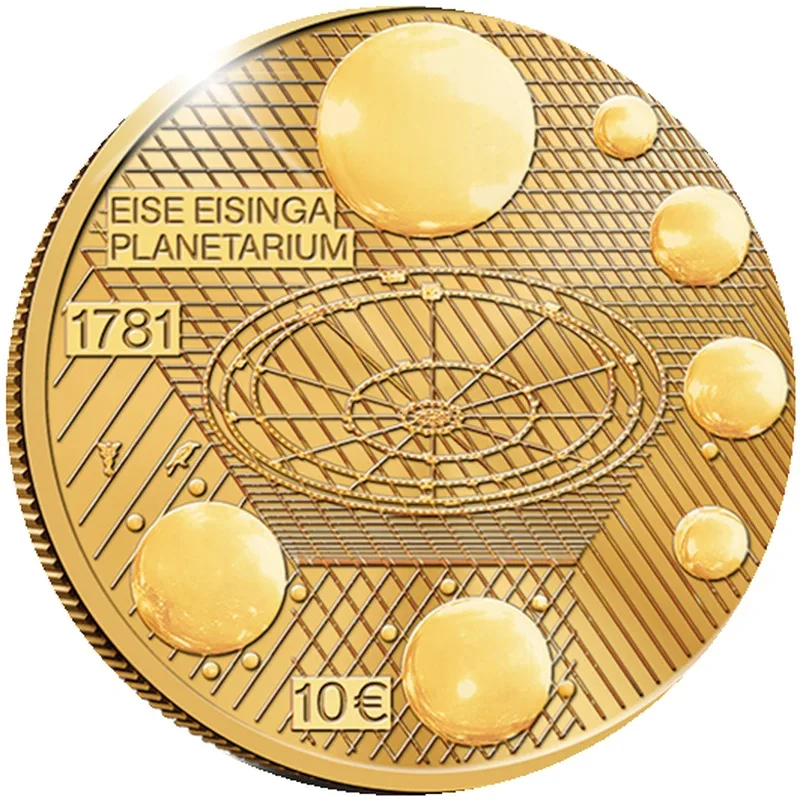
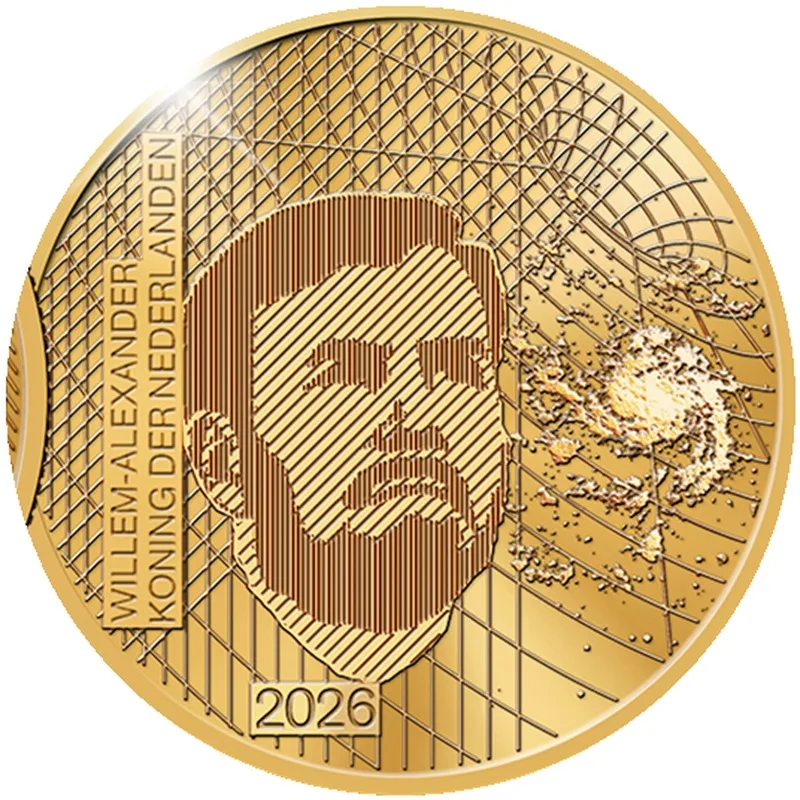
The gold coin is issued as a “gouden tientje” — the name by which ten-guilder gold coins have long been known in the Netherlands, and this familiar image is carried over to the modern euro. The design is the same as on the five-euro piece, but on gold the hatching and the planet-spheres look different: the surface glimmers with a warm light, and the strength of the relief is noticeable even on a small diameter. The coin is issued only in proof and is supplied in a wooden case with the planetarium’s logo — the most “gift-like” version of the issue. For a collector of the “Netherlands World Heritage” series the gold ten is a kind of crown of the issue: it repeats the same design in the noblest metal and in the smallest mintage of all the versions.
Obverse
The official side of the coin is a portrait of King Willem-Alexander facing right. The figure is rendered in fine hatching and looks upward, towards space: in the background are two well-known cosmic phenomena discovered long after the planetarium was built — the black hole predicted by Albert Einstein’s theory of relativity and the spiral arm of the Milky Way, whose nature was demonstrated by Edwin Hubble. Along the left edge runs the inscription “WILLEM-ALEXANDER KONING DER NEDERLANDEN” (“Willem-Alexander, King of the Netherlands”), and below it the year “2026”. The edge carries the motto “★ GOD ★ ZIJ ★ MET ★ ONS” (“God be with us”).
Reverse
The artistic side is given over to the planetarium itself. In the centre is the ceiling of the living room with the planetarium in perspective, drawn after an engraving by Barentie Willem Dietz of 1824: the room and the mechanism are rendered in fine hatching. Around it are the Sun and the six planets known in Eisinga’s time, set on the field of the coin as little spheres, which gives the relief a particular expressiveness. On the left are the inscription “EISE EISINGA PLANETARIUM”, the completion date “1781” and the mint mark, and below the value “5€”.