
Kinderdijk Windmills (5 euro, silver proof)
PDFGeneral information
Description
The Kinderdijk windmills are nineteen windmills in the north-west of the Alblasserwaard, a polder region in the province of South Holland, about fifteen kilometres east of Rotterdam. It is the largest surviving group of classic windmills in the Netherlands and, according to the Dutch Wikipedia, the largest concentration of old mills in the world. They have long become one of the best-known images of Holland and one of the main tourist attractions of the country, but they were built not for beauty but for water: without them the lowland would simply have gone under.
The Alblasserwaard had trouble with water as early as the thirteenth century: drained land kept subsiding, while the level of the rivers rose from deposits of sand. After a few centuries an additional way of keeping the polder dry was needed. It was decided to build a series of windmills of limited capacity — able not to push the water into the river at once but to raise it into an intermediate reservoir at a level between the polder soil and the river; from there other mills pumped it into the river when the level was low enough. Inside each mill, at the bottom, a scoop wheel turns, lifting the water, usually by about one and a half metres. The water was moved in two stages: first from the polder into the “boezem”, the storage basin, then into the river Lek.
Building of the Kinderdijk mills began as early as the end of the fifteenth century, but nearly all the present ones date from 1738 and 1740. In 1738 eight brick mills of the former Nederwaard water board were built, and in 1740 eight octagonal reed-thatched mills of the Overwaard. Also belonging to the site are two mills of the Nieuw-Lekkerland polder and the post mill De Blokker, which has stood since 1630. The sails of the largest mills span about 28–29 metres. A miller lived in each mill with his family. The name of the village, Kinderdijk, is translated as “children’s dike”: according to legend, after the St Elizabeth flood of 1421 a cradle with a baby was washed against the dike, kept balanced by a cat.
Today the main pumping work is done by two diesel pumping stations, but some of the mills still work. In 1997 the complex “Mill Network at Kinderdijk-Elshout” was inscribed on the UNESCO World Heritage List at the Committee’s 21st session under criteria (i), (ii) and (iv). UNESCO notes the outstanding contribution of the Dutch to the technology of handling water: in the Kinderdijk-Elshout area all the typical features of this technology survive — dykes, reservoirs, pumping stations, administrative buildings and a series of beautifully preserved windmills. Works to drain land began here in the Middle Ages and have continued without interruption to the present day. In 2008 restoration began on eleven of the nineteen mills, which had fallen into a neglected state through postponed maintenance.
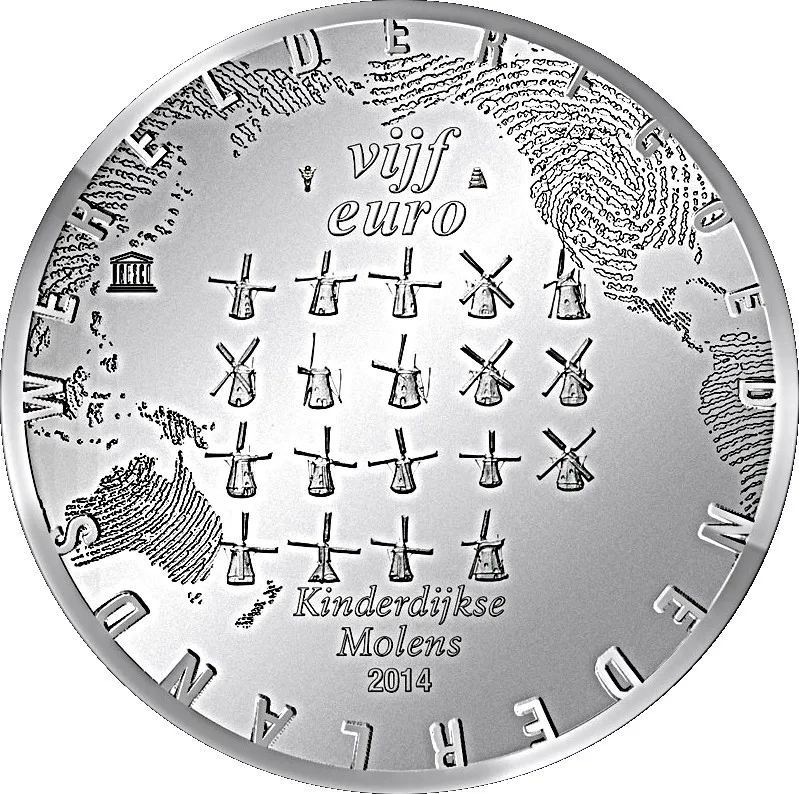
The silver proof is the most expressive reading of the mill design. Here the relief of the mills on the mirror field reads almost like an engraving, and the row of nineteen silhouettes lines up more crisply than on the base coin. The map of fingerprints on silver is almost tangible, and the letters set against the rim look cleaner on the larger coin than on the base piece. For the collector it matters that this coin is less “promotional” and more “authorial”: Melzer works here with a contrast that plays most delicately on silver. It is the version that is pleasant to examine under a loupe and in raking light.
Obverse
The artistic side continues the map of the world made of fingerprints begun on the front — together they make a semblance of a globe. On the map stand the Kinderdijk windmills: all nineteen are shown on the coin, each with its own silhouette, a real row rather than a conventional sign. Here too is the official UNESCO logo. The inscriptions are “NEDERLANDS WERELDERFGOED” (“Dutch World Heritage”), “Kinderdijkse Molens” (“Kinderdijk Windmills”), the year “2014”, and the value is written out in words — “vijf euro” (“five euros”). Many of the letters of the inscriptions are placed against the very rim of the coin: they stand “descending” and seem attached to the edge. For this the mint drew the model in a digital program and made sample dies by laser engraving.
Reverse
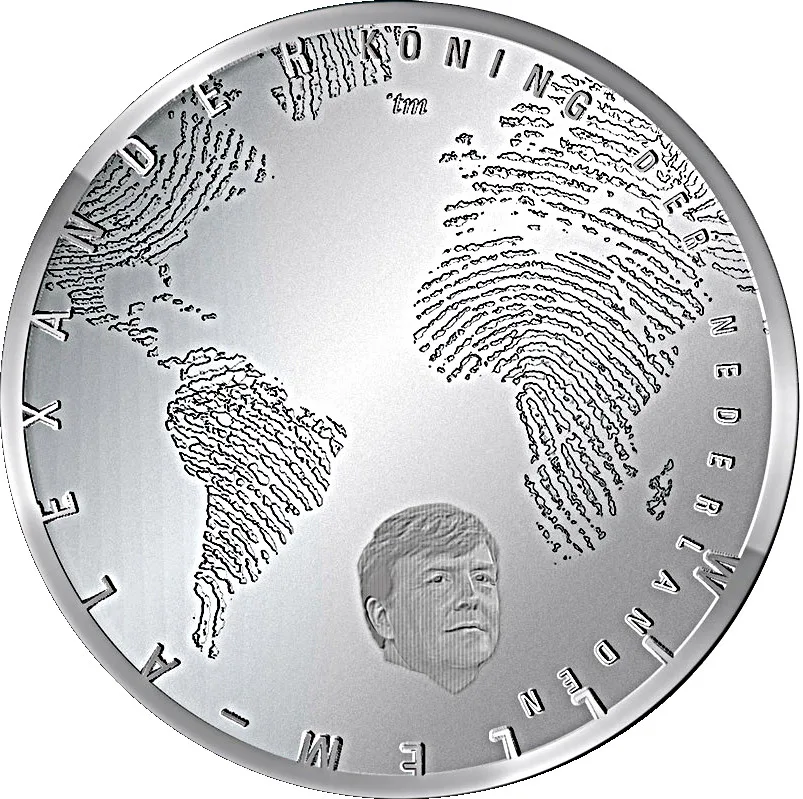
The official side is a stylised portrait of King Willem-Alexander on a map of the world made of fingerprints. The map is a symbol that Dutch heritage belongs to everyone and at the same time serves as a worldwide symbol of Dutch culture. Along the rim runs the inscription “WILLEM-ALEXANDER KONING DER NEDERLANDEN” (“Willem-Alexander, King of the Netherlands”); beside it are the designer’s initials “tm”. As on the previous coins of the programme, the map of fingerprints lies as a matte layer on the shiny field. The reverse continues the same map, so the two sides read as a single globe. On the edge is the motto “GOD * ZIJ * MET * ONS” (“God be with us”).