
Rietveld Schröder House (5 euro)
PDFGeneral information
Description
The Rietveld Schröder House in Utrecht is one of the icons of the Modern Movement in architecture and is regarded as arguably the only true building of the De Stijl movement. It stands at Prins Hendriklaan 50, on what was then the edge of the city, and was built in 1924 to a design by Gerrit Rietveld for Mrs Truus Schröder-Schräder and her three children. The client had been widowed in 1923. At first she wanted to move to Amsterdam, to be near her sister, and she and Rietveld searched together for a ready-made house, but found nothing suitable — then Rietveld suggested building a new one. For him it was the first design of a completely new dwelling together with its furnishing.
The house was created by two people. Rietveld’s first sketch did not please the client, nor did the second variant — a rectangular volume with “holes” for windows. The solution came when Rietveld drew transitions between interior and exterior enclosed by a system of horizontal and vertical elements. Truus Schröder dreamed of living freely, “not being lived in but living”, and wanted a house without walls — as far as possible, that is how it turned out. The living room and bedrooms are on the upper floor, which was declared an “attic” to satisfy building regulations, and inside it is divided by sliding and revolving panels: the rooms can be opened into one space or divided into three bedrooms, a bathroom and a living room. On the ground floor, around the central staircase, are the kitchen and several rooms which the owner later let to students.
From outside the house looks like a collage of planes and lines which seem to glide past one another. White and grey surfaces, black window and door frames and separate linear elements in primary colours all stress the plasticity of the facades. Like Rietveld’s famous Red and Blue Chair, each element here has its own form, position and colour. The windows open only exactly 90 degrees to the wall so as not to disturb the intersection of the planes, and the corner of the building seems to disappear when they are open — this is the “invisible corner”. Rietveld first wanted concrete, but for so small a house it proved too expensive: only the foundations and balconies are of concrete, the walls are brick and plaster, and the floors are wooden on steel girders.
Truus Schröder lived in the house from January 1925 until her death in 1985. The house was then restored by the architect Bertus Mulder and is now a museum run by the Centraal Museum in Utrecht; it has been a listed monument since 1976. On 2 December 2000, at its 24th session in Cairns, the World Heritage Committee inscribed the Rietveld Schröder House on the UNESCO World Heritage List under criteria (i) and (ii): as an “icon of the Modern Movement” and an outstanding expression of human creative genius in the purity of ideas developed by the De Stijl movement. The Committee noted that the radical approach to design and the use of space places the house in a seminal position in the development of architecture in the modern age.
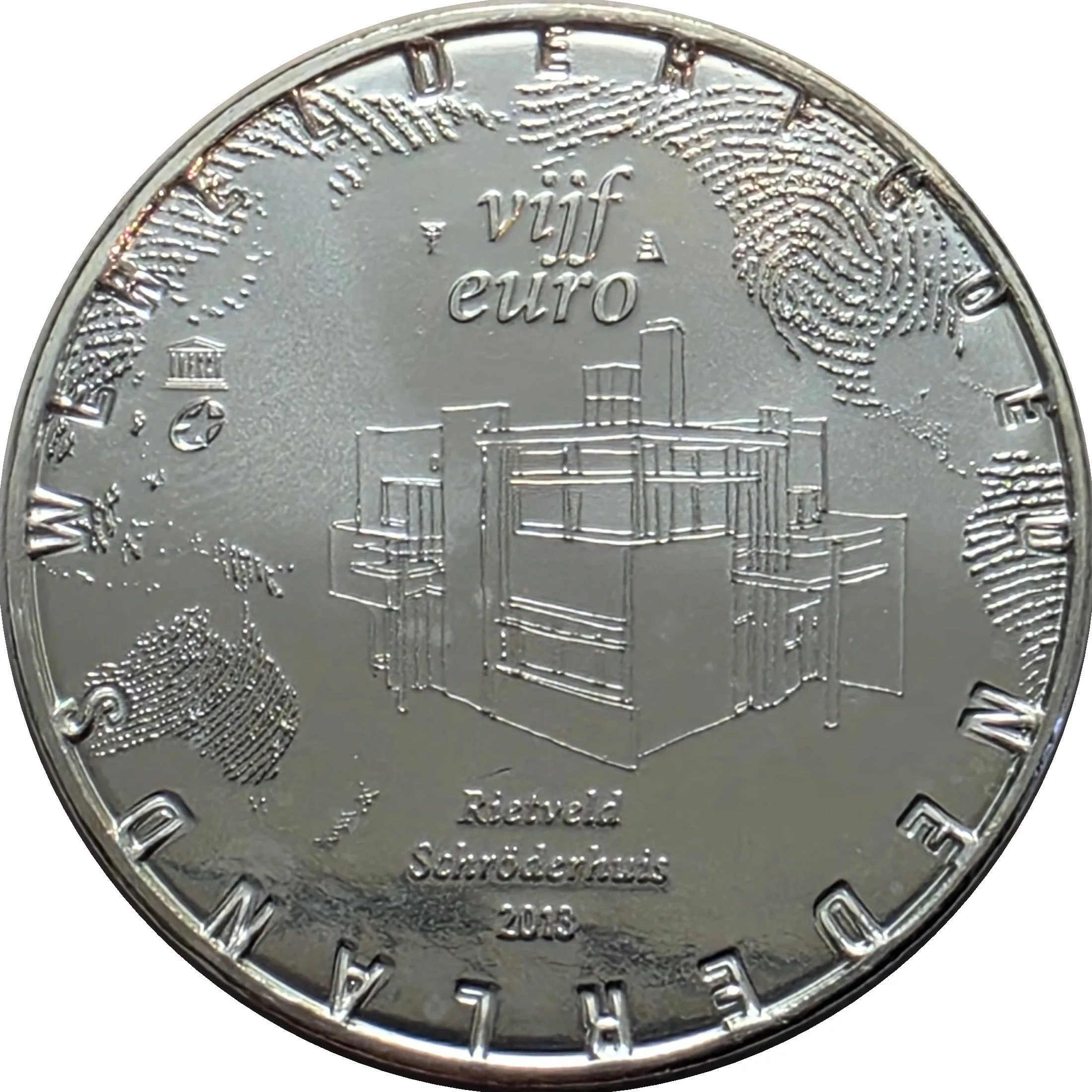
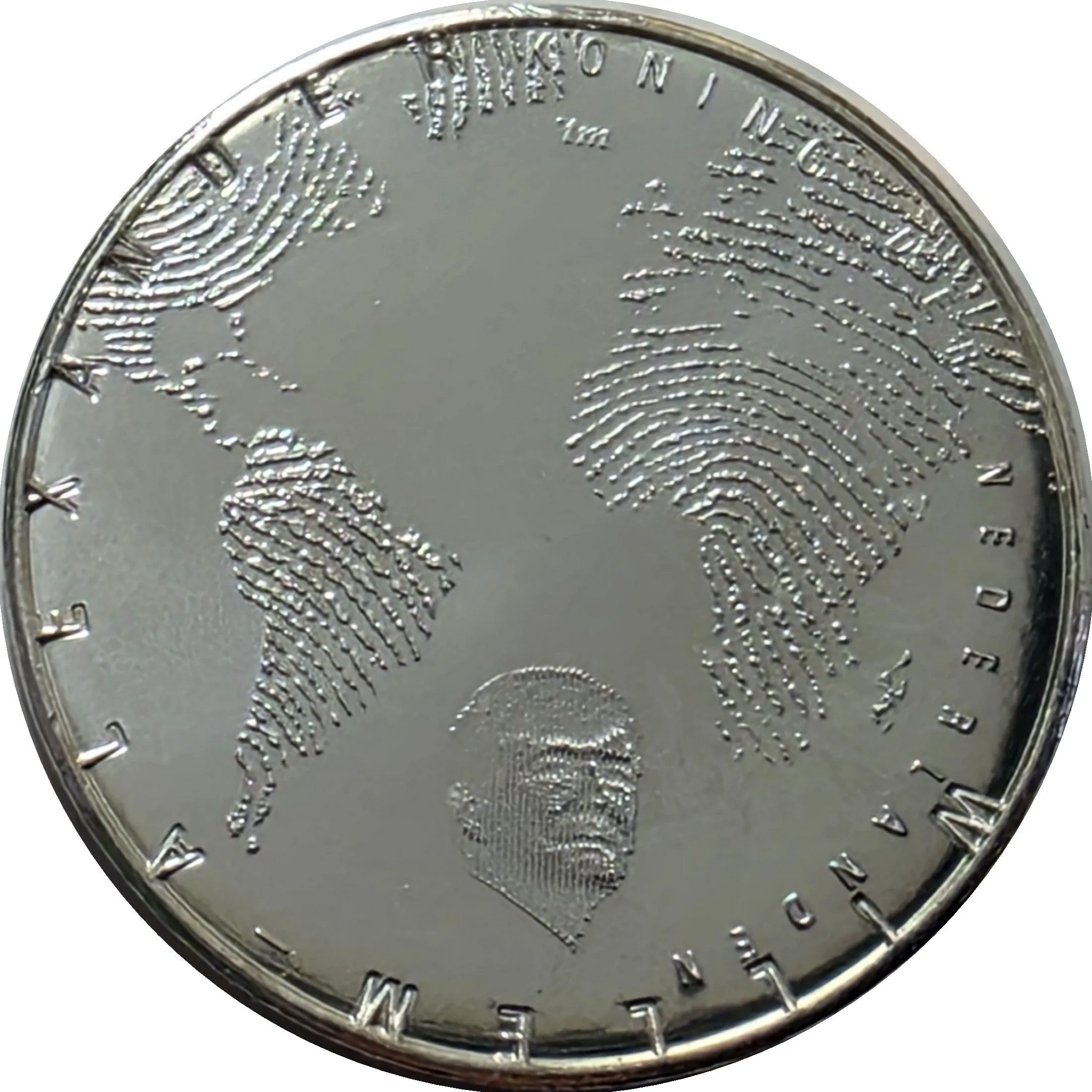
The second coin of the “Netherlands World Heritage” programme, and at once with a new monarch: the mass-market five-euro piece with the first portrait of Willem-Alexander on a collector coin of this denomination. For collectors this is doubly interesting — the coin joins a change of era with a modernist theme. Rietveld’s house is drawn so graphically that the laconic silhouette reads well even on silver-plated copper. In availability and numbers it is the easiest version of the issue to collect. Of the three versions of the year the design reads as the simplest and most open: large clean planes, clear lettering and a minimum of small detail, so it is easy to study without magnification.
Obverse
The artistic side is a hand-drawn image of the house in the centre with a world map around it. The designer Tine Melzer continued the map of the front: according to Numista, the Western Hemisphere lies on the portrait side and the Eastern on the subject side, so that together the two sides make a globe. In the centre is drawn the Rietveld Schröder House in Utrecht — a recognisable, laconic silhouette of planes, drawn by hand. The value, as on the other coins of the programme, is given in words: “vijf euro” (“five euros”); beside it are the inscriptions “Rietveld Schröderhuis”, “2013” and “NEDERLANDS WERELDERFGOED” (“Dutch World Heritage”). There is the official UNESCO logo and also the European star: the theme of the coin falls within the annual theme “European writers” of the Europa Star programme, in which the Netherlands entered Gerrit Rietveld.
Reverse
The official side is the first on five-euro pieces to bear the portrait of the new king. Willem-Alexander ascended the throne on 30 April 2013, and this is the first commemorative five-euro coin to show him. The portrait is executed in halftone, and behind it is a matte world map formed from the fingerprints of members of the designer’s family. The map is a symbol of the collective ownership of Dutch heritage and a worldwide symbol of Dutch culture. A small bust of the king stands below the map of the Western Hemisphere. Along the rim runs the inscription “WILLEM-ALEXANDER KONING DER NEDERLANDEN” (“Willem-Alexander, King of the Netherlands”) with the initials “tm”, and on the edge the motto “GOD * ZIJ * MET * ONS” (“God be with us”). Such treatment makes the official side graphic rather than ceremonial.