
Schokland (5 euro, silver proof)
PDFGeneral information
Description
Schokland is a former island in the Zuiderzee that today lies in the middle of the dry plain of the Noordoostpolder. It was a narrow strip of peat and, in the fifteenth century, as the sea rose and the peat bed sank after drainage, it turned from a peninsula into an island. Before that, in the Middle Ages, Schokland had been part of the mainland and was much larger; UNESCO notes that traces of human presence going back to prehistoric times have been found on its territory — within the boundaries of the property there are more than a hundred and sixty archaeological sites.
According to the Dutch Wikipedia, the name probably derives from the word “schokke”, a peat “cake” or a dried piece of cow dung used as fuel. The nickname was mocking: “peat for the poor”. The islanders lived in isolation: they had their own dialects (Schokkers) and their own costume, which the women wore until the middle of the nineteenth century. The northern part, Emmeloord, belonged to Holland and stayed largely Catholic, while the southern part, Ens, belonged to Overijssel and became Protestant, and the two were joined only by a narrow plank on which two people coming from opposite directions could hardly pass each other. In the eighteenth century the Schokkers had a large fishing fleet, and the island served as a landmark and shelter for ships at the mouth of the IJssel.
But the water advanced. The island had long stood on artificial mounds — terps — and the sea gnawed at the land year after year. The worst was the storm of 1825: the whole island went under water, more than two kilometres of sea dike were destroyed, both churches were damaged and the lighthouse at the southern tip was swept away. Thirteen people died, twenty houses were washed away and, according to the mayor’s letter, only seven houses remained habitable. Schokland was the poorest municipality in the country. In 1855 the southern part was evacuated because of erosion, and in 1859 a royal decree ordered the whole island abandoned. On 1 March the mayor, Gerrit Jan Gillot, announced to the inhabitants that they had four months: about six hundred and fifty people lived there then. The houses were pulled down and the material was reused for new buildings on the mainland.
After that the history of the island took an unexpected turn. In the twentieth century the Netherlands drained part of the Zuiderzee, and in 1942, when the Noordoostpolder was drained, Schokland ceased to be an island — it is now a slightly raised part of the polder. The outline of the former island is clearly visible on the ground: four large terps, the remains of dikes and pile defences, a church and the ruins of a church, a harbour, and residential and farm buildings have survived. Together they form, in UNESCO’s words, an exceptional example of an island community that fought the water, was forced to leave, and whose land then became the first land for the new polder inhabitants. Schokland is the only surviving peat island in the former Zuiderzee, and it is therefore also valuable as a geomorphological monument.
In 1995, at the 19th session of the Committee, Schokland and its surroundings were inscribed on the World Heritage List under criteria (iii) and (v). It was the first UNESCO site in the Netherlands. Today the Museum Schokland operates there, and visitors walk along the strip of land raised above the polder. For UNESCO, Schokland symbolises the age-old Dutch struggle against the water: without it, as the description of the property says, more than half of the country’s present area would be regularly flooded. It shows that land in the Netherlands is not a given but the result of the labour and perseverance of many generations.
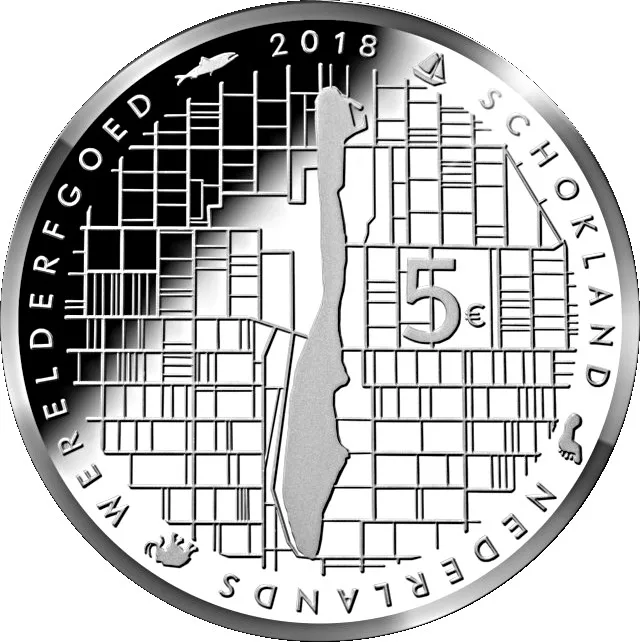
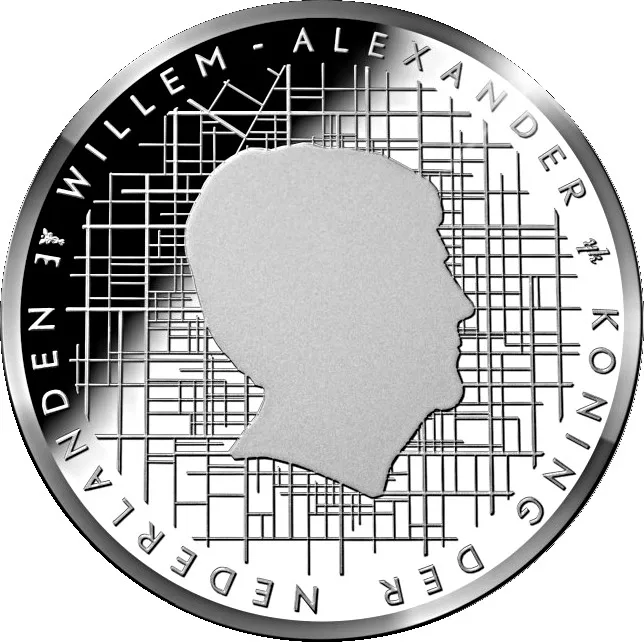
In the silver proof Korfmann’s fine linear graphics open up completely. The mirror fields work as water and the matte relief of the raster as land: the contrast between them makes visible what the coin is about — the border between dry land and water that once defined the life of the island. The king’s profile, drawn with the same line, looks on the proof almost like an engraving. Fine strokes that slightly merge on the basic coin read separately here, and the landscape pattern is perceived as a full work of graphic art on metal. It suits a collection in which the subject matters more than the shine.
Obverse
The story side is built entirely on the landscape. The designer Katrin Korfmann used the typical Dutch polder mosaic as a raster: a grid of fields, roads and canals sets the background, and over it emerge the outlines of the former island of Schokland, which are the same as they were at the time of reclamation. The picture looks like a view from an aeroplane or a map and at the same time like a graphic work: the lines do not depict the island but “cut” it out of the surrounding plain. The inscription “2018 SCHOKLAND NEDERLANDS WERELDERFGOED” (“2018, Schokland, Dutch World Heritage”) and the value “5 €” are set within the same raster. The solution is deliberately modest and abstract — it conveys the thought that the island did not vanish physically but changed its status: now it can be “read” only from the pattern of the fields.
Reverse
The official side bears a silhouette of King Willem-Alexander’s head facing right. It is a line drawing in the style of the same polder grid as on the story side: the profile is abstract yet recognisable, and the field raster shows through in its very outline. The designer’s idea is to link the monarch himself with the cultural landscape created by generations of Dutch people: the king and the polder are described in a single language. Around the edge runs the legend “WILLEM-ALEXANDER KONING DER NEDERLANDEN” (“Willem-Alexander, King of the Netherlands”), and on the edge the motto “GOD * ZIJ * MET * ONS *” (“God be with us”). The design is by Katrin Korfmann, an artist who lives in Amsterdam.