
Van Nelle Factory (5 euro)
PDFGeneral information

Description
The Van Nelle Factory is a former factory for processing coffee, tea and tobacco on the banks of the Delfshaven Schie in Rotterdam, in the Spaanse Polder industrial zone. It is regarded as the most important industrial monument of the Netherlands and one of the prime examples of modernist and functionalist architecture — Nieuwe Bouwen, “New Building”. Contemporaries marvelled: in 1930 Robertson called it “a poem in steel and glass”, and in 1932 Le Corbusier “the most beautiful spectacle of the modern age”. In 2015 the factory topped the list of “The 25 Most Beautiful Factories in the World”.
The factory was built between 1925 and 1931 to a design by Leendert van der Vlugt of the office Brinkman & Van der Vlugt, together with the engineer Jan Wiebenga, a specialist in reinforced-concrete structures; sources differ a little on dates, and the Dutch Wikipedia gives 1927–1930. The client was the co-owner of the firm, Cees van der Leeuw: he wanted an “ideal factory” — open to the world, in which daylight would create pleasant working conditions and the interior space would change according to need. He had begun buying land in the Spaanse Polder as early as 1916, and the marshy site had to be raised with fill. Van der Leeuw and the company directors Matthijs de Bruyn and Bertus Sonneveld valued Van der Vlugt so highly that they also commissioned their own houses from him in Rotterdam and Schiedam; the restored Sonneveld House is now a museum. Authorship was disputed: the design is sometimes also attributed to Mart Stam, who worked as a draughtsman in the office in 1926 and left it after a dispute over authorship.
The complex consists of buildings whose facades are essentially steel and glass — the curtain-wall principle is used here on a large scale. It is claimed to be the first industrially prefabricated curtain wall in the world. The buildings are linked by overhead bridges, and the neon letters “Van Nelle” survive on the facades. A stream of goods from the tropics passed through the factory: coffee, tea and tobacco were processed and packed here for the European market, later also chewing gum, cigarettes, instant pudding and rice. In 1989 Van Nelle was bought by Sara Lee/Douwe Egberts, and in 1996 production was closed. After a renovation begun in 2000 the factory was for a time known as the Van Nelle Design Factory; today it houses various companies, a co-working space and conference rooms, and since 2017 there has been a visitor centre.
The factory was inscribed on the UNESCO World Heritage List in June 2014 at the Committee’s 38th session under criteria (ii) and (iv). UNESCO calls it one of the icons of twentieth-century industrial architecture and a new kind of factory that became a symbol of the modernist and functionalist culture of the inter-war years; it also bears witness to the long commercial and industrial history of the Netherlands — the importation and processing of food products from tropical countries for sale in Europe. The Committee stressed that the factory has become an emblematic example and an influential reference throughout the world, and that all its functional relationships — warehousing, dispatch, transport — have remained unchanged.
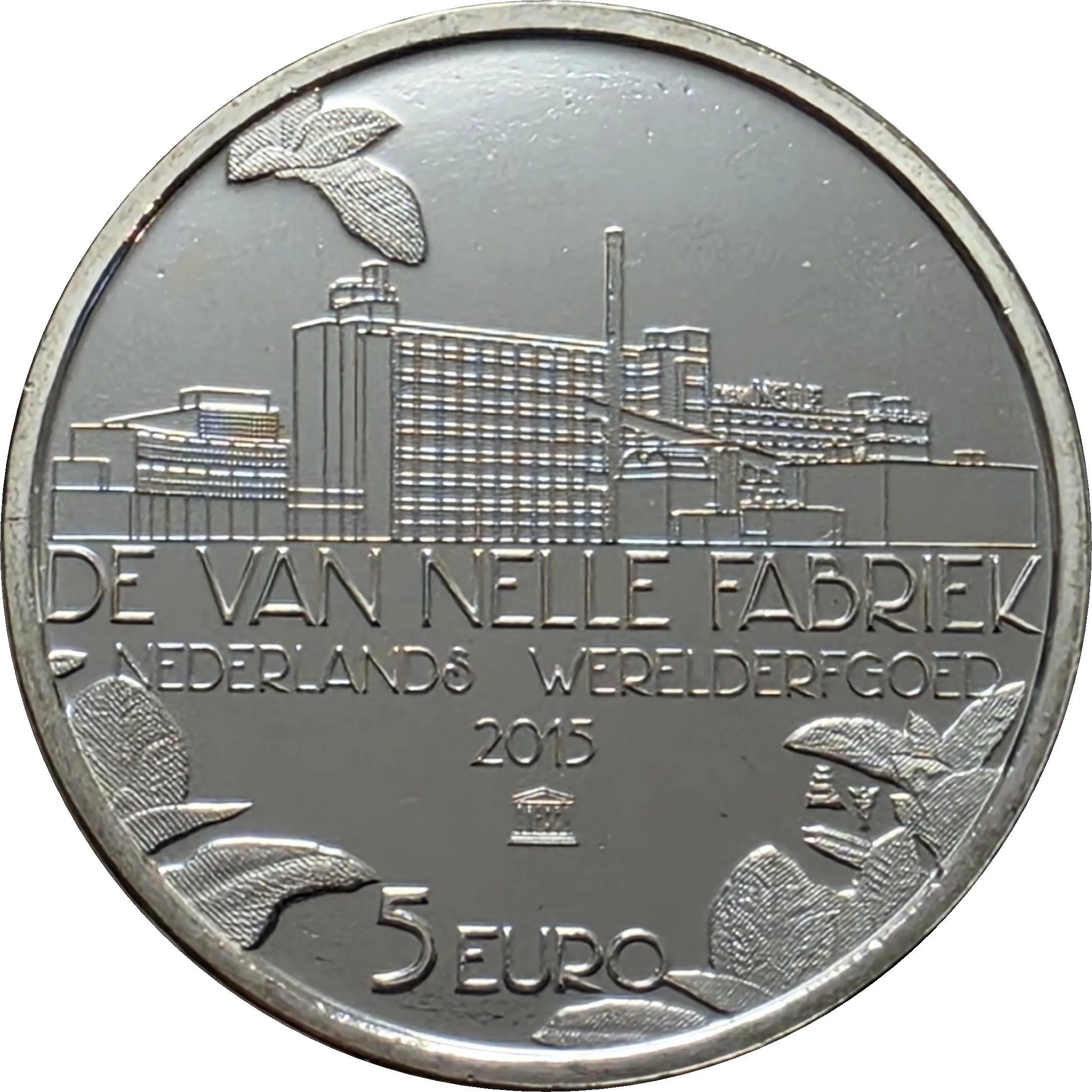
The fourth coin of the “Netherlands World Heritage” programme and the first in a new graphic key: after the globe of fingerprints, a strict, almost archival image of the factory with tobacco leaves and a typeface of the 1930s. The mass-market five-euro piece conveys the character of the site well: planes, the rhythm of windows and clarity of composition, as in modernism itself. For a collector this coin is also interesting as a boundary: the designer changes here and a line is set that Motallebi will continue in the two following years. For those who collect coins on the theme of twentieth-century architecture this five-euro piece is one of the most telling: it is a reminder that the UNESCO list includes not only ancient monuments but also industrial buildings of the modern age.
Obverse
The artistic side is devoted entirely to the factory: the building is shown with its extended facade of glass and steel. Beside it stand tobacco leaves — a reminder that Van Nelle processed tobacco as well as coffee and tea. All the inscriptions on the coin are in a typeface of the 1930s, the time of the factory’s opening: “DE VAN NELLE FABRIEK” (“The Van Nelle Factory”), “NEDERLANDS WERELDERFGOED” (“Dutch World Heritage”), the year “2015” and the value “5 EURO”. Here too is the official UNESCO logo. The coin was struck with the most modern minting techniques, including micro-raster.
Reverse
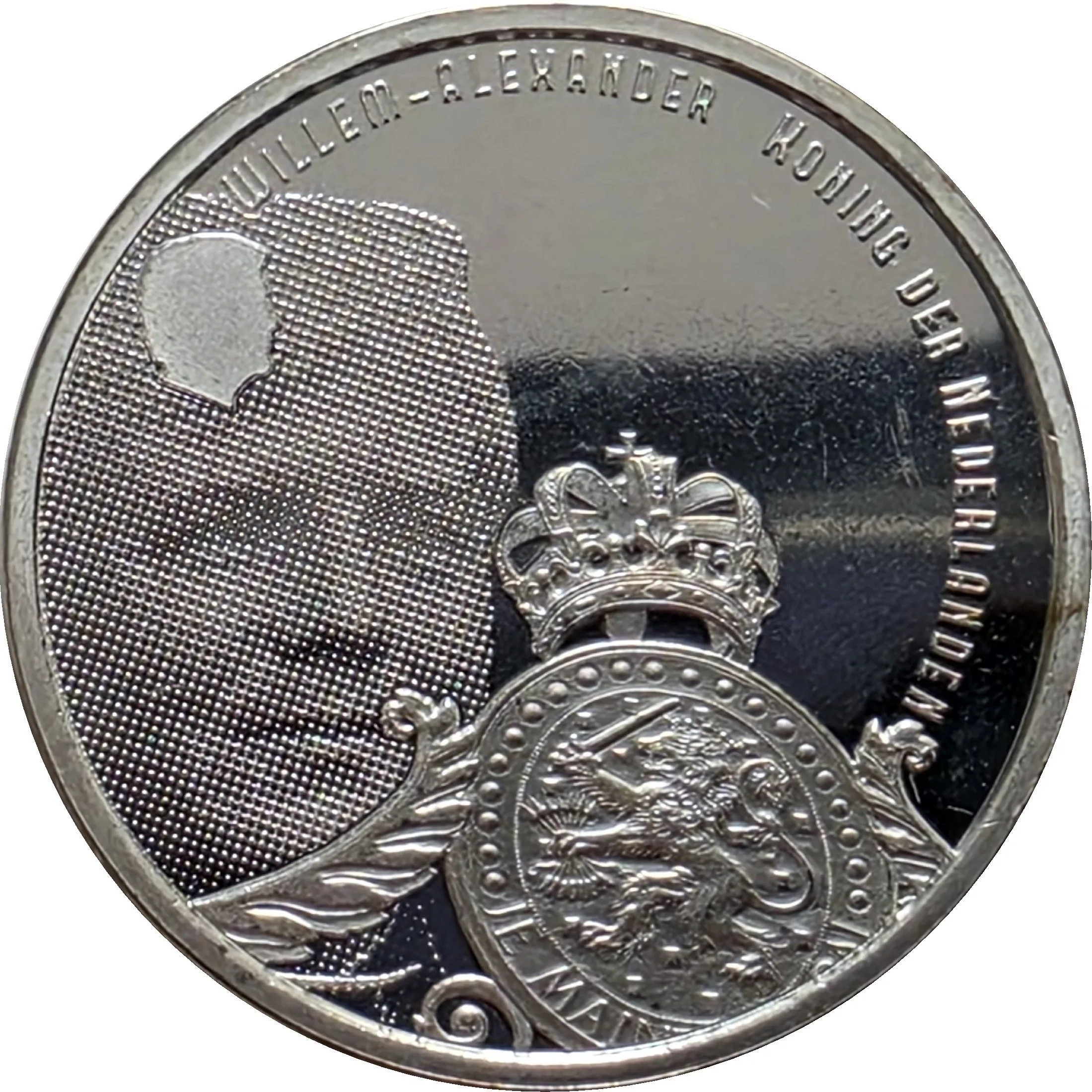
The official side is a portrait of King Willem-Alexander, and for the first time his image is given twice on a coin: a large, very sharp portrait and a small silhouette beside it. The royal coat of arms is also shown. The inscription “WILLEM-ALEXANDER KONING DER NEDERLANDEN” (“Willem-Alexander, King of the Netherlands”) runs along the rim, and beside it stands part of the motto of the House of Orange, “JE MAIN…” — from “Je maintiendrai”, “I will maintain”. The author of the drawing is Kianoosh Motallebi, and this is his first coin of the programme: before it Tine Melzer worked for three years, and the design of the official side became quite different — instead of a map of fingerprints there is a graphic portrait and a coat of arms. On the edge is stamped “GOD * ZIJ * MET * ONS *” (“God be with us”).