
Wadden Sea (5 euro)
PDFGeneral information
Description
The Wadden Sea is an intertidal zone in the south-east of the North Sea, between the coast of north-western continental Europe and the chain of low Frisian Islands. The word “wad” in Frisian and Dutch means a “mud flat that is bared at ebb”: the water here is shallow and twice a day the bed shows itself. UNESCO calls the Wadden Sea the largest unbroken system of intertidal sand and mud flats in the world. It stretches along the coast for some five hundred kilometres from Den Helder in the Netherlands past the great river estuaries of Germany to Skallingen in Denmark; the total area is about ten thousand square kilometres. In the Netherlands it is separated from the IJsselmeer by the Afsluitdijk.
Here land and sea constantly contest territory. The landscape was shaped in large part by storm tides of the tenth to fourteenth centuries, which flooded the peat land behind the coastal dunes and carried it away. The present islands are the remnants of the former dunes: towards the North Sea they are marked by dunes and wide sandy beaches, towards the Wadden Sea by a low tidal coast. Currents and waves slowly change the outlines; for instance, the islands of Vlieland and Ameland have moved eastwards over the centuries, losing land on one side and gaining it on the other. The history of the coast includes terrible floods — St Marcellus’ floods of 1219 and 1362, the Burchardi flood of 1634, the Christmas Flood of 1717 — which cost thousands of lives; after them many dikes were built, and today floods hardly ever cost lives, which makes it one of the most human-altered natural environments on the planet.
The Wadden Sea holds a multitude of transitional habitats: tidal channels, sandy shoals, sea-grass meadows, mussel beds, salt marshes, estuaries, beaches and dunes. It is one of the last large-scale intertidal ecosystems in which natural processes continue to function largely undisturbed. It is famous for its birds: hundreds of thousands of waders, ducks and geese use it as a migration stopover or wintering site, and gulls, terns, herons, spoonbills and birds of prey breed here, including a small and increasing breeding population of white-tailed eagles. Marine mammals live here too — harbour and grey seals, harbour porpoises. Greater flamingos and Dalmatian pelicans were once common here as well, but human activity has changed the mix of species; the European oyster, which once formed large beds, was wiped out, and the Pacific oyster has taken its place.
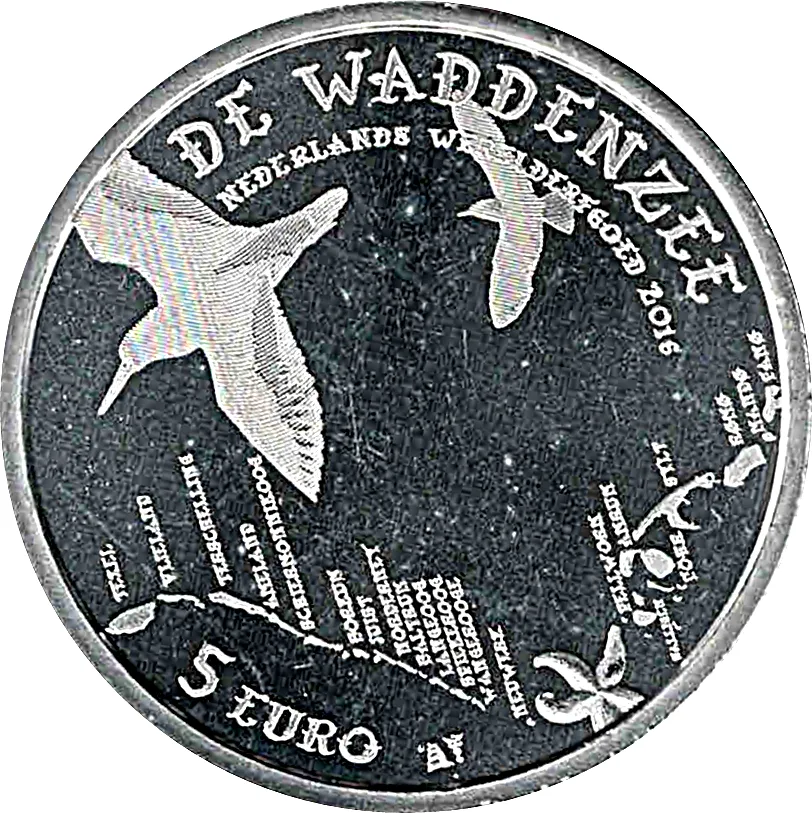
The Dutch and German parts of the Wadden Sea were inscribed on the UNESCO World Heritage List in 2009 at the Committee’s 33rd session under the natural criteria (viii), (ix) and (x); in 2011 the area was extended, and in June 2014 the Danish part was added. The site includes the Dutch Wadden Sea Conservation Area, the German national parks of Lower Saxony and Schleswig-Holstein and most of the Danish maritime conservation area. Three countries manage the sea together, and it is one of the rare transboundary heritage sites — which is why the coin shows the islands of all three countries, from Texel to Fanø.
The fifth coin of the “Netherlands World Heritage” programme and the first devoted not to a building but to nature. For collectors this is a change of tone: instead of an architectural drawing, a map of islands, birds above the water, a starfish. It appeals also to those interested in geography: the island names from Texel to Fanø turn the coin into a tiny map. The light, “living” composition sets it apart from the stricter architectural coins of the programme. The Wadden Sea is hard to show with a single building, so a view from above was chosen: three countries, whose islands belong to the protected area, fit on one small disc.
Obverse
The artistic side is an aerial view of the Wadden Sea with the islands of the Netherlands, Germany and Denmark. Beside each island stands its name: from the Dutch Texel, Vlieland, Terschelling, Ameland and Schiermonnikoog to the German Borkum, Norderney, Langeoog, Sylt and the Danish Rømø, Mandø and Fanø. Above them seabirds soar — according to a dealer’s description, a gull and a cormorant — and a starfish can also be seen. The inscription “DE WADDENZEE” (“The Wadden Sea”) is set in the typeface used on old sea charts; beside it are “NEDERLANDS WERELDERFGOED 2016” (“Dutch World Heritage”) and the value “5 EURO”. Below are the mint mark and the privy mark: the star means that the post of mint master was vacant at that moment. The silver proof here was the first to receive the technique of Line Phase Modulation, with which the birds are made.
Reverse
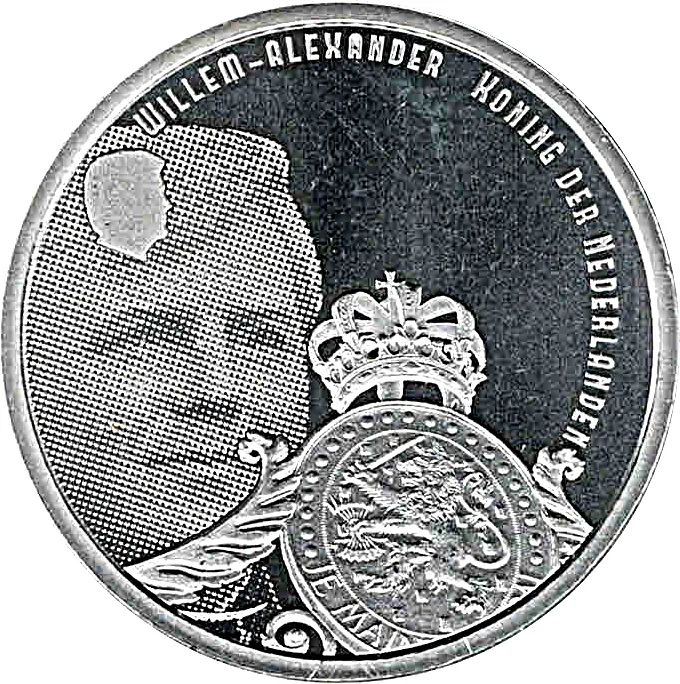
The official side shows King Willem-Alexander almost en face, and beside him a small silhouette of his head worked into the design — as on the coin of 2015, his portrait is given twice. Beside him is the coat of arms of the Netherlands, and part of the motto of the House of Orange, “JE MAIN AI…” (from “Je maintiendrai”, “I will maintain”), is part of the lettering. The inscription “WILLEM-ALEXANDER KONING DER NEDERLANDEN” (“Willem-Alexander, King of the Netherlands”) surrounds the portrait. The author is Kianoosh Motallebi, and this is his second coin of the programme. Here the portrait is photographic and very sharp, and therefore combines well with the broad, graphic view of the Wadden Sea on the other side. On the edge is the motto “GOD * ZIJ * MET * ONS *” (“God be with us”).