
Willemstad, Curaçao (5 euro, silver proof)
PDFGeneral information
Description
The historic area of Willemstad, the capital of Curaçao, an island in the southern Caribbean, is the first site outside Europe to which a coin of this line has been devoted. The island was discovered by the Spaniards: the Dutch Wikipedia gives 1499, and they settled for good in 1527. In 1634 a trading post on St Anna Bay was seized by the Dutch West India Company, and the history of the town begins with the building of Fort Amsterdam on the eastern bank of the bay. According to the English Wikipedia, the name “Willemstad” is first recorded in 1680 and was given in honour of William II or William III of Orange.
The city grew up around a natural deep-water harbour. Its oldest district is Punda, built in the seventeenth century on the eastern side of St Anna Bay beside the fort; it is the only part of the city that was surrounded by walls and ramparts. The other three historic districts — Pietermaai, Otrobanda and Scharloo — date from the eighteenth century: Otrobanda, founded on the opposite shore in 1707, took its name from the Papiamentu “otro banda”, “the other side”. Water Fort and Rif Fort, also part of the property, were built in the late 1820s. The walls of Punda were pulled down in the 1860s and houses were built between Punda and Pietermaai. The two sides of the bay are linked by the floating pedestrian Queen Emma Bridge, built in 1886 and opening for ships, while the main traffic goes over the high Queen Juliana Bridge.
Willemstad was a trading and transhipment centre, and its history has a dark side: from the seventeenth century the city became a free port and the chief regional slave market, where enslaved people brought from Africa were sold on to Central and South America. A large Jewish community formed here early — from 1651 — and in 1732 the Sephardim built the Mikvé Israël-Emanuel synagogue, the oldest synagogue in continuous use on the American continent. After the Shell oil refinery was built (according to the English Wikipedia, in 1915) the city expanded quickly: working-class districts grew up around the Schottegat, including Emmastad and Julianadorp. On 30 May 1969 a strike at the refinery turned into riots, and many buildings in Punda and Otrobanda were set on fire.
What Willemstad is best known for is colour. The coral-stone houses were originally white, but in 1817 Governor Albert Kikkert introduced a law that obliged people, on pain of a fine of 25 pesos, to paint their facades. The law was proposed by the court physician Benjamin de Sola, who, like other European eye doctors, wrongly believed that sunlight reflected from white walls harmed the eyes. The law was repealed in 1932 but the colours stayed: today red, blue, ochre-yellow and shades of green predominate. The architecture combines Dutch urban-planning ideas, the influence of the tropical climate and the styles of towns across the Caribbean: galleries appeared along the facades, local materials and craftsmanship were used, and in Otrobanda there are spacious houses like plantation residences. Willemstad is often called the “Amsterdam of the Western Hemisphere”, though Portuguese and Spanish features are also noticeable in the architecture.
In 1997, at the 21st session of the Committee, the Historic Area of Willemstad, Inner City and Harbour was inscribed on the World Heritage List under criteria (ii), (iv) and (v). UNESCO describes it as a colonial ensemble in the Caribbean that shows the organic growth of a multicultural community over three centuries, and stresses that the four districts show successive stages of the city’s development: it can be read as a textbook of its own history. It is one of the few places regarded as monuments for their culture and history, and its exceptional setting around the water explains why Willemstad is not merely a city but a port. Since 2010 Curaçao has been a self-governing country within the Kingdom of the Netherlands, and Willemstad is the former capital of the Netherlands Antilles.
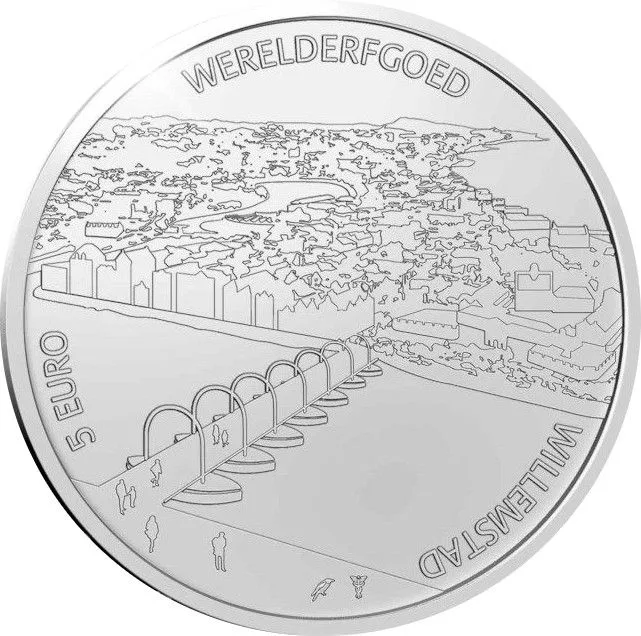
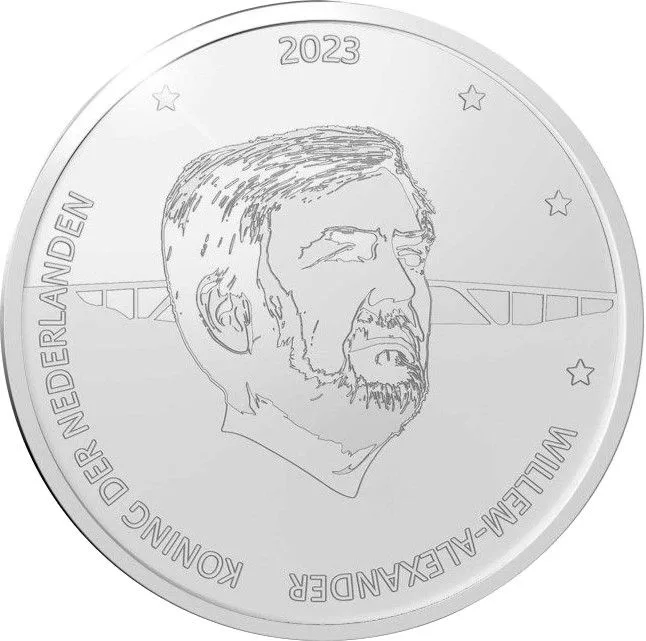
The silver proof turns the panorama of Willemstad into an engraving. The mirror field works as the water of St Anna Bay, while the matte relief of the houses, the fort and the bridge stands out above it; against this contrast individual buildings read well: the quay, the synagogue, the Emanu-El temple. On the basic coin the dense building can blur slightly, but on the proof each house shows its own roof and each tier of the fort. The stars above the portrait are especially clear on the mirror field and are perceived as a small constellation-emblem of the Kingdom. For those who choose silver for the sake of the subject this is one of the most detail-rich coins of the line, and it is worth examining under a loupe, because the delicacy of the small buildings is exactly what the proof format was for.
Obverse
The story side is a view of the city that combines all four districts on the UNESCO list: Punda, Otrobanda, Scharloo and Pietermaai. Characteristic buildings can be picked out: the Handelskade quay, the Mikvé Israël-Emanuel synagogue and Fort Amsterdam in Punda, and the Emanu-El temple, with which Pietermaai begins; the floating Queen Emma Bridge is visible in the centre. The picture conveys what put Willemstad on the list: dense, multicoloured buildings around water. The inscription “WERELDERFGOED WILLEMSTAD 5 EURO” (“World Heritage, Willemstad, 5 euro”) is placed next to the view. The designer is Cleo Maxime de Brabander, and her solution rests on the panorama rather than on a single building.
Reverse
The official side bears a portrait of King Willem-Alexander facing right; in the background is the Queen Juliana Bridge in Willemstad, a high arch over St Anna Bay. In the upper part of the field are four stars: they stand for the four countries that make up the Kingdom of the Netherlands — the Netherlands, Curaçao, Aruba and Sint Maarten. In this way the king’s portrait is tied to the city itself and to the idea of the Kingdom as a union of countries rather than of a single European capital. The legend reads “2023 ☆ ☆ ☆ WILLEM-ALEXANDER KONING DER NEDERLANDEN ☆” (“Willem-Alexander, King of the Netherlands”), and the edge carries the motto “GOD * ZIJ * MET * ONS *” (“God be with us”).