
Wouda Pumping Station (Woudagemaal) (5 euro, silver proof)
PDFGeneral information

Description
The Ir. D.F. Wouda Steam Pumping Station (Ir. D.F. Woudagemaal) stands at Tacozijl near the town of Lemmer in Friesland. It is the largest steam pumping station ever built, and it is still in working order. Queen Wilhelmina opened it on 7 October 1920. The station was to pump excess water out of Friesland: first into the Zuiderzee and later into the IJsselmeer. It was named in 1947 after the engineer D.F. Wouda, chief engineer of the Provincial Water Authority of Friesland, who designed the building in a traditional manner with an influence of rationalism.
The station was built in 1916–1920, and not without incident. When the freshly erected free-standing chimney was complete, it was struck by lightning: the lightning conductor had not yet been fitted because the mortar was still too wet. The chimney had to be taken down entirely and built again. To feed the station with water a special canal, the Stroomkanaal, was dug, extra wide to carry the large volume of water. The machinery was devised by Professor J.C. Dijxhoorn and built by the Jaffa factory in Utrecht in 1919–1920: four tandem-compound steam engines and eight double-suction centrifugal pumps, each engine connected to two pumps. The pumping capacity of the station is four thousand cubic metres a minute.
The chimney is especially important: it serves not merely to carry off smoke but to create draught in the boilers, without which air would not reach the furnaces and the hot gases would not give up their heat to the walls of the flue tubes. The boilers were replaced in 1955: six coal-fired Piedboeuf boilers gave way to four Werkspoor flue-tube boilers, which in 1967 were converted to heavy fuel oil. Nothing else significant has changed in the station: UNESCO calls its authenticity total, because in form, materials and function it is virtually the same as when it opened.
Until 1966 the station lowered the water level in the Frisian polders and canals. In that year the J.L. Hoogland pumping station at Stavoren was completed, and since then the Wouda has run on average once a year — at exceptionally high water — and is also fired up twice a year as planned so that the staff do not lose their skill. Because of climate change it is still needed: in prolonged heavy rain it helps keep the level of the Frisian water system. The owner of the station is the water board Wetterskip Fryslân, and when the engines are running they can be seen at work; since 2011 a visitor centre with an exhibition called “Steam and Water” has operated for visitors.
In 1998, at the 22nd session of the Committee, the Woudagemaal was inscribed on the World Heritage List under criteria (i), (ii) and (iv). UNESCO calls it a masterpiece of Dutch hydraulic engineers and architects and stresses that at the time of building it was the largest and technologically most advanced steam pumping station in the world, and that it has remained so ever since. It is a monument to the fight against water by means of steam: steam gave the Dutch a powerful tool in their millennial task of water management, and the Wouda was its high point. The station is also among the hundred chief Dutch monuments and is a national monument, a Rijksmonument.
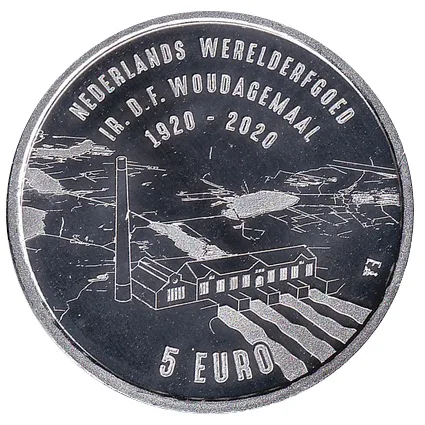
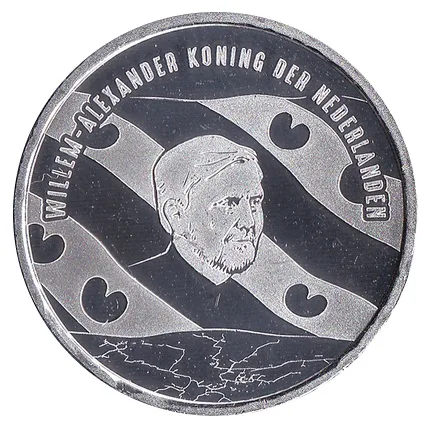
In silver the Woudagemaal reveals itself as an exact drawing: straight lines and sharp angles reproduce best on the proof, where the mirror field is set against the matte relief. The Frisian flag behind the portrait looks on the mirror like moving ripples, and the stripes of the sluices on the story side lie flatter and with more contrast than on the basic coin. The king’s beard, the most unusual detail of the issue, gains a soft play of light and shade on the proof and reads convincingly instead of turning into a flat patch. For a collector this is an engineer’s engraving on a coin, and it is especially valued by those who like graphics without ornament. Silver here is perceived as the material of the machine itself — steel and water — rather than as a jeweller’s shine.
Obverse
The story side is a view of the station from above, as from a bird’s eye, drawn in straight, simple lines. The designer wanted to show the building in the characteristic flat Frisian landscape: the canals around the station appear as fragments, and the sluices are drawn at the same angle as the stripes of the flag on the portrait side. The lettering is set in the typeface used on the steam engines inside the station: “NEDERLANDS WERELDERFGOED” (“Dutch World Heritage”), “IR. D. F. WOUDAGEMAAL”, the dates “1920 – 2020” and the value “5 EURO”. The result is something between a drawing and a plan: the coin does not reproduce the facade but conveys the geometry of water and machine that makes up the essence of this monument.
Reverse
The official side bears a portrait of King Willem-Alexander facing right, and this is the first commemorative coin on which the king is shown with a beard. Behind the portrait waves the flag of the province of Friesland, and beneath it is a fragment of the canals that surround the Woudagemaal. In this way the coin ties the monarch to a specific place and a water landscape. The typeface is the same as on the station’s steam engines; around the edge runs the legend “WILLEM-ALEXANDER KONING DER NEDERLANDEN” (“Willem-Alexander, King of the Netherlands”), and on the edge the motto “GOD * ZIJ * MET * ONS *” (“God be with us”). The designer is Berend Strik, a visual artist who fourteen years earlier had already created a five-euro coin with Rembrandt.