
Nizhny Novgorod Kremlin
PDFGeneral information

Description
The Nizhny Novgorod Kremlin is a fortress in the historic centre of Nizhny Novgorod, its oldest part and its main civic and political complex. It stands on the high right bank, at the confluence of the Volga and the Oka. Among the surviving Russian kremlins it is second only to the Moscow Kremlin in area and length of walls. The city itself was founded, according to the chronicle, in 1221 by Grand Prince Yuri Vsevolodovich of Vladimir and was at first defended by timber-and-earth fortifications.
The first attempt to replace them with a stone kremlin dates to 1374, when Prince Dmitry Konstantinovich laid down a white-stone fortress, but because of financial and political difficulties only the Dmitrievskaya Tower was built, and it has not survived. Under Ivan III Nizhny was a border town with a standing garrison and a mustering place for campaigns against Kazan, so its defences were strengthened again. Work on the stone kremlin began on 1 September 1500 with the laying of the Tverskaya (now Kladovaya) Tower. In 1505 the raid and siege by the army of Khan Muhammad Amin interrupted the work; it resumed in 1508, and the old oak kremlin burned down in the fire of 1513. Construction was completed, it is thought, shortly after 1516. The works were led by the architect Pietro Francesco (Pyotr Fryazin), sent from Moscow.
The walls are 2,045 metres long and enclose 22.7 hectares. The walls are 12 to 22 metres high and 3.5 to 4.5 metres thick. There are 13 towers, 18 to 30 metres high: 5 rectangular gate towers and 8 round blind ones. They are the Georgievskaya, Borisoglebskaya, Zachatskaya, Belaya, Ivanovskaya, Chasovaya, Severnaya, Taynitskaya, Koromyslova, Nikolskaya, Kladovaya, Dmitrievskaya and Porokhovaya towers. In front of the Dmitrievskaya Tower stood an outlying work — a stone bridge with a bridge tower, an innovation in Russian fortification. On the upland side the fortress was ringed by a dry moat. In the 16th century Kazan Tatars besieged the kremlin in 1521 and 1536 but never took it. By 1697 it had lost its military significance.
Nizhny Novgorod is tied to an event that shaped Russian history: in 1611–1612 the popular militia of Kuzma Minin and Prince Dmitry Pozharsky assembled here and freed Moscow from the interventionists. Today the kremlin is the official residence of the presidential envoy in the Volga Federal District, of the governor of the Nizhny Novgorod region and of the city’s mayor, and the square by its south-eastern walls bears the name of Minin and Pozharsky.
Obverse
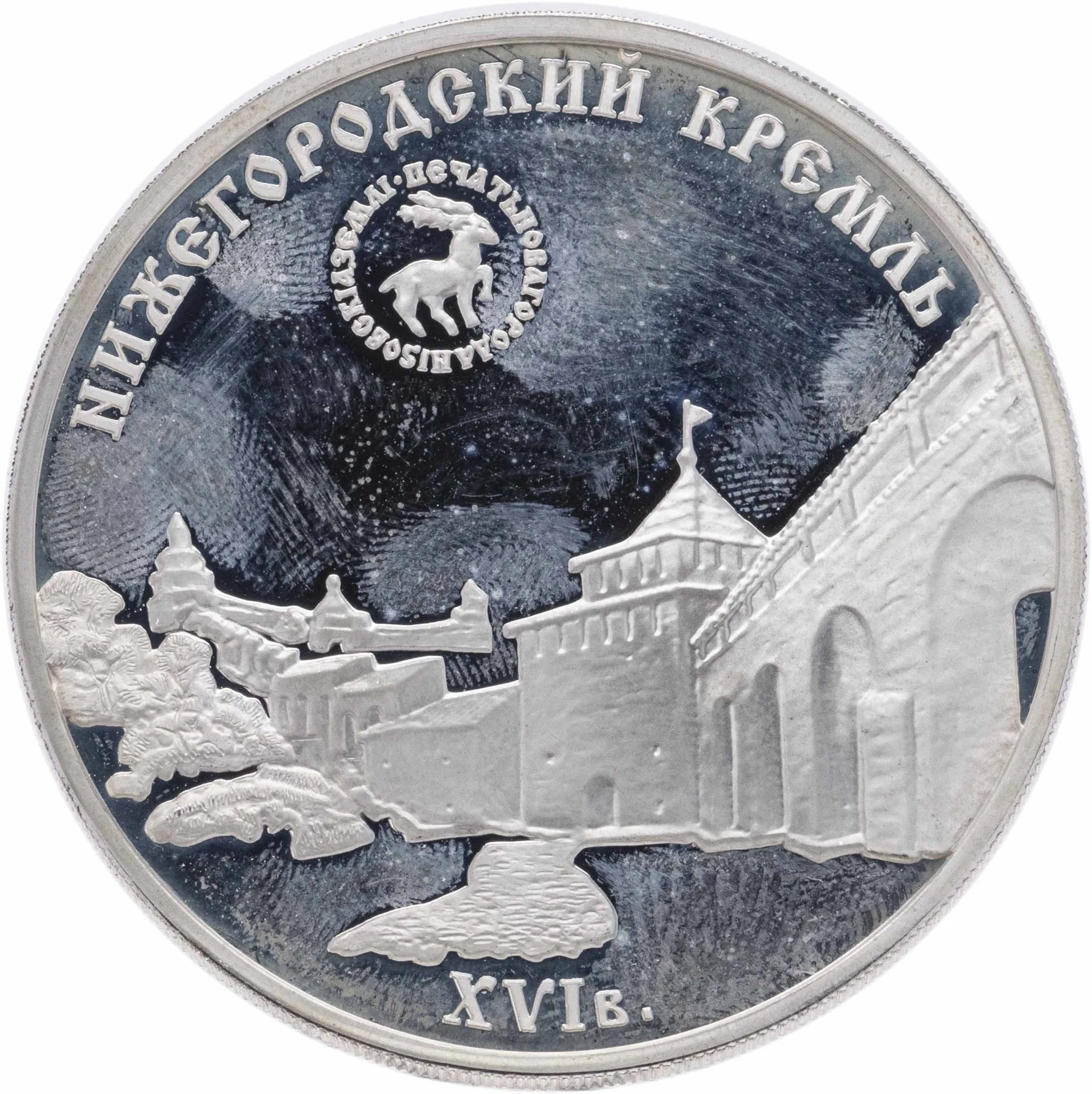
The obverse is devoted to the fortress. At the centre are the walls and towers of the Nizhny Novgorod Kremlin — mighty curtain walls and tall towers above the Volga bank; the relief conveys the massiveness of the masonry.
Above the walls is the old seal of Nizhny Novgorod of the 16th century: a deer in a circle framed by an inscription. At the top the name “НИЖЕГОРОДСКИЙ КРЕМЛЬ” (“Nizhny Novgorod Kremlin”) is stamped, and at the bottom the date “XVI в.” (16th century). The fortress and the city seal are joined into one image: this is not only a structure but a sign of the city itself.
Reverse
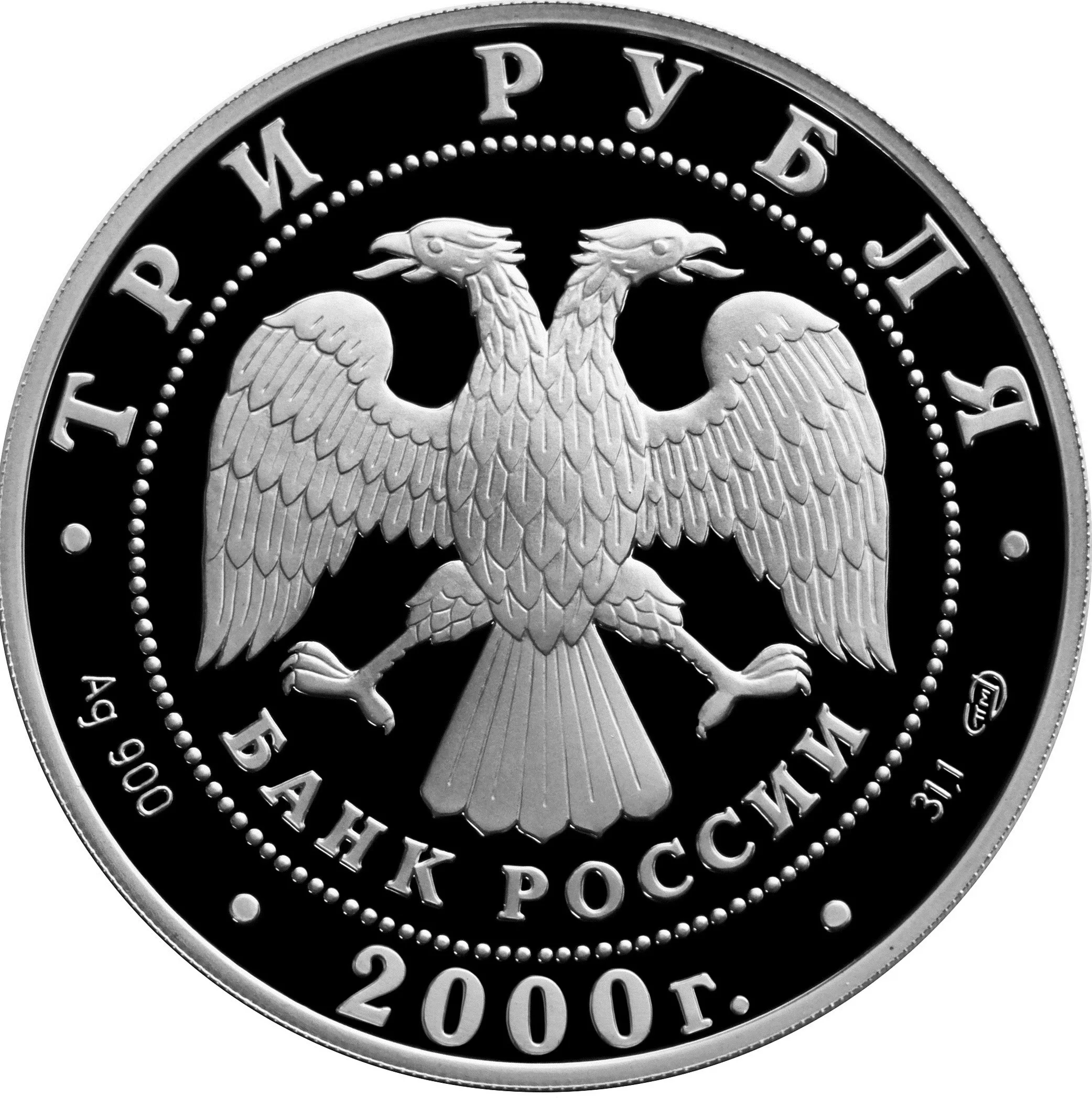
The reverse carries state symbols: a relief double-headed eagle, the emblem of the Bank of Russia, and beneath it the inscription “БАНК РОССИИ” in an arc. At the bottom, the year of issue is marked: 2000.