
The Great Imperial Crown
PDFGeneral information

Description
When the masters Georg Friedrich Eckart and Jérémie Pauzié received the commission for the crown of Catherine II, they had only about two months. In 1762, after the coup of June, the empress was preparing for the Moscow crowning set for the autumn, and every day counted. The jewellers created a crown that became the chief symbol of the Russian Empire and was used for crowning monarchs up to 1896. Today it belongs to the Diamond Fund, whose collection begins with the decree of Peter the Great of 1719 and is open to visitors in the Kremlin.
The crown is decorated with 4936 diamonds, and its summit is occupied by a red spinel of 398.72 carats. In 1676 it was acquired from the Chinese emperor Kangxi and then served as an ornament for the headdress of Elizabeth Petrovna. For a long time the spinel was taken for an enormous ruby; gemologists established the truth only later. This stone is one of the seven world-famous gemstones of the collection, and around it the rows of diamonds close in the crown.
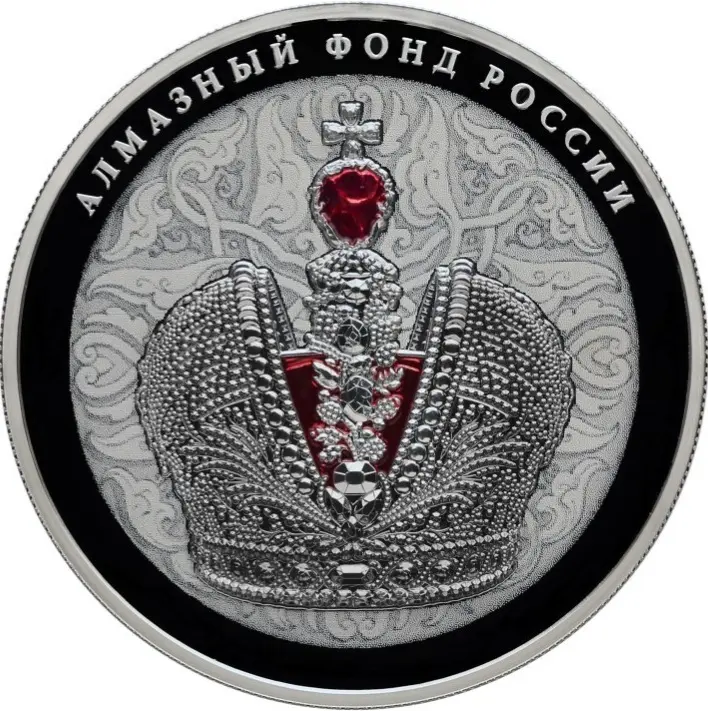
A feature of this coin's finish is its coloured elements. On the image of the crown, colour picks out the red stone at the summit and other details that give the picture volume and let the viewer see at once what the main treasure of the crown is. Colour works as light works on the real crown: it makes the eye linger on the principal stone and see its colour, not only its outline.
For a collector the crown is also a lesson in history: it reminds us how quickly and decisively the image of power was built in the age of Catherine II, and how objects made in a matter of weeks turned out to be more durable than many political regimes. More than two and a half centuries have passed, but the object itself has survived complete and continues to attract visitors to the Kremlin.
The crowning took place in September 1762 in the Dormition Cathedral of the Moscow Kremlin. Catherine II placed the crown on herself, a gesture that contemporaries remembered as a sign of her firm intention to rule independently. Since then the Dormition Cathedral remained the place of coronations of Russian emperors, and the Great Imperial Crown the principal object for which guests and courtiers gathered.
Obverse
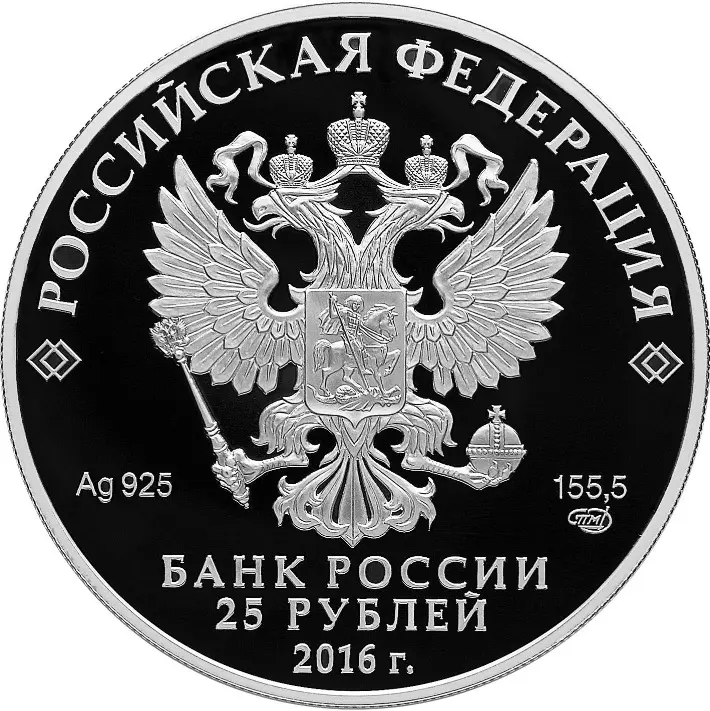
At the centre of the obverse is the relief State Emblem of the Russian Federation. Above it runs a circular inscription reading "RUSSIAN FEDERATION" in Russian, with paired rhombuses at the sides. Under the emblem are the mint's service marks and trademark, and below, in three lines, the inscription "BANK OF RUSSIA" and the year of issue. The austere design of the obverse leaves all the attention to the reverse with the crown and reminds us that the coin was issued by the state bank.
Reverse
In the centre of the disc, against elements of a traditional Russian ornament, is the Great Imperial Crown with coloured elements. At the top along the rim runs the inscription "DIAMOND FUND OF RUSSIA". Colour is used to render the stones of the crown, above all the red spinel at its summit. The ornamental background recalls the old Russian decorative tradition and joins the imperial crown with an older Russian pattern. The coloured details make the picture more expressive than on an ordinary coin of the same subject.