
The Imperial Scepter and Orb
PDFGeneral information

Description
In the old Russian tradition the sceptre and the orb were the objects the monarch took in his hands at the most solemn moment, the coronation. The sceptre spoke of the right to govern and judge, the orb of power over the earth. The set the coin tells about was made for Empress Catherine II in the 1760s and is now kept in the Diamond Fund of Russia in the Kremlin. The foundation of that collection is the decree of Peter the Great of 1719, so the sceptre and the orb are among its most honoured exhibits.
A special place in the sceptre belongs to the Orlov diamond of 189.62 carats, which was found in India, came to Amsterdam and there passed to the court jeweller I. Lazarev. The version of events most often retold is this: Count Grigory Orlov, one of the main figures of the coup of 1762, bought the stone and in 1773 gave it to Catherine. In 1774 the diamond was set in the sceptre. Above it is a cast golden eagle with black enamel and diamonds, and the smooth surface of the gold is divided by diamond rims.
The orb, made by the court jeweller Georg Friedrich Eckart, looks more modest: a golden sphere girdled by bands of diamonds. But it carries a Ceylon sapphire of 195 carats topped by a cross. The pair of objects is deliberately contrasted: a brightly burning diamond and a deep blue stone, the sharp details of the eagle and a smooth sphere. Such a combination gives the regalia both solemnity and expressiveness.
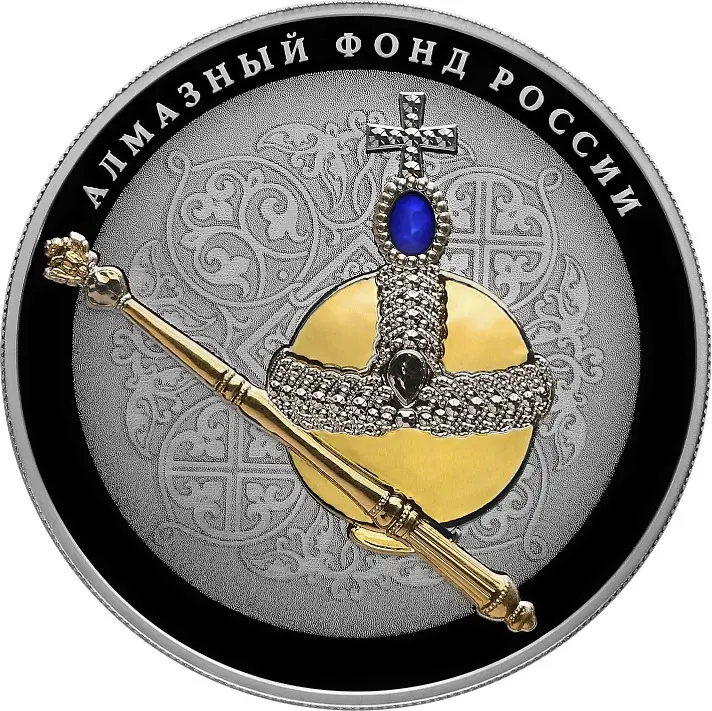
The special finish of the coin helps to see this expressiveness: the images of the symbols of power are gilded, and the orb carries a coloured element that conveys the tint of the sapphire. Gold on a silvery background underlines the likeness to the real objects, where gold was the principal material. For a collector such a coin is not just a copy of an exhibit but an attempt to convey its brilliance through modern striking and colour.
It is interesting that both objects are linked with the names of masters who worked for the court. Eckart was one of the leading court jewellers of the middle of the eighteenth century, and Lazarev belonged to the circle of jewel dealers who linked Russia with the world market in stones. Thus one object joins the history of palace workshops, international trade and politics.
Obverse
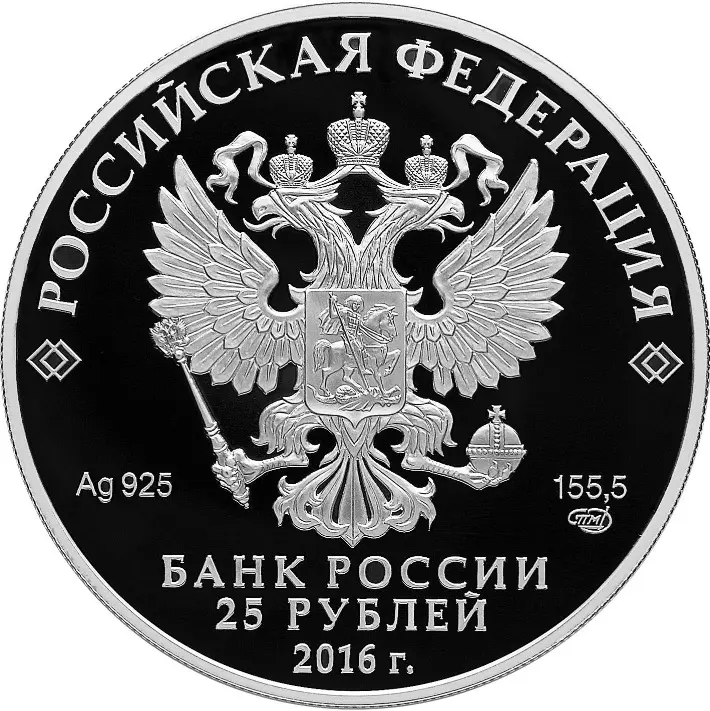
The relief shows the State Emblem of the Russian Federation. Above it runs a semicircular inscription reading "RUSSIAN FEDERATION" in Russian, with paired rhombuses on both sides. Beneath the emblem are the mint's service marks and trademark, and at the bottom, in three lines, the inscription "BANK OF RUSSIA" and the year of issue. The austere composition of the obverse does not distract from the main theme, the reverse with the regalia, but reminds us that the coin is issued by the state bank.
Reverse
Against elements of a traditional Russian ornament, the centre of the disc shows gilded images of the sceptre and the orb, with a coloured element picked out on the orb. At the top along the rim runs the inscription "DIAMOND FUND OF RUSSIA". The gilding conveys the colour of the real objects, and the colour highlights the stone on the orb. The ornamental background points to the old Russian decorative tradition, joining the imperial regalia of the eighteenth century with an older Russian ornamental art.