
Hygieia
PDFGeneral information

Description
The collector coin “Hygieia”, with a face value of ½ dollar, was issued in the name of Samoa in 2020 and is devoted to Hygieia, the ancient Greek goddess of health, cleanliness and the prevention of disease. Her name became the basis of the modern word “hygiene”, so the image chosen for the coin is directly connected with one of the most important spheres of human life — the preservation of health.
In ancient Greek mythology Hygieia was considered the daughter of Asclepius, the god of healing. Unlike her father, who personified the actual treatment of illness, Hygieia was associated above all with the maintenance of health, cleanliness and the prevention of disease. That is why in time her image acquired special significance in the history of medicine.
One of Hygieia’s main attributes is the snake. In ancient art the goddess was often depicted as a young woman with a snake which she holds in her hands or feeds from a bowl. This image later had an enormous influence on medical and pharmaceutical symbolism. The Bowl of Hygieia with a snake became one of the most recognisable international symbols of pharmacy.
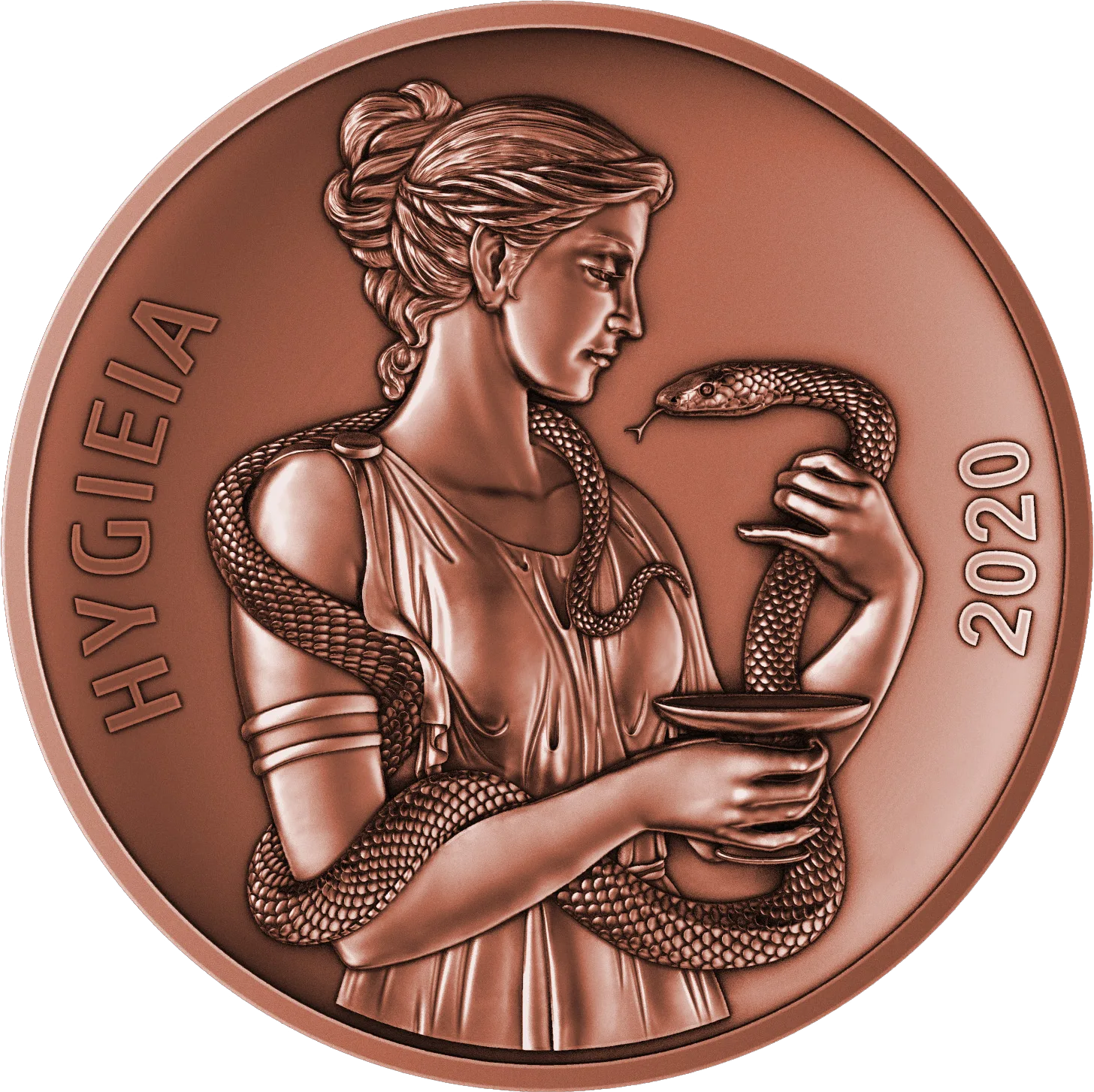
It is the classical image of the goddess with a snake that is used on the reverse of the Samoan coin. Hygieia is presented in ancient style with a large snake in her hands.
The coin is interesting not only for its subject but also for its unusual technical characteristics. It is made of copper and weighs as much as 155 grams. With a diameter of 60 mm its thickness reaches 10 mm. This is a very massive collector issue which in size and weight considerably exceeds ordinary coins.
Particular attention is drawn by the execution of the relief. The coin is struck in high relief, and its surface has a pronounced concave shape. Thanks to this the composition acquires additional depth: the image is perceived not simply as relief on a flat metal field but almost as a small sculptural composition.
The Antique Finish technique was used for the surface treatment. Darkened recesses contrast with the lighter protruding areas of the relief, which combines especially well with the ancient subject of the issue. This treatment visually recalls the natural patina of an old metal object and at the same time makes it possible to bring out the numerous details of the high relief better.
Despite its medal-like design, large size and unusual shape of surface, “Hygieia” is a collector coin of Samoa, not a medal or token. It has an official face value of ½ Samoan dollar.
The mintage of the issue is only 2,020 pieces — the number of pieces symbolically coincides with the year of issue. The coin is made in a Piedfort version with Antique Finish treatment.
Obverse
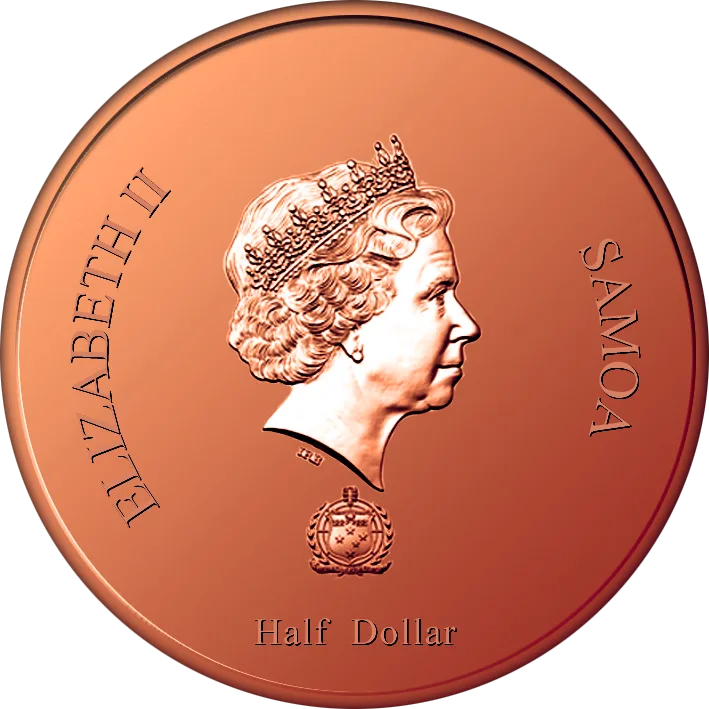
The main element of the obverse is the portrait of Queen Elizabeth II, facing left.
The portrait is based on the work of the well-known British sculptor and medallist Ian Rank-Broadley. His initials “IRB” are placed directly beside the image of the Queen.
Along the upper part of the coin runs the inscription “ELIZABETH II SAMOA”, combining the name of Elizabeth II and the name of the issuing state.
Below the portrait is a small State Coat of Arms of Samoa. Its presence directly indicates the state in whose name the coin was issued.
The composition of the coat of arms includes the national motto “FA’AVAE I LE ATUA SAMOA”, which can be translated as “May God be the foundation of Samoa” or “Samoa is founded on God”.
In the lower part of the obverse is the designation of the face value — “HALF DOLLAR”, that is, half a dollar.
The obverse thus performs above all an official function. It brings together the portrait of Elizabeth II, the name of Samoa, the country’s coat of arms, the national motto and the face value of the coin.
This side looks especially expressive thanks to its large size and high relief. With a diameter of 60 mm and a thickness of 10 mm, the portrait and state symbols have considerably more space than on an ordinary coin of standard size.
Reverse
The reverse is the main artistic side of the coin and is entirely devoted to the ancient Greek goddess Hygieia.
In the centre is a large classical image of the goddess. Hygieia is presented in the ancient tradition as a young woman, and the most important element of the composition is the large snake which she holds in her hands.
The snake has fundamental symbolic significance. In ancient tradition it was closely associated with Asclepius and his family and gradually became one of the main symbols of healing. The snake’s ability to shed its skin periodically gave rise to associations with renewal, recovery and the continuation of life.
The image of Hygieia differs somewhat from the images of deities directly connected with the healing of existing diseases. She personified above all the preservation of health, cleanliness and the prevention of illness. The image of Hygieia with a snake can therefore be perceived as a symbol of the preventive side of medicine.
Later the image of the goddess found a continuation in the famous Bowl of Hygieia — a bowl around which a snake coils. Today this symbol is widely used by pharmaceutical organisations and institutions in many countries of the world.
High relief plays a particularly important role on the reverse. The figure of the goddess and the body of the snake stand out noticeably above the surrounding field, and the concave shape of the surface creates an additional sense of depth. Thanks to this the composition resembles an ancient sculptural relief.
The effect is strengthened by the Antique Finish treatment. The dark areas in the recesses emphasise the contours of the figure, the folds of the clothing, the body of the snake and the many small elements of the image, while the protruding parts of the relief look lighter.
As a result a modern collector coin deliberately takes on the appearance of an ancient metal artefact. For a subject based on ancient Greek mythology, such an artistic solution is especially appropriate.
The inscription “HYGIEIA” is placed on the reverse, making it possible to identify the depicted goddess unambiguously.
Next to it is the year of issue, “2020”. The text design of the reverse is thus extremely laconic: only the name of the character and the year are present, while most of the surface is given over to the artistic composition.
Hygieia was chosen for the coin not simply as one of the numerous characters of ancient Greek mythology. Her legacy has survived in modern culture far more strongly than may appear at first glance. The very concept of “hygiene” derives from the name of the goddess, and the snake and the Bowl of Hygieia associated with her still remain among the most recognisable symbols of medicine and pharmacy.
The “Hygieia” coin was issued in the name of Samoa in 2020 with a face value of ½ dollar. It is made of copper, has a weight of 155 g, a diameter of 60 mm and a thickness of 10 mm. The coin is executed in high relief, with a concave surface and an Antique Finish treatment. The mintage is only 2,020 pieces.