
The honey bee
PDFGeneral information
Description
The honey bee stands out clearly from the other members of the bee family. In Slovakia it is the only one kept in hives and the only one that gives people honey, together with pollen, wax, bee venom, royal jelly and propolis, which is used in medicine. It is also unusual in that a whole colony spends the winter together and lives a continuous life: while solitary bees are barely waking up, honey bees are already out in the fields in early spring and become the most important pollinators of crops and wild vegetation.
To obtain two vital kinds of food, bees must visit flowering plants. Nectar or honeydew, rich in sugar, supplies energy for flight and a reserve for winter, while pollen, rich in protein, feeds the developing larvae. As social insects, bees show a clear division of labour, shared care of the brood and the ability to survive hard times: the colony keeps the nest at the right temperature and builds up stores.
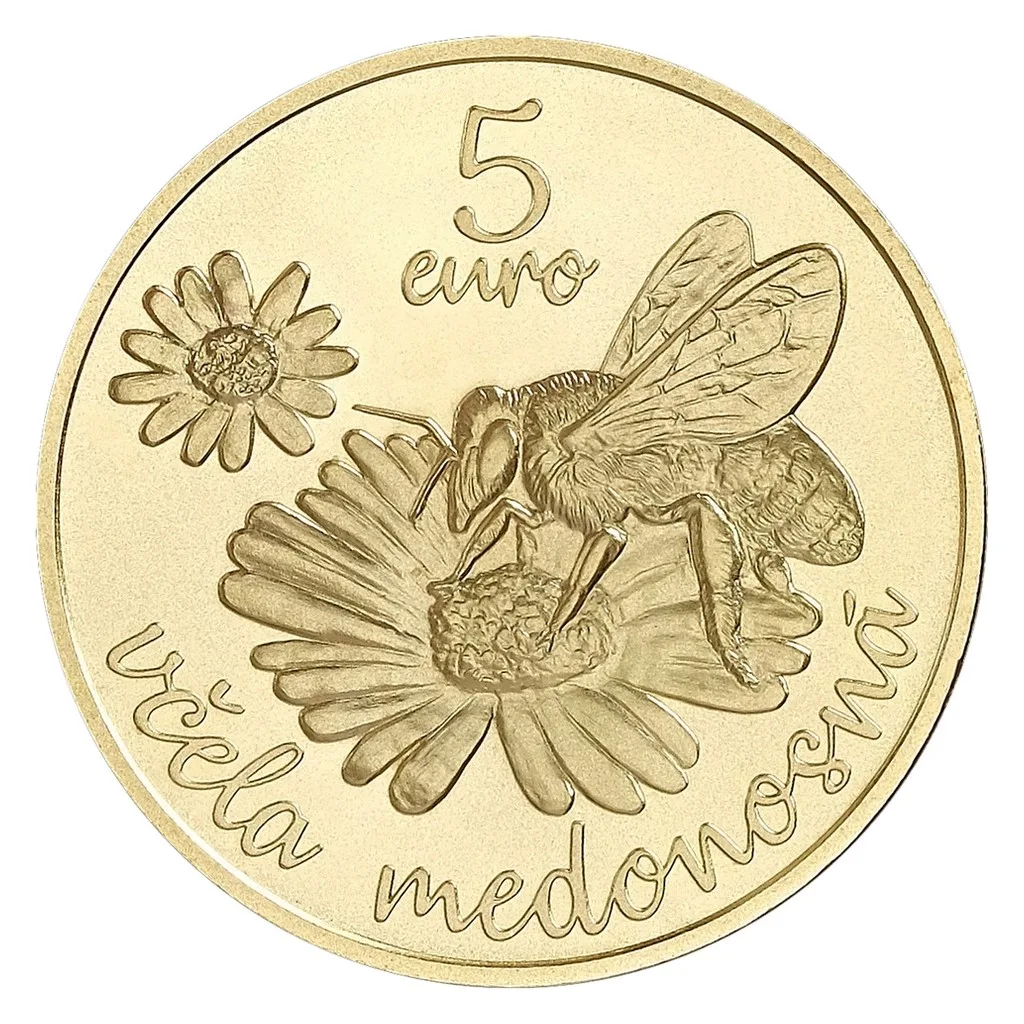
The role of bees in nature is not limited to honey. Above all they pollinate plants and so support harvests and the variety of meadows and gardens. Their numbers are hurt by climate change, intensive farming, chemical plant-protection products, and also by bacteria, mites and alien beetles. The motif of the coin grows out of the most important work a honey bee does for people, the pollination of a flower, and at the same time makes the bee a symbol of diligence and hard work. It is a reminder of how much depends on a small insect that we usually notice only when it stings.
A bee colony is one of the most complex organisms in the insect world. Thousands of worker bees, a single queen and seasonally appearing drones live in it, and each has its own task: some feed the larvae, others build the combs, others guard the entrance, and still others fly out for nectar. Returning to the hive, a scout tells the others where to find a flowering meadow by means of a special dance. This very coordination has made the bee a model of industriousness in many cultures, and its disappearance from the fields is today seen as an alarming signal about the state of nature as a whole.
Obverse
The artistic side shows a composition of two flowers and a honey bee sitting on one of them. In the upper part of the field "5 euro" is shown in two lines, and along the bottom runs the inscription "včela medonosná".
Reverse
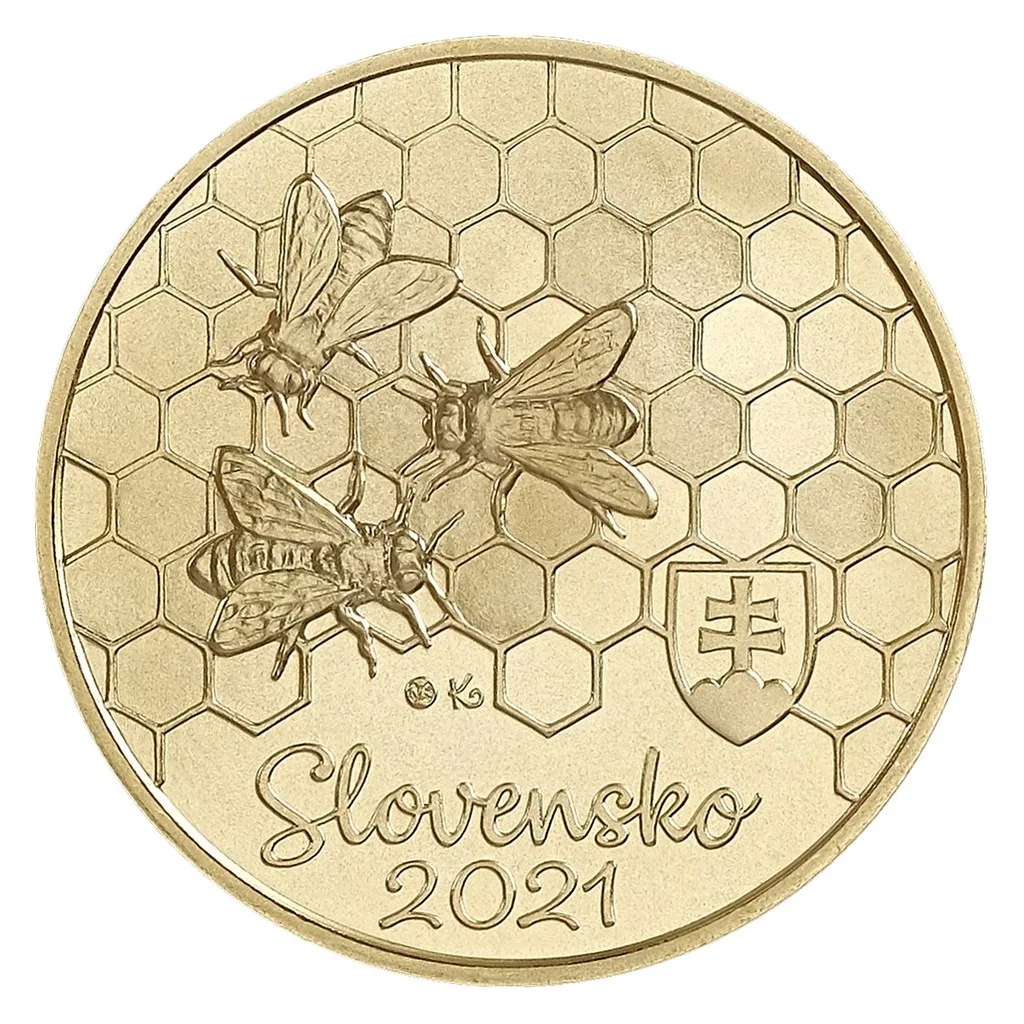
The official side shows three bees on a honeycomb, with the coat of arms of the Slovak Republic set into the right-hand part of the comb. At the bottom stands the name of the state, "Slovensko", with the year "2021" beneath it. Above the name is the mark of the Kremnica Mint, "MK" between two dies, and beside it the stylised initials of the author, "KL". The artistic solution is by the Slovak medallist Karol Ličko and the engraver was Dalibor Schmidt.