
The maned bison
PDFGeneral information
Description
The maned bison, better known in Europe as the wisent, is the largest land mammal on the continent, and its fate is one of the most dramatic stories of a species brought back from the brink. The animal looks a little like a heavy bovine: the head is short and rounded, the body and tail are covered with brown fur, the front of the body is clearly more massive than the rear, and the long hair on the chest and shoulders forms the shaggy "mane" that gave the animal its name. Both sexes carry powerful hollow horns, which are never shed and keep growing year after year.
The bison is active mostly at dusk, and its eyesight is adapted to that way of life, while hearing and smell are very well developed. A wisent lives for about thirty-five years. It is a social animal: only old bulls usually keep to themselves, and a typical herd counts from eight to thirteen animals. It feeds on the green and woody parts of plants, on twigs, bark and leaves, and likes young forest plantations with a rich undergrowth; in winter it relies on bramble, the bark of trees and shrubs, and dry grass that it scrapes out from under the snow.
Once the range of the wisent covered almost all of Europe, but the felling of forests and hunting drove the species to the edge of extinction: almost no free-living animals were left, and the species was saved only thanks to animals kept in zoos and reserves. Today about seventy maned bison live in Slovakia, in a once-empty part of the Poloniny National Park. This return of a mighty beast to the Carpathian forests is the motif of the coin. It reminds us that what has been lost can be won back when people take up the task, and it honours one of the best-known and yet most vulnerable inhabitants of the Slovak mountains.
The image of the wisent has long been part of Central European culture: it was painted on cave walls, medieval chroniclers wrote about it, and in hunting lore it was regarded as the most worthy opponent. All the more impressive is the fact that large herds once again roam the forested slopes of the Carpathians. The return became possible thanks to many years of work by zoologists, foresters and reserve staff, who bred the animals, chose release sites and watched the health of the population. For Slovakia the wisent is not simply a rare beast but a living sign that a society can correct its own mistakes towards nature.
Obverse
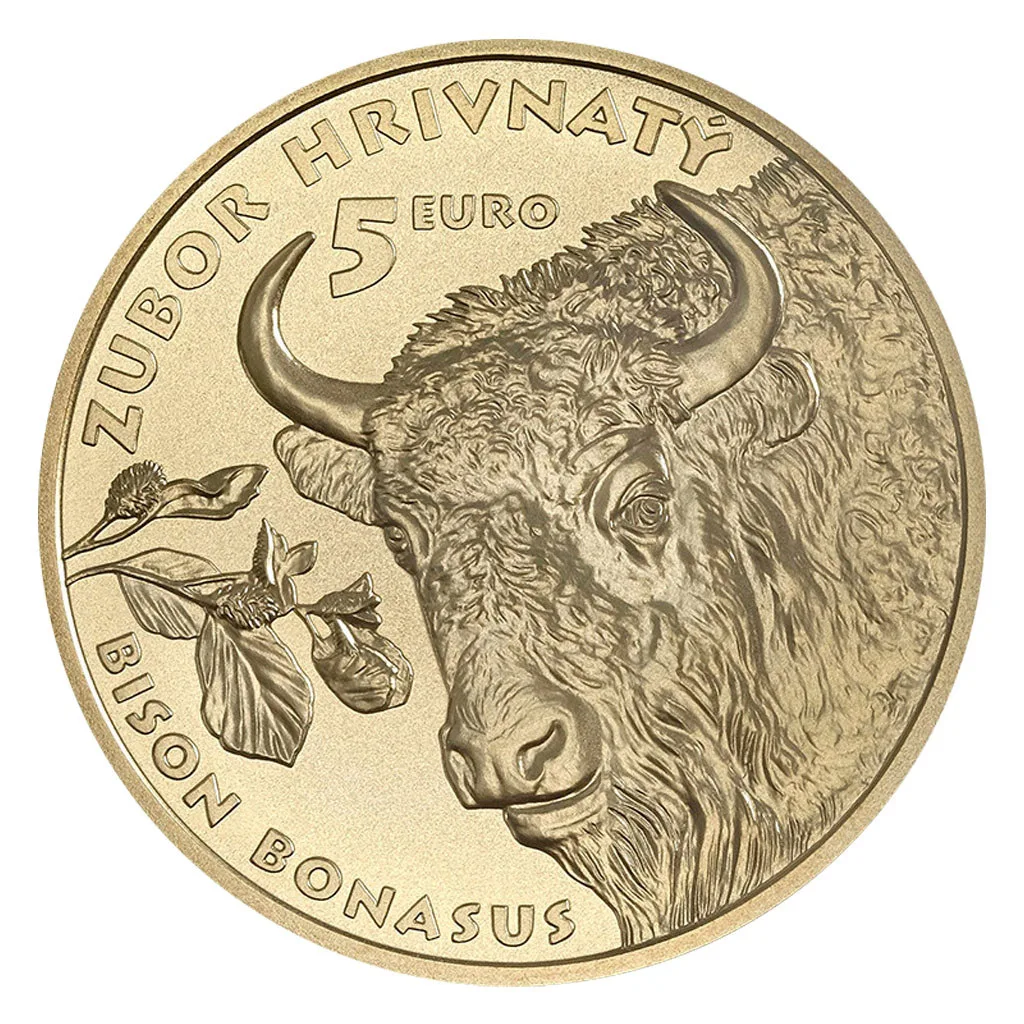
The artistic side shows the head of a maned bison, a heavy, slightly lowered profile with mighty horns and thick hair on the forehead and neck. Above the head stands the inscription "5 EURO", the upper part of the field carries the Slovak name "ZUBOR HRIVNATÝ" and the lower part the Latin name "BISON BONASUS". The two names are separated by a small twig with beech leaves and the initials.
Reverse
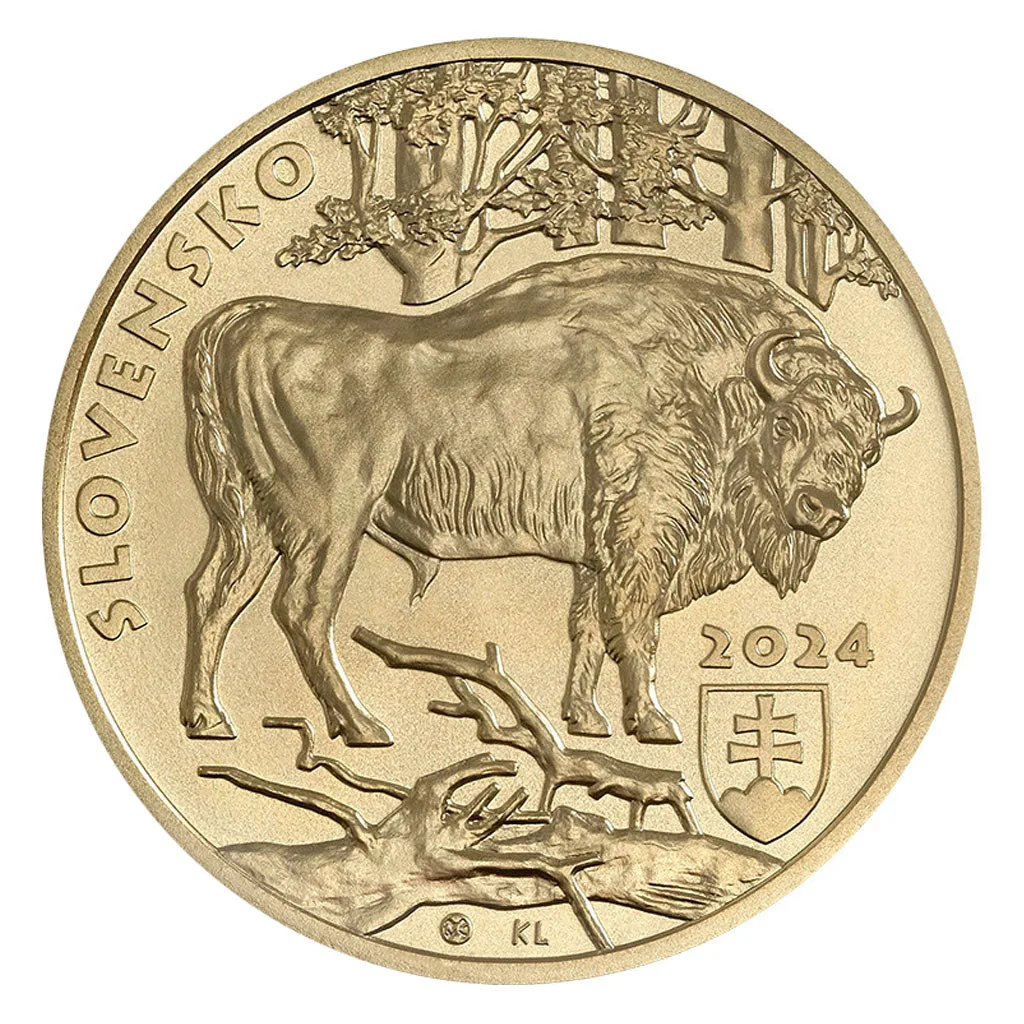
The official side shows a male bison among trees: tree trunks stand in the background and fallen branches lie in the foreground. To the right of the composition is the coat of arms of the Slovak Republic with the year "2024" above it, and the inscription "SLOVENSKO" runs along the left of the field. Along the lower edge are the mark of the Kremnica Mint, "MK" between two dies, and the stylised initials of the author, "KL". The design is by the Slovak medallist Karol Ličko and the engraver was Dalibor Schmidt.