
Best of the Mint Standing Liberty Gold
PDFGeneral information

Description
The 1916 Standing Liberty quarter is among the boldest and most recognisable coins of the United States. It was created by the sculptor Hermon Atkins MacNeil, and in 2026 the design gained a new life in the jubilee programme Best of the Mint. The gold coin repeats the original design, and a paired silver medal is issued with it, on which the same image is read in a modern way.
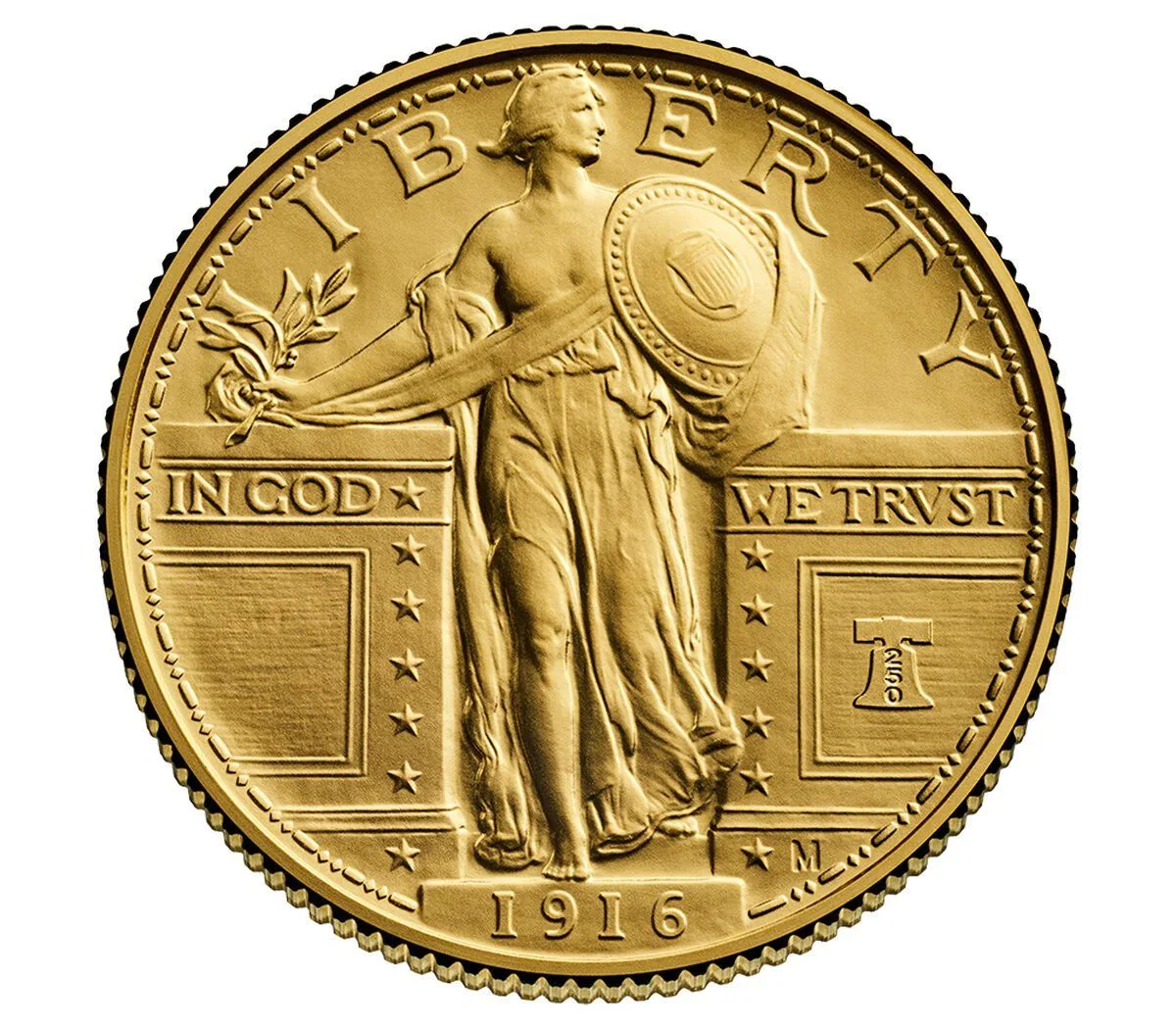
The image of Liberty on this coin is unusual: a female figure stands at full height, stepping through a gap in a wall on which thirteen stars are carved. In one hand she holds a shield and in the other an olive branch. MacNeil showed Liberty not as an abstract allegory but as an active heroine, ready for both peace and defence. It is this duality that makes the coin so expressive.
The quarter appeared in 1916 together with the Mercury dime and the Walking Liberty half dollar as part of a large renewal of American small change, and at once caused controversy. The first version showed Liberty with a bare breast, which many found excessive. In 1917 the design was changed, giving her a coat of mail, and the coin became more restrained. It stayed in circulation until 1930.
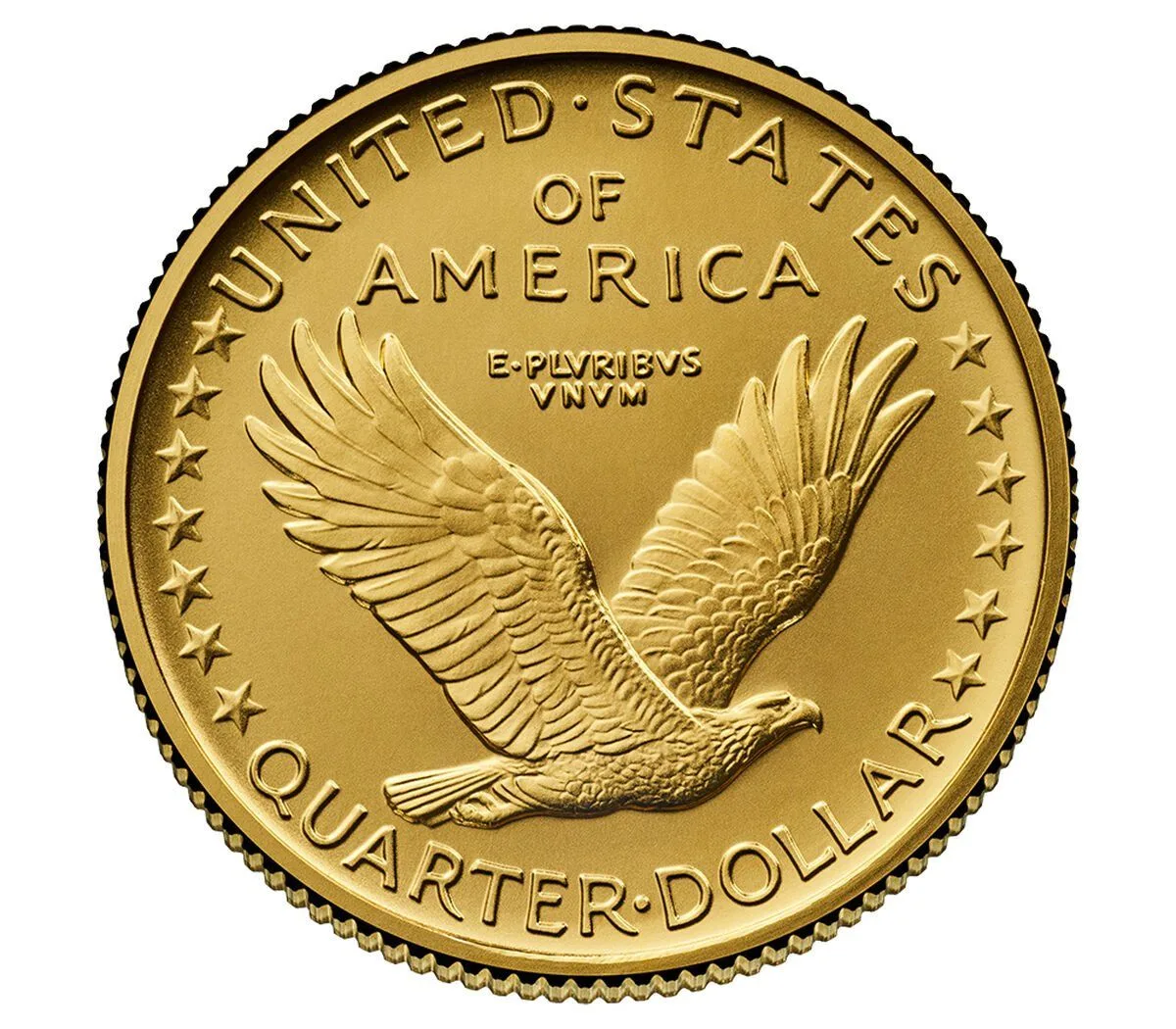
The reverse of the original shows an eagle in flight with thirteen stars around it. Thirteen is the number of the first states, and it is repeated on the front, on the wall through which Liberty emerges. Both sides are thus joined by one idea: the country grows from thirteen colonies into something greater, and the eagle, the heraldic symbol of the nation, soars above the process.
In the jubilee embodiment the design is reproduced with great accuracy, and a privy mark has been added to the coin, the Liberty Bell with the figure 250. The Mint did not publish the names of the engravers of the reissue, so authorship still belongs to MacNeil. For the programme this is fundamental: the jubilee does not replace the master but returns his work to the viewer.
The gold quarter is an object that can be seen both as a historical document and as a work of art. It reminds us that an American coin was never merely a means of payment: it was given the significance of a national symbol, and the best artists of the day worked on its face.
The story of the quarter is often told as one of a quarrel between modesty and beauty, but it is no less important that it became one of the first American designs in which an allegory acquired movement. Liberty does not pose but acts, taking a step, and that step is remembered better than any inscription. The jubilee gold issue returns precisely this sense of movement to the viewer.
Obverse
Liberty at full height steps through a gap in a wall with thirteen stars; she holds a shield and an olive branch. The branch is a sign of peace, the shield of readiness to defend, and the movement through the gap the nation's advance toward new frontiers. The author of the original design is Hermon Atkins MacNeil; a privy mark with the Liberty Bell and the figure 250 has been added to the coin.
Reverse
An eagle in flight, surrounded by thirteen stars, repeats the reverse of the original. The stars recall the first thirteen states and echo the wall on the front. The composition is soaring and solemn: the bird has spread its wings and the stars radiate outward.