
Trolleybus
PDFGeneral information

Description
The trolleybus is a special kind of urban transport: it draws electricity from overhead wires, does not pollute the air with exhaust and glides quietly along the streets, leaving citizens able to hear their own city. In Belarus it is one of the best-loved forms of transport. Trolleybus networks work in Minsk and in several other large cities, and the very history of the country's electric transport is linked with the wish to make the city cleaner and more convenient. On the coin Tralejbus a whole page is devoted to this image. For many citizens a trolleybus ride is a familiar ritual: to work in the morning, home in the evening, book in hand, with a view of familiar streets through the big window.
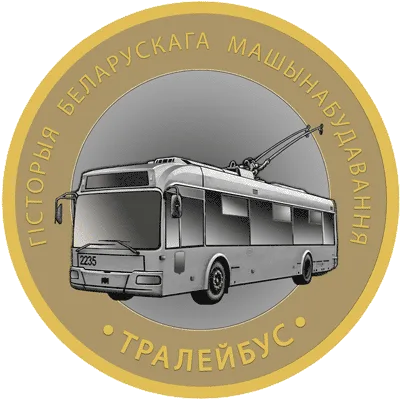
The coin shows the city trolleybus BKM-321, created by the Minsk enterprise Belkommunmash. The company arose in the 1970s as a plant for repairing trams and trolleybuses, and in the 1990s it mastered its own production of passenger electric transport. Since then it has become the main supplier of trolleybuses, trams and electric buses for Belarusian cities and one of the notable makers of electric transport in the post-Soviet space; machines built in Minsk work in dozens of cities in Belarus, Russia, Ukraine, Moldova, Kazakhstan and other countries.
The BKM-321 is a low-floor trolleybus designed so that people with limited mobility, parents with prams and elderly passengers can use it in comfort. A modern traction control system helps to save electricity, and the roomy cabin is planned for the city flow. For many Minsk residents this type is the picture of an everyday ride: hundreds of such machines run through the streets of the capital every day, and the familiar pair of current collectors on the roof has become as much a part of the urban landscape as bridges and lamp posts.
Electric transport in Belarus develops steadily: the country has not only kept its trolleybuses but added electric buses to them, and Belkommunmash takes part in modernising urban infrastructure. So the coin speaks not only of the past but also of the future of cities in which quiet and clean air have ceased to be a luxury.
The trolleybus story in Belarus began in 1952, when the first line linked the streets of Minsk; since then electric transport has been part of the urban order, and depots have become enterprises of their own with repair shops and training classes for drivers. In Soviet times the trolleybus driver's trade was considered prestigious: it demanded endurance, knowledge of the electrical part and skill with passengers. Today articulated and extended models have joined the familiar machines, and electric buses are replacing some routes, but the principle remains the same: power from the overhead wire. For a city this means a predictable timetable, no exhaust in the centre and a noise level at which you can hear the footsteps of passers-by.
Obverse
The artistic side carries a relief image of a BKM-321 trolleybus in profile, with its recognisable low-floor body and two current collectors on the roof. Around it run the inscriptions: at the top ГІСТОРЫЯ БЕЛАРУСКАГА МАШЫНАБУДАВАННЯ, at the bottom ТРАЛЕЙБУС. The fine relief conveys the lines of the body and the large windows of the cabin.
Reverse
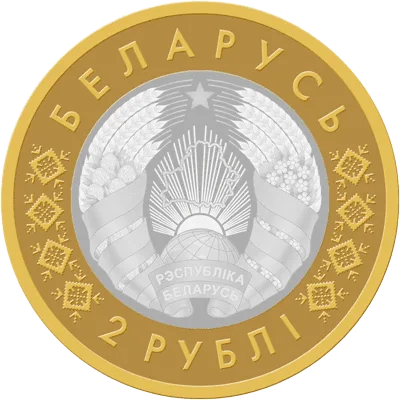
The official side shows a relief of the State Coat of Arms of the Republic of Belarus; around it are engraved the name of the country, БЕЛАРУСЬ, and the mark of the currency unit, with a stylised national ornament set between the inscriptions. The word БЕЛАРУСЬ, the year 2025 and ornamental elements repeat along the edge. The concise state symbolism stands against the expressive industrial subject of the obverse.