
Panda, 1/2 oz (1983)
PDFGeneral information




Description
The bullion Panda coin of 50 yuan in gold, 1/2 oz, belongs to the 1983 Chinese Panda issue. The denomination of this coin is 50 yuan, its weight is 1/2 oz and its diameter is 27 mm. The actual mintage according to the Bank of China is 28 596. The whole mintage of this denomination contains about 444.3 kg of pure metal, and this figure reflects the coins actually struck rather than a planned limit. The coin contains about 15.54 g of pure metal at 999 fineness, i.e. 0.5 troy ounce. One yuan of face value corresponds to 0.311 g of pure gold, so the face value is far below the market price of the metal and is only symbolic. The share of this coin in the maximum mintage of bullion coins of the same metal in the issue is about 11 %. Compared with the lightest gold coin of the issue (1/20 oz, 1.555 g) this coin is 10 times heavier, and compared with the one-ounce gold coin it makes up 50 % of its mass. A diameter of 27 mm at this mass gives a thickness and weight against which the coin can be checked with the specification table of the 1983 issue: any deviation from the stated mass and size is a reason to doubt the authenticity of the piece. In the structure of the issue this is the half-ounce coin — a compromise between the price of the one-ounce piece and its size; such coins are often bought to complete a “all weights of the year” set. The denominations of the issue differ both in the price of the metal and in their purpose: with the large pieces the buyer pays for the metal and its rarity, with the small ones for the very possession of a year of the series. The difference in diameter within one issue is not accidental: with the same design, size helps to tell the coins apart at a touch, by the edge and by weight. The coin is a bullion piece: it is struck from high-fineness metal and sold at a price close to the value of the metal, with a small premium. That is why bullion pandas come without presentation packaging or a certificate — they are bought not as a souvenir but as a way of holding savings in precious metal.
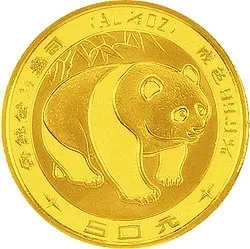
The 1983 design is a single adult panda standing in profile and turning its head toward the viewer. The paws hold nothing, the animal rests on the smooth surface of the field, and stylised bamboo leaves and a branch are drawn above and behind it. It is an early issue with a restrained composition: no water, rocks or cub. The design is shared by all five gold denominations; the issue has no silver bullion coin. The sources name the subject briefly — “Giant Panda” (大熊猫).
The giant panda is not merely a rare animal but a national symbol of China and one of the most recognisable images in the world. Its depiction on the coins of the Chinese Panda series has become a genre of its own: the artists of the Chinese mint look for a new angle, a new pose and a new subject every year, so even a small design reads as a miniature.
Bamboo forms the basis of the giant panda’s diet: shoots, stems and leaves provide up to ninety-nine per cent of its food. The animal feeds sitting down, freeing its front paws, and spends up to twelve hours a day eating, consuming thirty to forty kilograms. To grip a slippery stem the panda has a “false thumb” — an enlarged wrist bone that works as a sixth digit.
The giant panda lives only in the mountain forests of central China — in Sichuan, Shaanxi and Gansu, at elevations from 1200 to 3400 metres. A thick double coat protects it from cold and damp, and the contrasting black-and-white pattern, according to one hypothesis, helps the animals recognise one another and blend into the dappled light of bamboo thickets and into snow.
About 1800–1900 giant pandas remain in the wild, and several hundred more live in zoos and breeding centres. In 2016 the International Union for Conservation of Nature moved the species from “endangered” to “vulnerable”, and in 2021 China created the first Giant Panda National Park, covering more than 27,000 square kilometres.
Since 1961 the image of the giant panda has served as the emblem of the World Wide Fund for Nature, and the loan of animals to zoos in other countries became a special form of “panda diplomacy”. Pandas breed slowly: a female gives birth once every two or three years, usually to a single cub weighing about a hundred grams, and stays with it for up to one and a half to two years.
Pandas climb trees well and swim well, and in hot weather they like to rest in the shade or in water. A tree is both a refuge and a lookout: leaving the cub on the branches, the mother goes off to feed, and in case of danger the little one climbs higher. Adults live alone, meeting only briefly, and mark the borders of their home ranges by scent.
The 1983 bullion coins are five gold coins (1/20, 1/10, 1/4, 1/2 and 1 ounce); the issue has no silver bullion coins. The on-sale date is not named in the available sources, so only the year is given. The gold mintages are actual figures according to the Bank of China.
Obverse
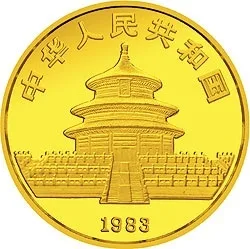
The Temple of Heaven in Beijing, common to all coins of the issue, with the inscription “中华人民共和国” (People’s Republic of China) and the year 1983.
Reverse
A panda stands in profile with its head turned toward the viewer, with bamboo leaves and a branch above and behind it (“大熊猫”). The coins bear the face value, weight and fineness