
Albatros D.II (1 Peso)
PDFGeneral information

Description
If we look for the aircraft with which the air war began in its familiar form — organised, tactical, with hunting units — it is the Albatros D.II. It was created at the Albatros-Flugzeugwerke factory in Johannisthal, with Robert Thelen as the chief author. The machine appeared as a correction of the faults of the previous model: pilots complained that the upper wing of the D.I blocked the view upward. The designers lowered the wing and moved it forward, and rearranged the struts — and the aircraft became noticeably more convenient in combat.
The new fighter also received a streamlined plywood fuselage glued on the semi-monocoque principle. For 1916 this was a bold solution: the body turned out stronger and more aerodynamic than the usual framed structures with fabric covering. The engine stood in front, the machine guns above it, and the pilot aimed with the whole aircraft, pointing the nose at the target. Such a layout, which became standard, was only being worked out on the D.II and proving its effectiveness.
The D.II came to the front in September 1916 and at once showed what it was worth. The first hunting squadrons — Jagdstaffel, created on the idea of the strategist pilot Oswald Boelcke — received precisely this machine. Their task was to seek out and destroy enemy aircraft, and the tactics worked out on the D.II became the basis of air combat for the rest of the war. It was in such an aircraft that the future “Red Baron” scored his first air victory.
In 1994 the Cuban mint included the Albatros D.II in the series “Famous Aircraft”, issued for collectors. The coins of the series, struck in Havana, were not meant for payments and became small miniatures of aviation history. For a collector this subject is interesting because next to the Fokker triplane it shows the second face of German aviation — less famous but no less important.
The people who flew the D.II should also be mentioned. They were pilots of a new generation: young, trained in flying schools, brought up on the idea that air combat is a discipline and not only courage. Boelcke set down his rules of air combat as a small code — the “Dicta Boelcke” — which others adopted. Aircraft and strategy thus developed together, and the coin with the Albatros recalls that fortunate union of technology and thought which in 1916 changed the character of war in the air.
Obverse
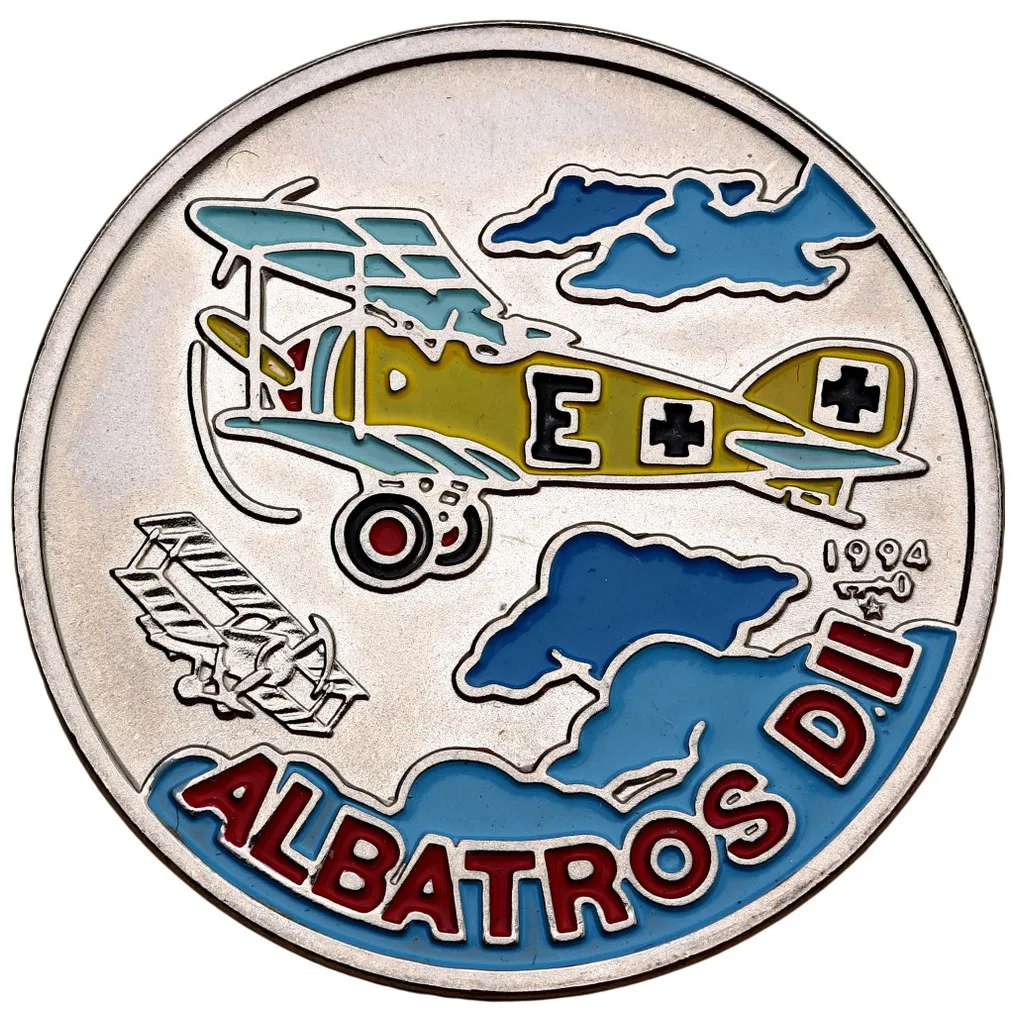
The obverse is the artistic side. The Albatros D.II biplane is shown in flight: the relief conveys the streamlined body and the forward-shifted upper wing, while hand painting picks out the yellow-green surfaces and black markings. Around it, on painted parts of the field, outlines of clouds and water can be read. At lower left is a small graphic drawing of the same aircraft, at right the year 1994 and the mint mark; the name ALBATROS D.II runs along the lower arc and is also painted by hand.
Reverse
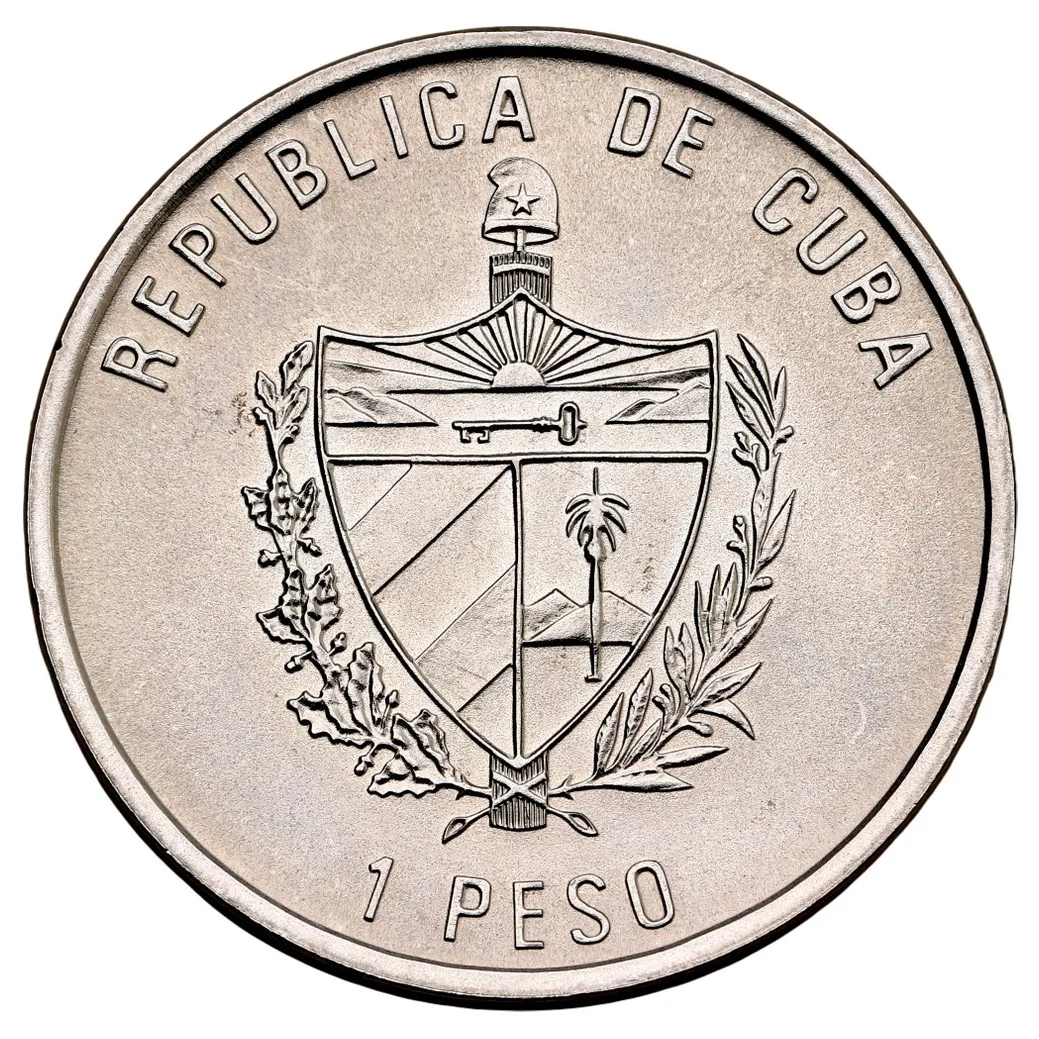
The reverse is the official side common to all coins of the “Famous Aircraft” series: the national arms of the Republic of Cuba in a drawing that goes back to Charles Edward Barber’s work. A shield with a landscape, a key, a royal palm and a rising sun is surrounded by oak and laurel branches and topped with a fasces bearing a Phrygian cap and a star. The inscription REPUBLICA DE CUBA runs along the upper arc, and below the arms the coin’s denomination is marked. The strict heraldry balances the bright painted scene on the other side.