
Butterfly Flower (5 Pesos)
PDFGeneral information
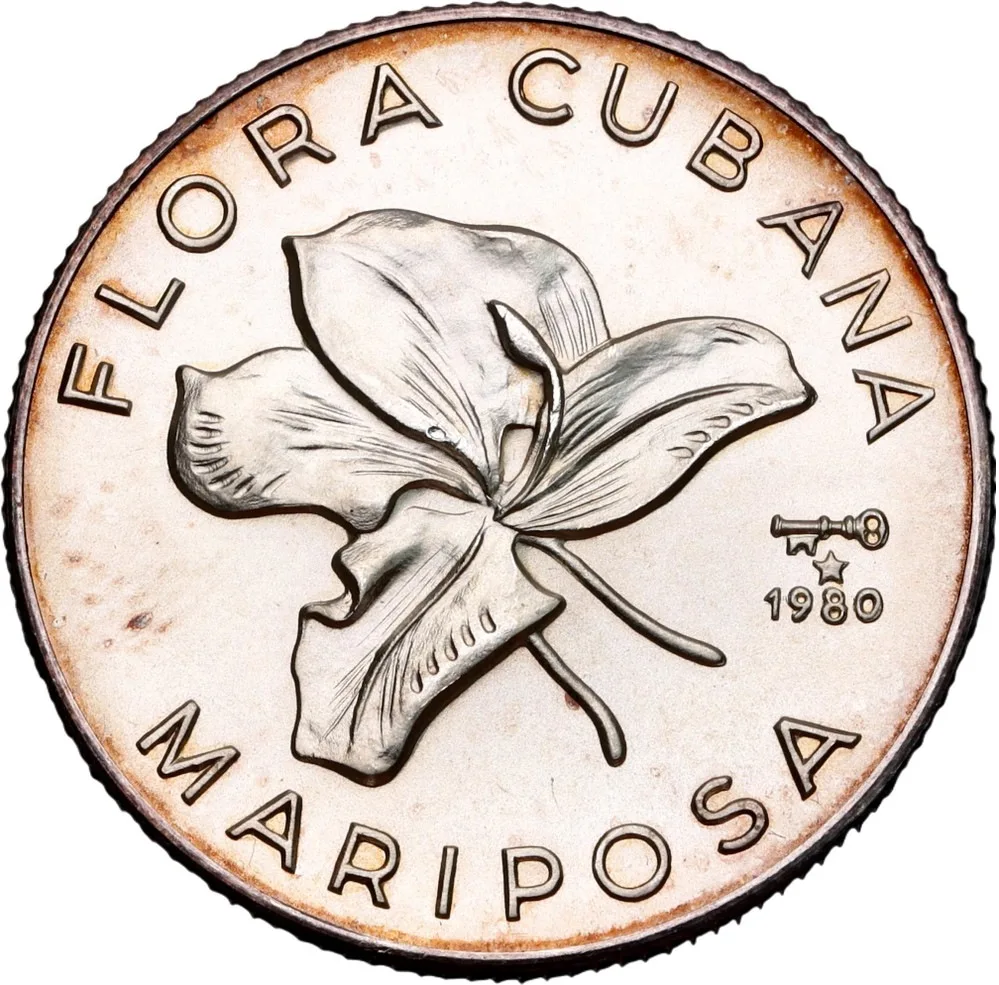
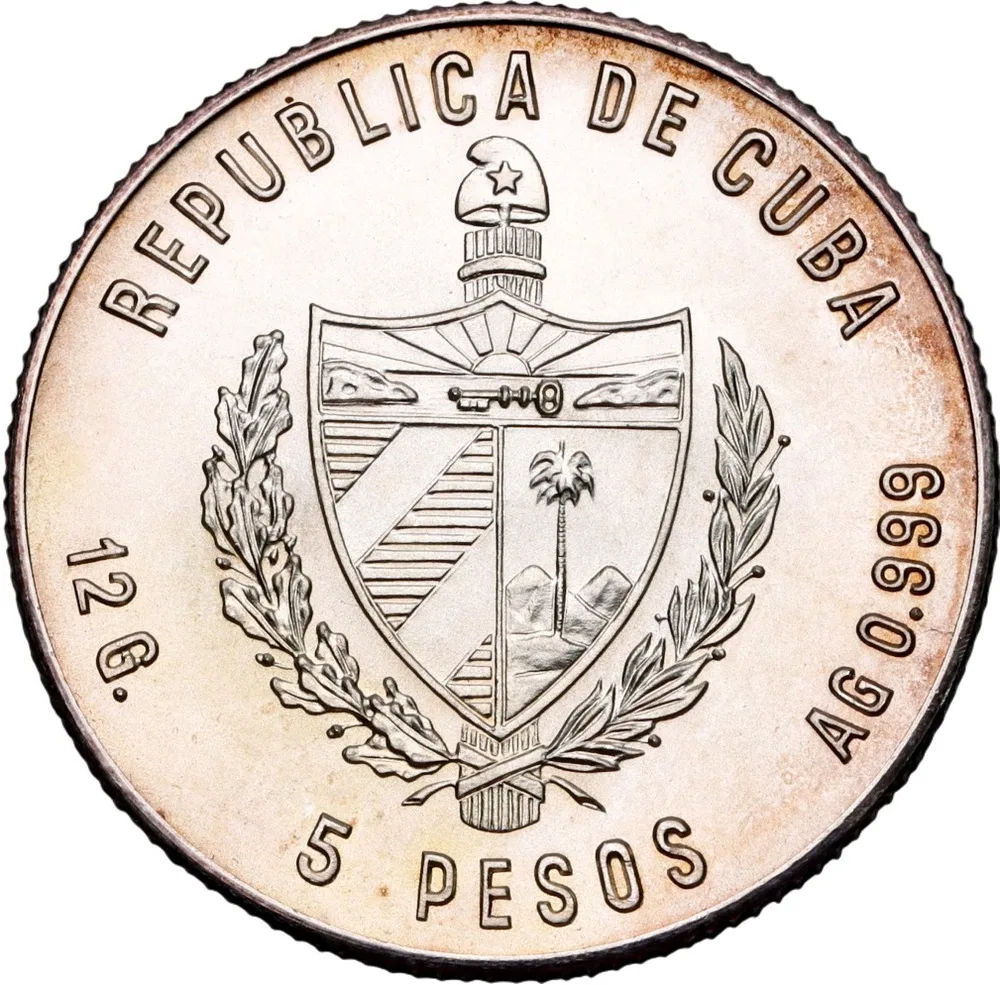
Пруф
Исполнение Proof («пруф»). Это та же монета, что и основная карточка, но отчеканена на полированных заготовках двумя ударами: поле получило зеркальную поверхность, рельеф — матовую и контрастную. Тираж — 3000 экземпляров, каталожный номер Аледона AAEE 029; обычное исполнение BU — 10000 экземпляров (AAEE 032). Характеристики обоих исполнений одинаковы: серебро 999 пробы, масса 12 г, диаметр 30 мм, рубчатый гурт; монетный двор Empresa Cubana de Acuñaciones (Гавана, Куба). Официальная сторона — герб Кубы с легендой REPUBICA DE CUBA, художественная сторона — цветок-бабочка с названием программы и годом. По каталогу Аледона 1999 года пруфовая монета стоила $38, обычная — $27.

Description
Cuba has a flower that everyone knows, from schoolchildren to poets: the white mariposa. In English it is called butterfly ginger lily, and botanists call it Hedychium coronarium: its large white blossoms, with petals spread like wings, really do look like a butterfly alighting on a stem. The plant belongs to the ginger family and is native to Asia, but it has settled on the island so well that it has become part of the landscape: it grows along riverbanks and in damp places, and its thick sweet scent can be felt from afar, especially in the evening.
In 1936 the mariposa was proclaimed the national flower of Cuba, and ever since it has been one of the country’s symbols. A tradition from the wars of independence is attached to it: white flowers and buds, so the stories go, helped patriots pass secret notes to one another, hidden in the blossoms and in hairstyles. Historians argue about how much of this is legend, but the image has stuck: the white mariposa recalls peace, unity and the memory of the struggle for freedom, which is why its depiction is especially fitting on a coin.
The “Flora Cubana” series of 1980–1981 is one of the first thematic programmes of the Cuban mint intended for collectors: the coins were not issued for circulation. It has three subjects — the butterfly flower, the orange blossom and the orchid — and the butterfly flower opens the series because for Cubans it matters more than the others. The coins were struck in Havana, while the designs for the dies of the artistic sides were prepared in Spain, so the artists’ names are not given in the sources.
The composition is simple and poetic: in the centre an open flower surrounded by leaves, and a caption naming the plant in Spanish. No contrived details — only the flower, as in a botanical illustration. That simplicity gives the coin dignity: there is nothing superfluous on it, and the eye stops at once on the image itself, of Cuban nature and Cuban memory.
It is also curious how the mariposa entered Cuban culture. It is called the flower of love for the homeland, its petals are compared with a bride’s white dress, its scent with the cool of evening after a hot day. For emigrants far from the island the white mariposa has become a reminder of home, and this gives a simple botanical subject a special human tone. A coin with nothing on it but the flower says this more quietly and more precisely than any inscription.
Obverse
The artistic side is occupied by a large open mariposa flower with long petals and slender leaves around it. The flower is shown in soft relief so the curves of the petals and the veins of the foliage are easy to distinguish. The inscriptions name the programme — FLORA CUBANA, the plant — MARIPOSA, and the year 1980; the mint mark is here too. The composition is built without superfluous background, so the white flower, as in life, reads as the hero of the scene. The petals are raised slightly and the leaves are rendered flatter, which makes the flower seem to step forward.
Reverse
The official side is the same on every coin of the series: the national arms of the Republic of Cuba in a drawing that goes back to the American engraver Charles Edward Barber. The shield is divided into three fields, a Phrygian cap with a star stands above it, laurel and oak branches flank it; the inscription REPUBLICA DE CUBA runs along the arc, and the coin’s denomination is marked below. The strict heraldic reverse balances the soft, living floral composition of the artistic side and confirms that this is a state issue.