
Chalicotherium (1 Peso)
PDFGeneral information

Description
Chalicotherium is an animal that is hard to believe ever really existed. It has the head of a horse, but its forelegs are longer than the hind legs and end not in hooves but in large curved claws. It lived in Europe, Asia and Africa from the Oligocene to the Pliocene, roughly 28 to 3 million years ago, and belonged to the odd-toed ungulates, so it was a distant relative of horses, rhinoceroses and tapirs.
When palaeontologists first found its bones they could not for a long time assemble a coherent picture. The teeth resembled a horse's, while the claws resembled those of a sloth or some other animal of an entirely different group. Only when sufficiently complete skeletons were found did it become clear that both belonged to one creature, and this discovery forced a revision of ideas about how odd-toed mammals could look.
We now know what Chalicotherium's claws were for. It used them to pull down high tree branches and eat foliage that was out of reach at height. Its forelimbs were long, its shoulder girdle powerful and its neck flexible. To rest on the claws the animal apparently walked on its knuckles, like a gorilla, so as not to wear down its tool. The genus name is tied to the teeth: the Greek word chalix means pebble, and the Chalicotherium tooth resembled a rounded stone.
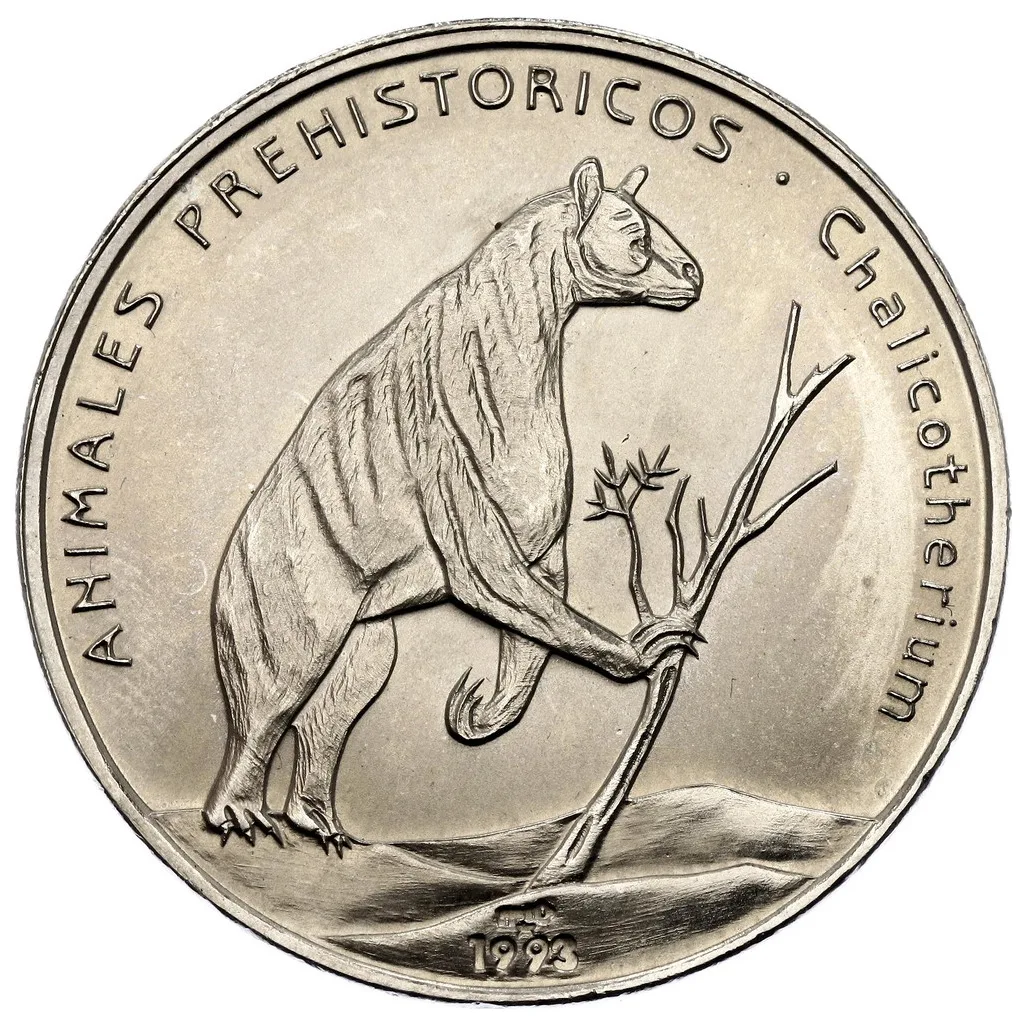
The image on the coin is Chalicotherium standing by a tree: forepaws stretched out and resting on the trunk, the neck bent toward the branches. The tree in the composition is no accident: it shows how the animal got its food. The viewer completes the rest himself, and anyone who has ever seen a giraffe or a sloth will understand the principle at once.
Among Cuban coins about ancient life Chalicotherium represents not dinosaurs but mammals, those that outlived them by tens of millions of years. It is a reminder that nature has more than once tried to create bizarre forms, and many of them vanished without trace, leaving only bones and riddles.
The animal's pose on the coin is almost comic and yet touching: it stretches like a person reaching for an apple on a high branch. This humanlike trait has made Chalicotherium a favourite of palaeo-artists, and its image is well remembered even by those who take no interest in palaeontology.
For the collector the coin is valuable also because it shows a rare subject: Chalicotherium is not often portrayed on world coins, and so a drawing that joins scientific accuracy with expressiveness is especially effective.
Obverse
The artistic side shows Chalicotherium by a tree: forepaws stretched out and resting on the trunk, the long neck bent toward the branches. The name of the programme runs in an arc above the drawing, with the animal's name, year and mint mark beside it. The whole drawing is rendered in relief. The design is by Alberto González Pereztol and the engraving by Belisario Álvarez Collado. The modelling of the figure conveys the long neck, the stooped back and the recognisable claws. The tree serves not only as a background but as the support of the whole composition.
Reverse
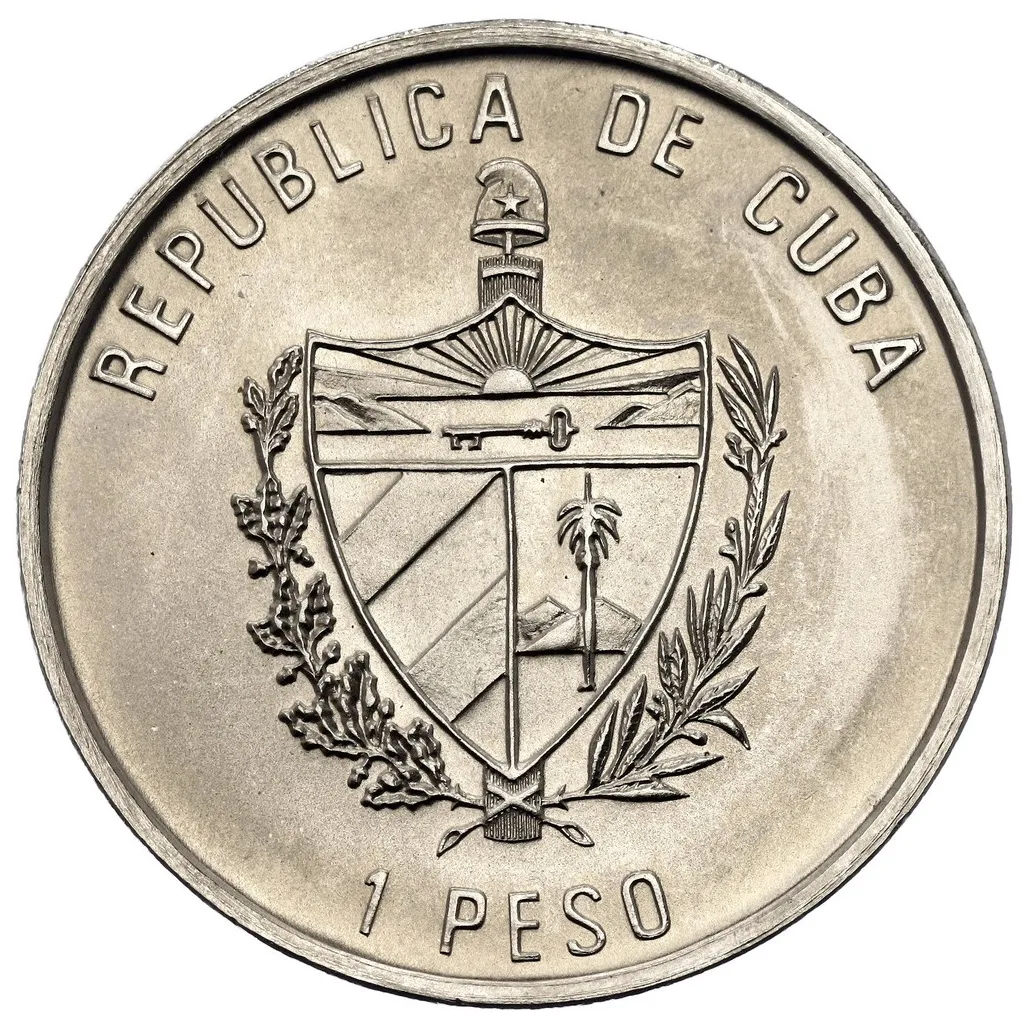
The official side is adorned with the national coat of arms of the Republic of Cuba: a shield with a rising sun, a royal palm and a key, framed by oak and laurel branches, under a Phrygian cap with a star. The design of the arms goes back to the work of the American engraver Charles Edward Barber.