
Cuban Crocodile (1 Peso)
PDFGeneral information

Description
If Cuban nature were choosing a reptile as its symbol, it would be the crocodile with a diamond pattern on its back, hence the Latin name Crocodylus rhombifer. It is not very large by crocodile standards, but it is strong and agile. The species lives in a small part of the island — the Zapata swamp and the Isla de la Juventud (formerly Isle of Pines) — and nowhere else in the world. That is why it is considered one of the rarest crocodiles on the planet.
Its behaviour is curious. The Cuban crocodile walks well on land on high legs and can run fast over short distances. It hunts by ambush and can leap out of the water almost to the height of its own body to seize prey from a branch or the bank. It feeds on fish, turtles, small mammals and birds. The female builds a nest in the form of a mound of plant matter and guards the clutch; hatchlings remain under the mother’s watch.
Hunting and the draining of swamps in the twentieth century led to a sharp decline in numbers. Present protection includes reserves and nurseries where the species is bred deliberately. For Cuba’s conservation work the crocodile is one of the main subjects, so its appearance on a collectible coin is not accidental: in 1981 the Cuban mint drew attention to a rare animal this way.
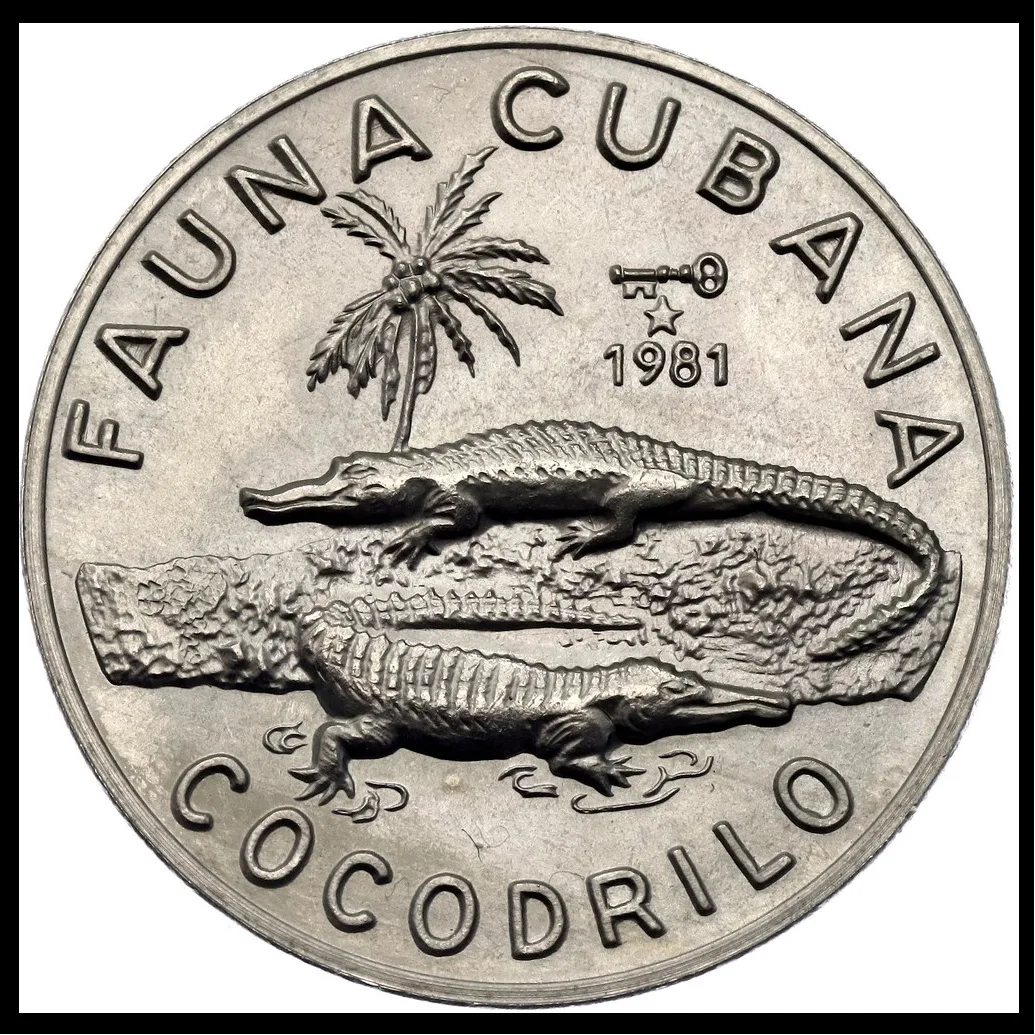
The coin belongs to the “Fauna Cubana I” series, which includes three subjects: the bee hummingbird, the emerald hummingbird and the Cuban crocodile. The series was struck in Havana for collectors. The drawing conveys the powerful silhouette of the reptile: a long snout, the cluster of scutes on the back and a heavy tail. This creates the image of a creature that came from the depths of time yet lives next to us.
The crocodile theme is not new in Cuban art: the island itself is often compared to a lying crocodile — that is how its outline, stretched from east to west, looks on old maps. Poets have called Cuba a long green lizard, and perhaps for this reason the image of the reptile is perceived by Cubans as something of their own rather than merely a zoological subject.
Obverse
The obverse is the artistic side. The Cuban crocodile is shown in profile against water and vegetation: a powerful body, scaly skin, rows of scutes along the spine, an elongated mouth. The relief accentuates the texture, so the animal looks heavy and ancient. The inscriptions FAUNA CUBANA, COCODRILO and the year 1981 are struck, with the mint mark nearby. The close view makes the subject recognisable even at a glance. The tail is curved as if the animal were ready to change direction abruptly.
Reverse
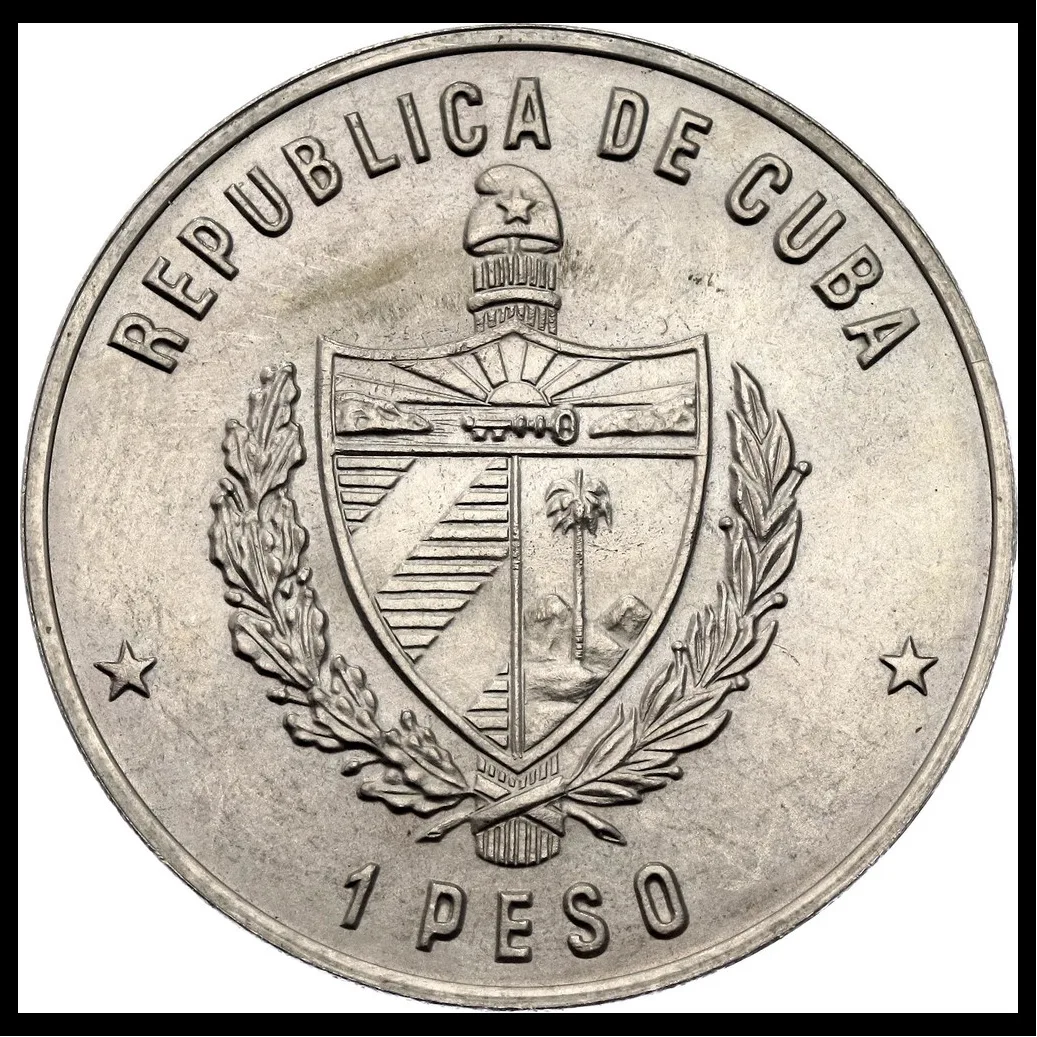
The official side is the same on every coin of the series: the national arms of the Republic of Cuba in Charles Edward Barber’s drawing. The shield is divided into three fields, a Phrygian cap with a star stands above it, with laurel and oak branches on the sides; the inscription REPUBLICA DE CUBA runs along the arc and the coin’s denomination is marked below. The strict heraldry is set against the lively, almost naturalistic image of the animal or bird on the other side and reminds us that this is a state issue. Here it serves as the common mark of the series, as on the other eight coins of the first series.