
Cuban Gar (1 Peso)
PDFGeneral information

Description
If one looks for a creature in Cuba that looks like a greeting from prehistoric times, it is the manjuarí — the Cuban gar, Atractosteus tristoechus. A fish with a narrow head, a toothy mouth and rhomboid scales shining like chain mail seems at first glance something between a pike and a crocodile. It was called “armoured” for its bony scales — ganoid, that is, covered with an enamel-like substance, ganoine, as in many ancient fish.
The secret of the species’ survival lies in the peculiarities of its breathing. The manjuarí breathes not only with gills but with air: its swim bladder is supplied with blood vessels and works as a lung. So the fish lives calmly in warm swampy waters where others lack oxygen. From time to time it can be seen at the surface: it gulps air, and rings spread across the water.
The manjuarí lives in the fresh waters of Cuba: in swamps and rivers of the west, including the broad Zapata area. It feeds on fish, lying in ambush among plants. This fish has long been caught; unfortunately fishing and the destruction of habitats have made the species vulnerable. Today manjuarí are bred on farms, and some of the young are released into the wild.
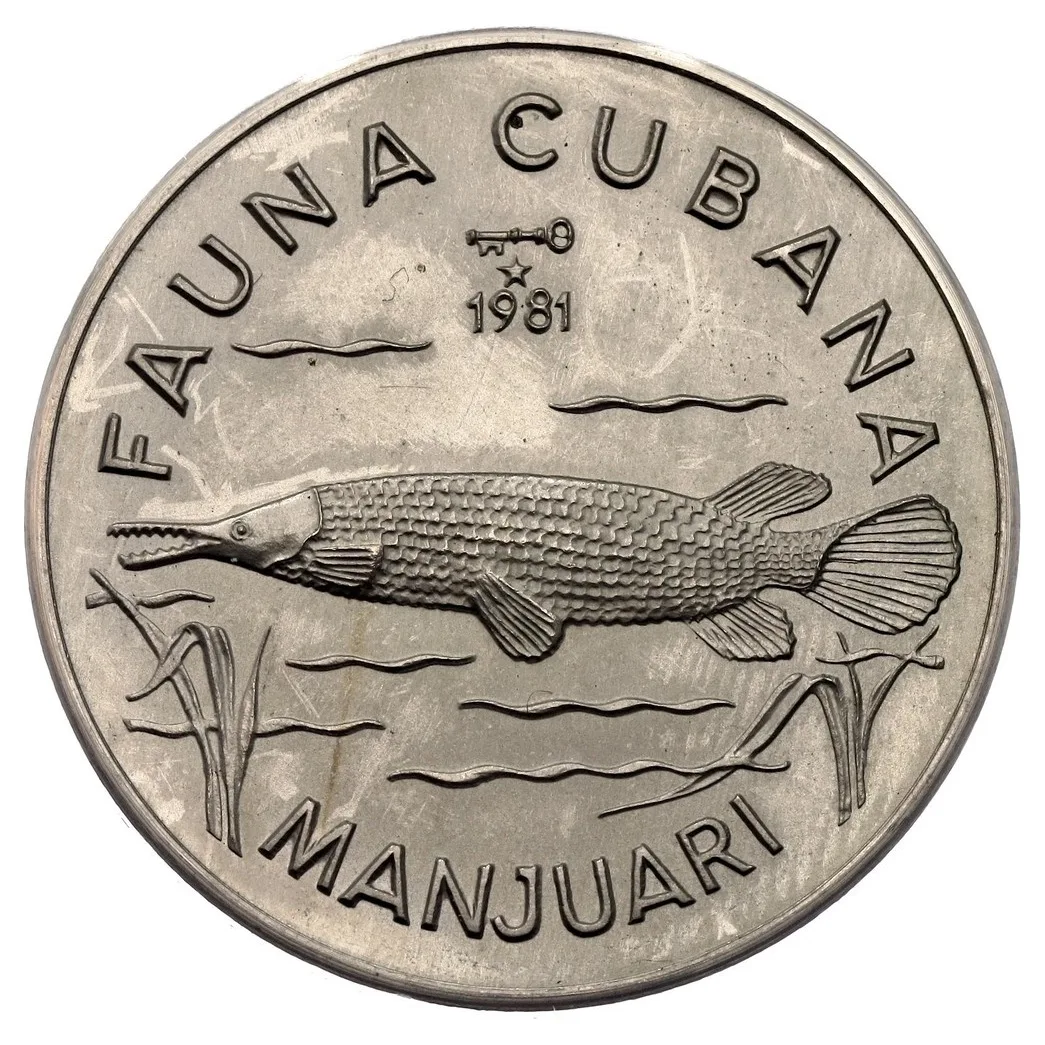
The coin was struck in 1981 in Havana in the series “Fauna Cubana II”, intended for collectors. The image of the fish on it conveys what distinguishes it from other river dwellers: the elongated snout, dense rows of scales and a strong body. For a series about the rare and unusual it is an excellent example: one cannot fail to notice that this is no ordinary fish but a “living fossil”.
The manjuarí is not only a natural rarity but part of local culture: the fish is known by name even to those who have never seen it, and is treated as something almost legendary — a “living fossil” of the island’s own rivers and swamps. This gives the coin more meaning than a simple zoological illustration: before us is the image of a creature firmly lodged in local memory, which is exactly why it was chosen for a series that tells of the distinctive nature of the island and invites collectors to a slow, attentive examination.
Obverse
The obverse is the artistic side. The Cuban gar swims among aquatic vegetation: an elongated body, a long toothy snout, spread fins and armour of rhomboid scales. The fine relief conveys the texture well, and the smooth curve of the body creates a sense of motion. The inscriptions FAUNA CUBANA, the animal’s name and the year 1981 are struck, with the mint mark beside them. The relief is deep enough for the scales to read even in weak light.
Reverse
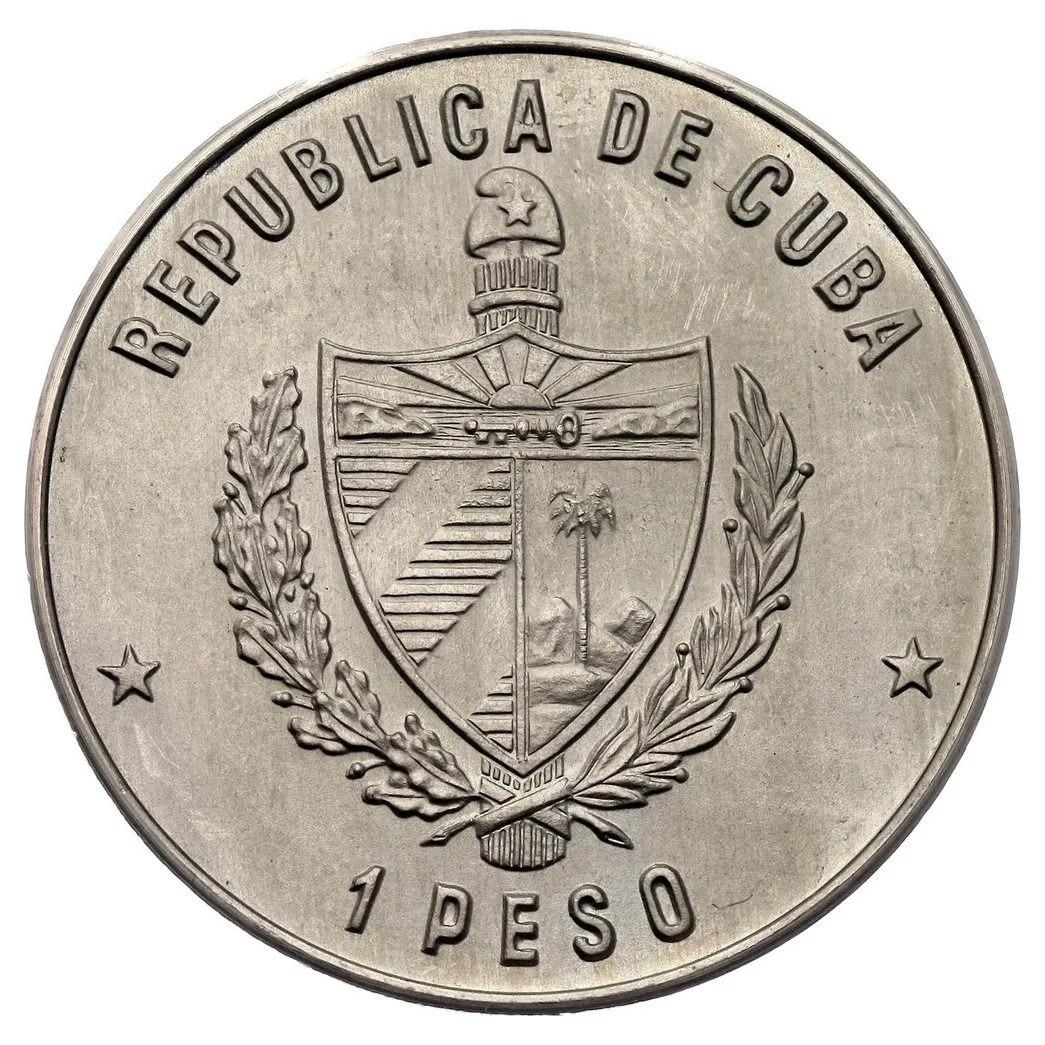
The official side is the same on every coin of the series: the national arms of the Republic of Cuba in Charles Edward Barber’s drawing. The shield is divided into three fields, a Phrygian cap with a star stands above it, with laurel and oak branches on the sides; the inscription REPUBLICA DE CUBA runs along the arc and the coin’s denomination is marked below. The strict heraldry is set against the lively, almost naturalistic image of the animal or bird on the other side and reminds us that this is a state issue. The strict drawing of the arms helps tell the coins of this series from other Cuban issues.