
Cuban Gar (5 Pesos)
PDFGeneral information
Пруф
Исполнение Proof («пруф»). Это та же монета, что и основная карточка, но отчеканена на полированных заготовках двумя ударами: поле получило зеркальную поверхность, рельеф — матовую и контрастную. Тираж — 1000 экземпляров, каталожный номер Аледона AAEE 060; обычное исполнение BU — 5000 экземпляров (AAEE 063). Характеристики обоих исполнений одинаковы: серебро 999 пробы, масса 12 г, диаметр 30 мм, рубчатый гурт; монетный двор Empresa Cubana de Acuñaciones (Гавана, Куба). Официальная сторона — герб Кубы с легендой REPUBICA DE CUBA, художественная сторона — кубинская панцирная щука с названием программы и годом. По каталогу Аледона 1999 года пруфовая монета стоила $38, обычная — $26.

Description
The Cuban gar is called manjuarí. Atractosteus tristoechus is a large freshwater fish of the gar family, whose history stretches back tens of millions of years. Its body is covered with thick rhomboid scales joined together so that they form a genuine bony armour. The snout is elongated like a pike’s and set with sharp teeth. The length of an adult fish can exceed a metre and a half or two.
Its breathing is unusual too. Besides gills the manjuarí has a swim bladder laced with blood vessels that serves as a lung: from time to time the fish rises to gulp air. Thanks to this it endures warm, oxygen-poor water in which other fish suffocate. The manjuarí hunts from ambush, waiting for prey in thickets; it feeds mainly on fish.
The species lives in the fresh waters of Cuba — swamps and rivers of the western part of the island, including the Zapata swamp. It is virtually absent elsewhere, which makes it one of the main symbols of Cuban river fauna. The fish is called a living fossil: its ancestors were contemporaries of the dinosaurs, and the general appearance has changed little since. Today it needs protection because of fishing and water pollution.
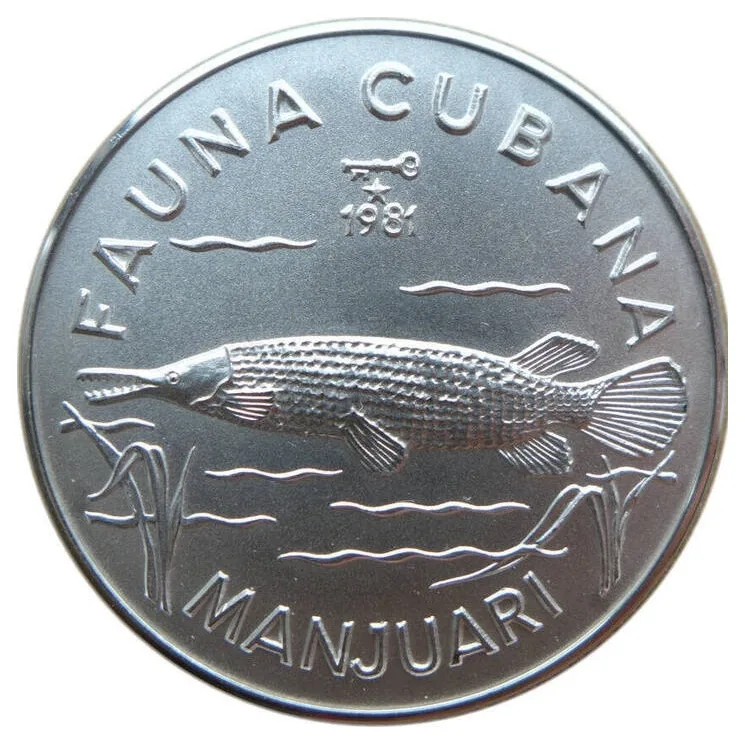
The coin belongs to the series “Fauna Cubana II”, issued in Havana in 1981 for collectors after the first series. For coin design a fish is a difficult subject: one must convey both the elongated body, the scaly armour and the long jaws. Here the master chose an almost profile view in which the fish is shown against water and aquatic plants, with the scales indicated by rows of small rhombuses.
Interest in the manjuarí has grown also because scientists see in it a key to understanding evolution: gars changed little over a very long time, and studying them helps reconstruct the history of fishes. For Cubans it is simply “their own” fish, known from fishermen’s stories and a source of pride. A coin in which the fish is shown in all its armour makes this interest visible and lets one examine what in a river is seen only fleetingly.
Obverse
The artistic side shows the Cuban gar swimming among aquatic plants. The body is elongated, the head with its long toothy snout is slightly raised, the fins are spread; the scales are rendered in rows of small rhombuses. Waves and weeds form the background. The inscriptions name the programme — FAUNA CUBANA, the animal and the year 1981; the mint mark is beside them. The strong relief gives the fish the look of a heavy predator that is hard to confuse with an ordinary pike. The fins are drawn with fine rays, and the tail is gently curved.
Reverse
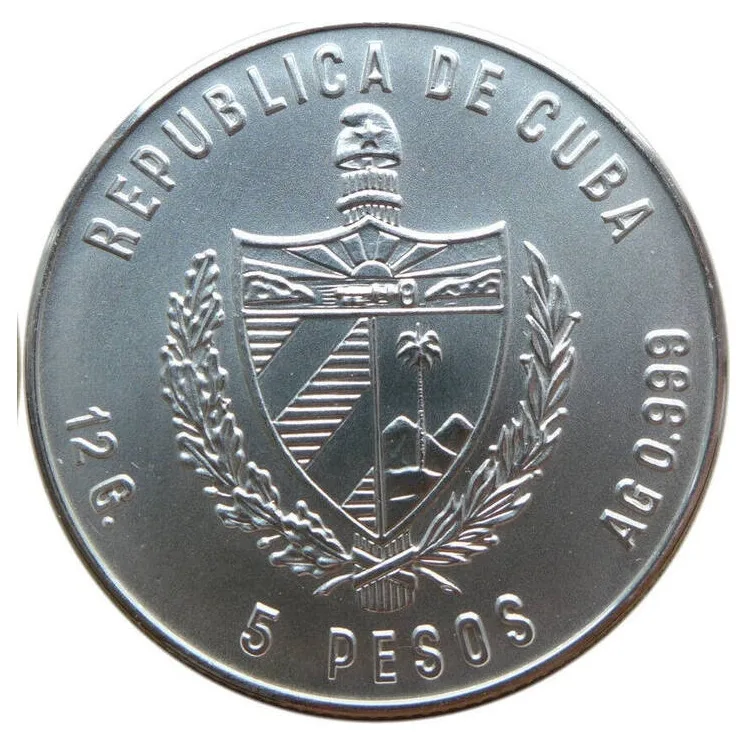
The official side is the same on every coin of the series: the national arms of the Republic of Cuba in Charles Edward Barber’s drawing. The shield is divided into three fields, a Phrygian cap with a star stands above it, with laurel and oak branches on the sides; the inscription REPUBLICA DE CUBA runs along the arc and the coin’s denomination is marked below. The strict heraldry is set against the lively, almost naturalistic image of the animal or bird on the other side and reminds us that this is a state issue.