
Cuban Railway (1 peso)
PDFGeneral information

Description
The coin tells about the first railroad in Latin America - the Cuban one, and about the steam locomotive that became a symbol of this story. Cuba was among the pioneers of rail transport long before many European countries: the first lines began to be built already in 1830, and in 1837 a connection between Havana and Guines opened. It was the first railway not only in Latin America, but also in the entire Spanish-speaking world, and only the third in the history of the planet - after Great Britain and the USA.
The reason for the early appearance of rails was quite practical - sugar. Plantations located in the interior of the island had to be connected to ports, from where the products went to Europe and North America; The horse-drawn roads turned into mud during the rainy season, and the carts did not have time to transport the crops. The railway solved this problem: cane and its products - sugar, molasses, rum - began to be delivered to the piers quickly and cheaply. The rails connected the island's sugar belt with Havana's piers and became the framework of the entire Cuban economy of the 19th century.
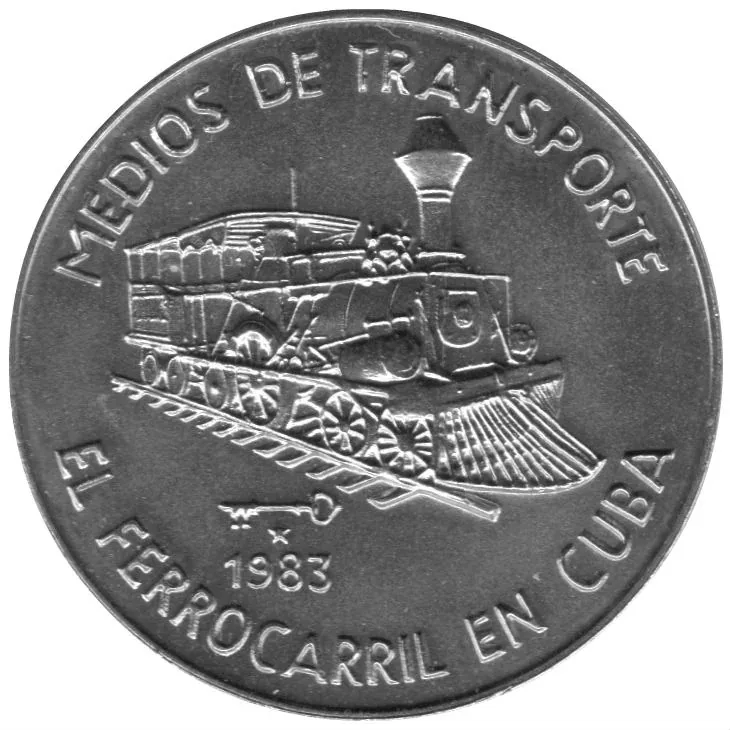
The first locomotive train passed on November 19, 1837 along the line from Havana to Bejucal, about 27.5 kilometers long, and by 1839 the road was extended to Guines, the center of the sugar region. By comparison, in Spain itself, the island's mother country, the first railway opened only in 1848, so the colony was ahead of the country that ruled it. It is that early locomotive with a tall chimney, a tender and smoke extending back over the train that is embodied on the coin.
In the 20th century, the island's railway network experienced both rise and decline, but the steam locomotive remained one of the most recognizable images of the industrial era in Cuban culture. By placing it on the coin, the medalists recalled the time when it was the rails that connected the disparate areas of the island into a single economic space, and the work of several generations of builders, machinists and sugar factory workers gave the country an infrastructure that was modern by those standards. Thus, an issue aimed at collectors turns into a small monument to technological progress.
Cuban locomotives of that time were purchased abroad, and they were serviced by Cuban workers, who gradually created their own school of railway engineering. Stations, warehouses, and workshops along the lines became towns, and the transportation of cane to sugar mills—the heart of the plantation economy—made the locomotive whistle a familiar sound in rural Cuba. For the collector, the coin is also interesting because it reminds that the path from colonial plantations to the modern state largely ran along rails.
Obverse
The artistic side is dedicated to the railway: in the center there is a steam locomotive with a tender and a high chimney from which smoke rises, and under the wheels the rails go into perspective, so that the composition conveys the very motive of movement. The circular legend MEDIOS DE TRANSPORTE names the program, the Spanish inscription EL FERROCARRIL EN CUBA - “The Railway in Cuba” - indicates the plot; next to it is the year 1983. Most of the subjects in this program were engraved by Cuban medalist Alberto González Pereztol: he combines the sharp, almost documentary silhouette of the car with a free, “breathing” background.
Reverse
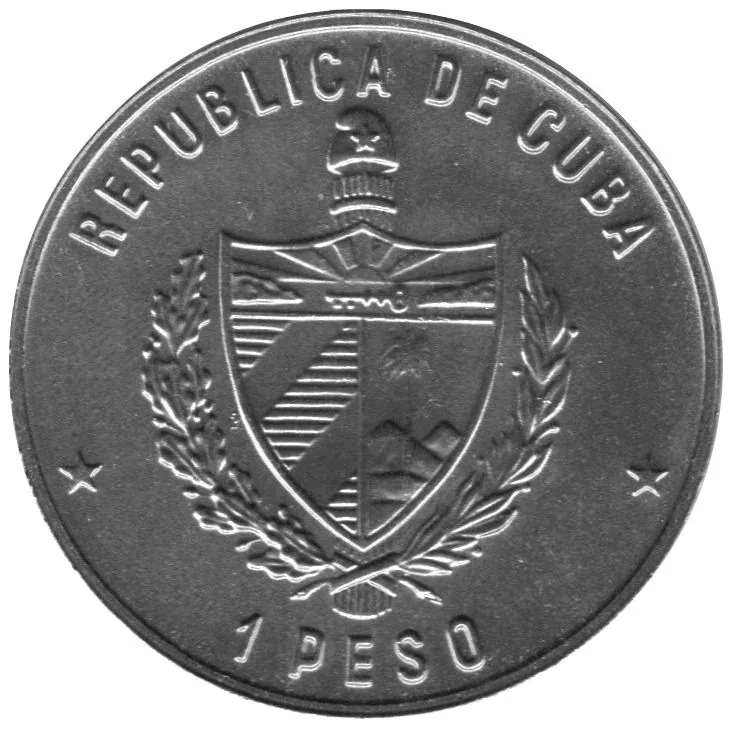
The official side is the same for all editions of the program: the coat of arms of the Republic of Cuba is a shield with a rising sun, a palm tree and a Cuban landscape, topped with a Phrygian cap with a star and framed by laurel branches. The design dates back to the work of American engraver Charles Edward Barber, adopted for Cuban coins in the early 20th century. Around the circle is the legend REPUBLICA DE CUBA, and below is the denomination of 1 PESO. The strict, symmetrical design is contrasted with the free composition of the artistic side and serves as an invariable feature of the Cuban coin program.